

715
the Meerwein-Ponndorf-Verley (MPV) reduction, is the basis of catalytic transfer
hydrogenation (CTH) [27].
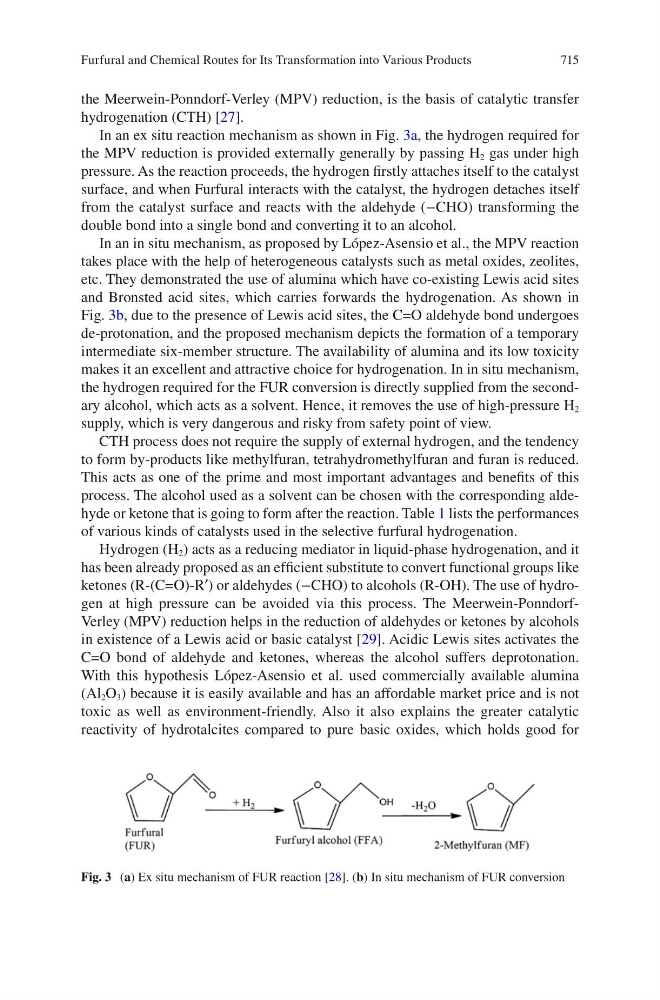
In an ex situ reaction mechanism as shown in Fig. 3a, the hydrogen required for
the MPV reduction is provided externally generally by passing H 2 gas under high
pressure. As the reaction proceeds, the hydrogen firstly attaches itself to the catalyst
surface, and when Furfural interacts with the catalyst, the hydrogen detaches itself
from the catalyst surface and reacts with the aldehyde (−CHO) transforming the
double bond into a single bond and converting it to an alcohol.
In an in situ mechanism, as proposed by López-Asensio et al., the MPV reaction
takes place with the help of heterogeneous catalysts such as metal oxides, zeolites,
etc. They demonstrated the use of alumina which have co-existing Lewis acid sites
and Bronsted acid sites, which carries forwards the hydrogenation. As shown in
Fig. 3b, due to the presence of Lewis acid sites, the C=O aldehyde bond undergoes
de-protonation, and the proposed mechanism depicts the formation of a temporary
intermediate six-member structure. The availability of alumina and its low toxicity
makes it an excellent and attractive choice for hydrogenation. In in situ mechanism,
the hydrogen required for the FUR conversion is directly supplied from the secondary alcohol, which acts as a solvent. Hence, it removes the use of high-pressure H 2
supply, which is very dangerous and risky from safety point of view.
CTH process does not require the supply of external hydrogen, and the tendency
to form by-products like methylfuran, tetrahydromethylfuran and furan is reduced.
This acts as one of the prime and most important advantages and benefits of this
process. The alcohol used as a solvent can be chosen with the corresponding aldehyde or ketone that is going to form after the reaction. Table 1 lists the performances
of various kinds of catalysts used in the selective furfural hydrogenation.
Hydrogen (H 2 ) acts as a reducing mediator in liquid-phase hydrogenation, and it
has been already proposed as an efficient substitute to convert functional groups like
ketones (R-(C=O)-R′) or aldehydes (−CHO) to alcohols (R-OH). The use of hydrogen at high pressure can be avoided via this process. The Meerwein-PonndorfVerley (MPV) reduction helps in the reduction of aldehydes or ketones by alcohols
in existence of a Lewis acid or basic catalyst [29]. Acidic Lewis sites activates the
C=O bond of aldehyde and ketones, whereas the alcohol suffers deprotonation.
With this hypothesis López-Asensio et al. used commercially available alumina
(Al 2 O 3 ) because it is easily available and has an affordable market price and is not
toxic as well as environment-friendly. Also it also explains the greater catalytic
reactivity of hydrotalcites compared to pure basic oxides, which holds good for
Fig. 3 (a) Ex situ mechanism of FUR reaction [28]. (b) In situ mechanism of FUR conversion
Furfural and Chemical Routes for Its Transformation into Various Products