

708
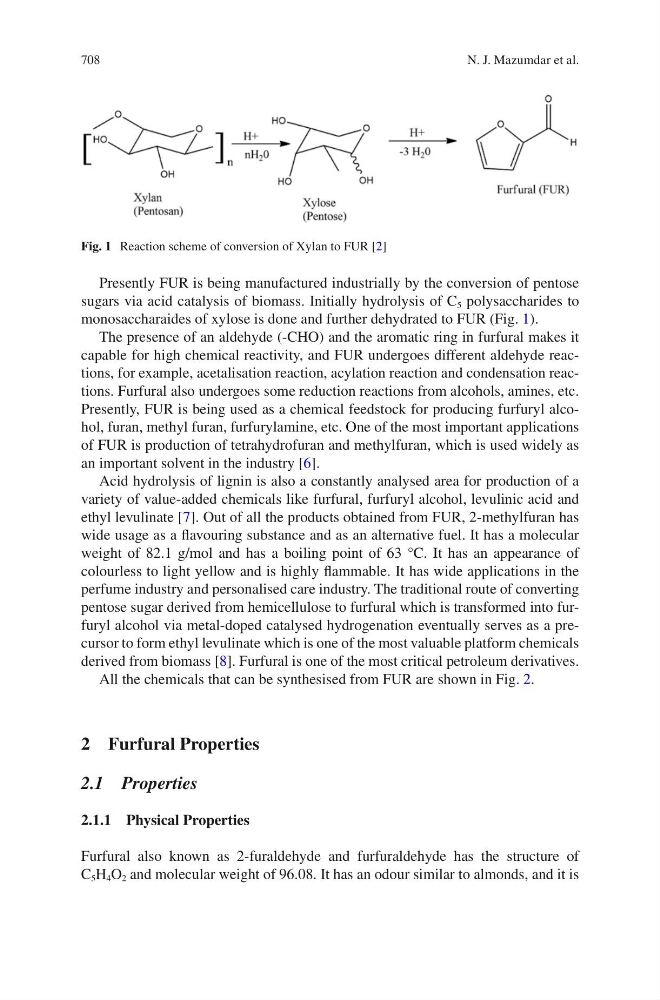
Presently FUR is being manufactured industrially by the conversion of pentose
sugars via acid catalysis of biomass. Initially hydrolysis of C 5 polysaccharides to
monosaccharaides of xylose is done and further dehydrated to FUR (Fig. 1).
The presence of an aldehyde (-CHO) and the aromatic ring in furfural makes it
capable for high chemical reactivity, and FUR undergoes different aldehyde reactions, for example, acetalisation reaction, acylation reaction and condensation reactions. Furfural also undergoes some reduction reactions from alcohols, amines, etc.
Presently, FUR is being used as a chemical feedstock for producing furfuryl alcohol, furan, methyl furan, furfurylamine, etc. One of the most important applications
of FUR is production of tetrahydrofuran and methylfuran, which is used widely as
an important solvent in the industry [6].
Acid hydrolysis of lignin is also a constantly analysed area for production of a
variety of value-added chemicals like furfural, furfuryl alcohol, levulinic acid and
ethyl levulinate [7]. Out of all the products obtained from FUR, 2-methylfuran has
wide usage as a flavouring substance and as an alternative fuel. It has a molecular
weight of 82.1 g/mol and has a boiling point of 63 °C. It has an appearance of
colourless to light yellow and is highly flammable. It has wide applications in the
perfume industry and personalised care industry. The traditional route of converting
pentose sugar derived from hemicellulose to furfural which is transformed into furfuryl alcohol via metal-doped catalysed hydrogenation eventually serves as a precursor to form ethyl levulinate which is one of the most valuable platform chemicals
derived from biomass [8]. Furfural is one of the most critical petroleum derivatives.
All the chemicals that can be synthesised from FUR are shown in Fig. 2.
2 Furfural Properties
2.1 Properties
2.1.1 Physical Properties
Furfural also known as 2-furaldehyde and furfuraldehyde has the structure of
C 5 H 4 O 2 and molecular weight of 96.08. It has an odour similar to almonds, and it is
Fig. 1 Reaction scheme of conversion of Xylan to FUR [2]
N. J. Mazumdar et al.