

681
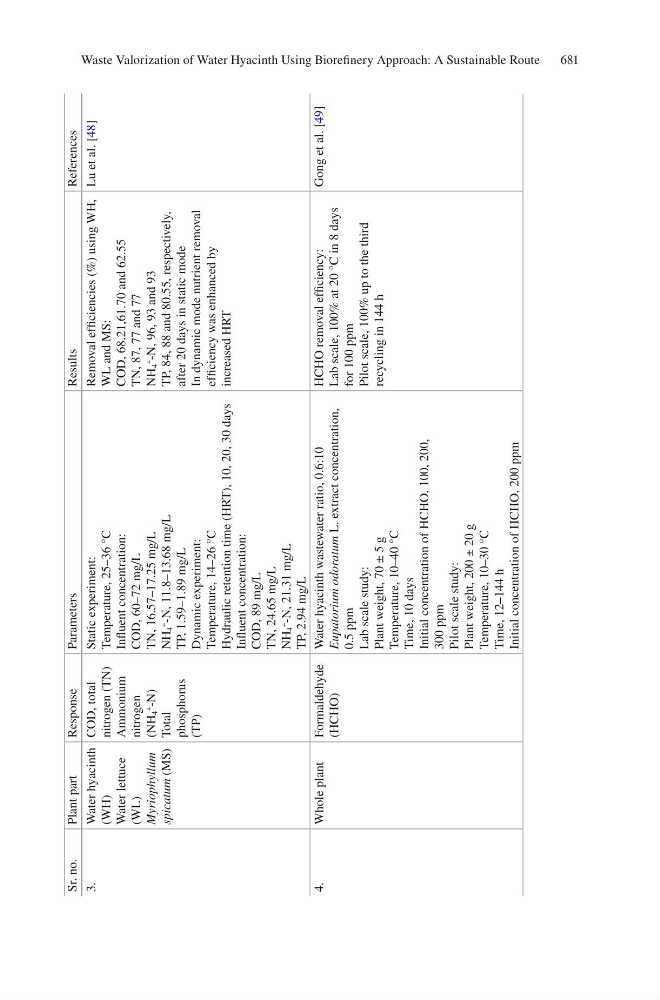
Sr. no.
Plant part
Response
Parameters
Results
References
3.
Water hyacinth
(WH)
Water lettuce
(WL)
Myriophyllum
spicatum
(MS)
COD, total
nitrogen (TN)
Ammonium
nitrogen
(NH
4
+
-N)
Total
phosphorus
(TP)
Static experiment:
Temperature, 25–36 °C
Influent concentration:
COD, 60–72 mg/L
TN, 16.57–17.25 mg/L
NH
4
+
-N, 11.8–13.68 mg/L
TP, 1.59–1.89 mg/L
Dynamic experiment:
Temperature, 14–26 °C
Hydraulic retention time (HRT), 10, 20, 30 days
Influent concentration:
COD, 89 mg/L
TN, 24.65 mg/L
NH
4
+
-N, 21.31 mg/L
TP, 2.94 mg/L
Removal efficiencies (%) using WH,
WL and MS:
COD, 68.21,61.70 and 62.55
TN, 87, 77 and 77
NH
4
+
-N, 96, 93 and 93
TP, 84, 88 and 80.55, respectively,
after 20 days in static mode
In dynamic mode nutrient removal
efficiency was enhanced by
increased HRT
Lu et al. [48]
4.
Whole plant
Formaldehyde
(HCHO)
Water hyacinth wastewater ratio, 0.6:10
Eupatorium odoratum
L. extract concentration,
0.5 ppm
Lab scale study:
Plant weight, 70 ± 5 g
Temperature, 10–40 °C
Time, 10 days
Initial concentration of HCHO, 100, 200,
300 ppm
Pilot scale study:
Plant weight, 200 ± 20 g
Temperature, 10–30 °C
Time, 12–144 h
Initial concentration of HCHO, 200 ppm
HCHO removal efficiency:
Lab scale, 100% at 20 °C in 8 days
for 100 ppm
Pilot scale, 100% up to the third
recycling in 144 h
Gong et al. [49]
Waste Valorization of Water Hyacinth Using Biorefinery Approach: A Sustainable Route