

679
adsorbent concentration, time employed, temperature and pH of effluent have been
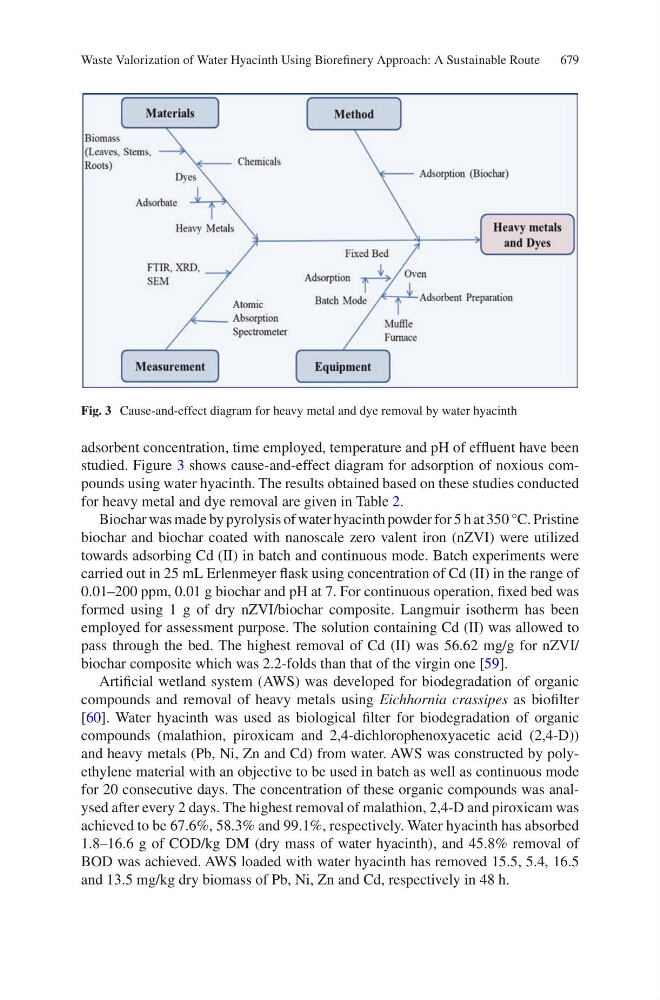
studied. Figure 3 shows cause-and-effect diagram for adsorption of noxious compounds using water hyacinth. The results obtained based on these studies conducted
for heavy metal and dye removal are given in Table 2.
Biochar was made by pyrolysis of water hyacinth powder for 5 h at 350 °C. Pristine
biochar and biochar coated with nanoscale zero valent iron (nZVI) were utilized
towards adsorbing Cd (II) in batch and continuous mode. Batch experiments were
carried out in 25 mL Erlenmeyer flask using concentration of Cd (II) in the range of
0.01–200 ppm, 0.01 g biochar and pH at 7. For continuous operation, fixed bed was
formed using 1 g of dry nZVI/biochar composite. Langmuir isotherm has been
employed for assessment purpose. The solution containing Cd (II) was allowed to
pass through the bed. The highest removal of Cd (II) was 56.62 mg/g for nZVI/
biochar composite which was 2.2-folds than that of the virgin one [59].
Artificial wetland system (AWS) was developed for biodegradation of organic
compounds and removal of heavy metals using Eichhornia crassipes as biofilter
[60]. Water hyacinth was used as biological filter for biodegradation of organic
compounds (malathion, piroxicam and 2,4-dichlorophenoxyacetic acid (2,4-D))
and heavy metals (Pb, Ni, Zn and Cd) from water. AWS was constructed by polyethylene material with an objective to be used in batch as well as continuous mode
for 20 consecutive days. The concentration of these organic compounds was analysed after every 2 days. The highest removal of malathion, 2,4-D and piroxicam was
achieved to be 67.6%, 58.3% and 99.1%, respectively. Water hyacinth has absorbed
1.8–16.6 g of COD/kg DM (dry mass of water hyacinth), and 45.8% removal of
BOD was achieved. AWS loaded with water hyacinth has removed 15.5, 5.4, 16.5
and 13.5 mg/kg dry biomass of Pb, Ni, Zn and Cd, respectively in 48 h.
Fig. 3 Cause-and-effect diagram for heavy metal and dye removal by water hyacinth
Waste Valorization of Water Hyacinth Using Biorefinery Approach: A Sustainable Route