

656
acetone leads to the formation of monomer species, whereas relatively lower concentration of acetone causes formation of dimer products. The same research group
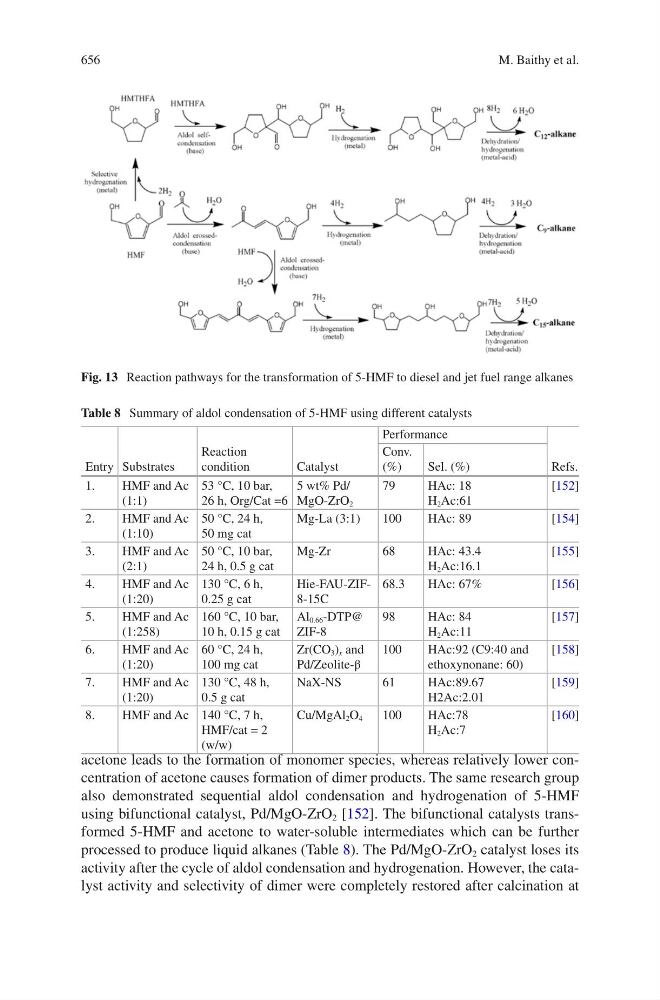
also demonstrated sequential aldol condensation and hydrogenation of 5-HMF
using bifunctional catalyst, Pd/MgO-ZrO 2 [152]. The bifunctional catalysts transformed 5-HMF and acetone to water-soluble intermediates which can be further
processed to produce liquid alkanes (Table 8). The Pd/MgO-ZrO 2 catalyst loses its
activity after the cycle of aldol condensation and hydrogenation. However, the catalyst activity and selectivity of dimer were completely restored after calcination at
Fig. 13 Reaction pathways for the transformation of 5-HMF to diesel and jet fuel range alkanes
Table 8 Summary of aldol condensation of 5-HMF using different catalysts
Entry Substrates
Reaction
condition
Catalyst
Performance
Refs.
Conv.
(%)
Sel. (%)
1.
HMF and Ac
(1:1)
53 °C, 10 bar,
26 h, Org/Cat =6
5 wt% Pd/
MgO-ZrO 2
79
HAc: 18
H 2 Ac:61
[152]
2.
HMF and Ac
(1:10)
50 °C, 24 h,
50 mg cat
Mg-La (3:1)
100
HAc: 89
[154]
3.
HMF and Ac
(2:1)
50 °C, 10 bar,
24 h, 0.5 g cat
Mg-Zr
68
HAc: 43.4
H 2 Ac:16.1
[155]
4.
HMF and Ac
(1:20)
130 °C, 6 h,
0.25 g cat
Hie-FAU-ZIF8-15C
68.3
HAc: 67%
[156]
5.
HMF and Ac
(1:258)
160 °C, 10 bar,
10 h, 0.15 g cat
Al 0.66 -DTP@
ZIF-8
98
HAc: 84
H 2 Ac:11
[157]
6.
HMF and Ac
(1:20)
60 °C, 24 h,
100 mg cat
Zr(CO 3 ) x and
Pd/Zeolite-β
100
HAc:92 (C9:40 and
ethoxynonane: 60)
[158]
7.
HMF and Ac
(1:20)
130 °C, 48 h,
0.5 g cat
NaX-NS
61
HAc:89.67
H2Ac:2.01
[159]
8.
HMF and Ac 140 °C, 7 h,
HMF/cat = 2
(w/w)
Cu/MgAl 2 O 4
100
HAc:78
H 2 Ac:7
[160]
M. Baithy et al.