

655
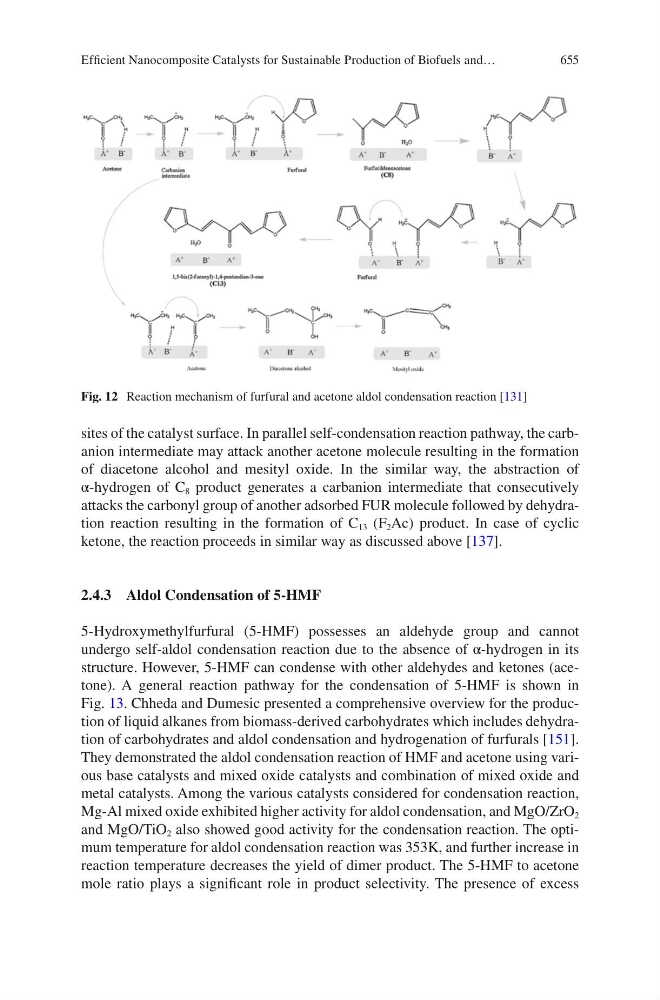
sites of the catalyst surface. In parallel self-condensation reaction pathway, the carbanion intermediate may attack another acetone molecule resulting in the formation
of diacetone alcohol and mesityl oxide. In the similar way, the abstraction of
α-hydrogen of C 8 product generates a carbanion intermediate that consecutively
attacks the carbonyl group of another adsorbed FUR molecule followed by dehydration reaction resulting in the formation of C 13 (F 2 Ac) product. In case of cyclic
ketone, the reaction proceeds in similar way as discussed above [137].
2.4.3 Aldol Condensation of 5-HMF
5-Hydroxymethylfurfural (5-HMF) possesses an aldehyde group and cannot
undergo self-aldol condensation reaction due to the absence of α-hydrogen in its
structure. However, 5-HMF can condense with other aldehydes and ketones (acetone). A general reaction pathway for the condensation of 5-HMF is shown in
Fig. 13. Chheda and Dumesic presented a comprehensive overview for the production of liquid alkanes from biomass-derived carbohydrates which includes dehydration of carbohydrates and aldol condensation and hydrogenation of furfurals [151].
They demonstrated the aldol condensation reaction of HMF and acetone using various base catalysts and mixed oxide catalysts and combination of mixed oxide and
metal catalysts. Among the various catalysts considered for condensation reaction,
Mg-Al mixed oxide exhibited higher activity for aldol condensation, and MgO/ZrO 2
and MgO/TiO 2 also showed good activity for the condensation reaction. The optimum temperature for aldol condensation reaction was 353K, and further increase in
reaction temperature decreases the yield of dimer product. The 5-HMF to acetone
mole ratio plays a significant role in product selectivity. The presence of excess
Fig. 12 Reaction mechanism of furfural and acetone aldol condensation reaction [131]
Efficient Nanocomposite Catalysts for Sustainable Production of Biofuels and…