

647
via hydrogenation and hydrodeoxygenation reactions. Moreover, furfurylidene
ketone-based compounds produced by aldol condensation reaction of FUR and
acetone are widely used in the food industry, (e.g., alcohol-free drinks, gelatins, ice
candies as aromas) and as monomers to produce furan-derived resins [125]. The
various linear cyclic ketones are employed for aldol condensation reaction. The
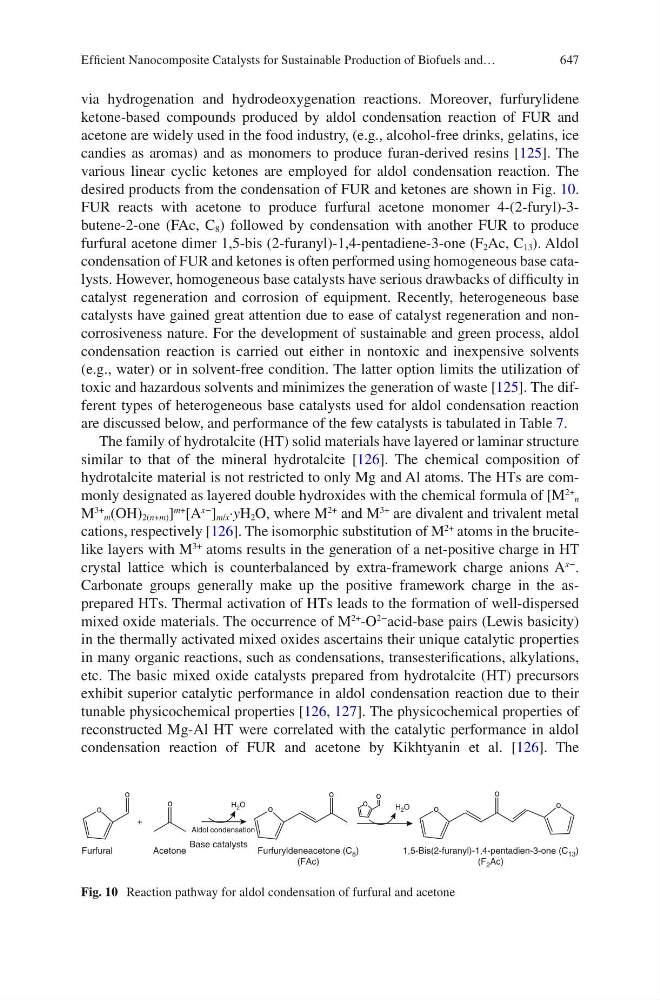
desired products from the condensation of FUR and ketones are shown in Fig. 10.
FUR reacts with acetone to produce furfural acetone monomer 4-(2-furyl)-3butene- 2-one (FAc, C 8 ) followed by condensation with another FUR to produce
furfural acetone dimer 1,5-bis (2-furanyl)-1,4-pentadiene-3-one (F 2 Ac, C 13 ). Aldol
condensation of FUR and ketones is often performed using homogeneous base catalysts. However, homogeneous base catalysts have serious drawbacks of difficulty in
catalyst regeneration and corrosion of equipment. Recently, heterogeneous base
catalysts have gained great attention due to ease of catalyst regeneration and noncorrosiveness nature. For the development of sustainable and green process, aldol
condensation reaction is carried out either in nontoxic and inexpensive solvents
(e.g., water) or in solvent-free condition. The latter option limits the utilization of
toxic and hazardous solvents and minimizes the generation of waste [125]. The different types of heterogeneous base catalysts used for aldol condensation reaction
are discussed below, and performance of the few catalysts is tabulated in Table 7.
The family of hydrotalcite (HT) solid materials have layered or laminar structure
similar to that of the mineral hydrotalcite [126]. The chemical composition of
hydrotalcite material is not restricted to only Mg and Al atoms. The HTs are commonly designated as layered double hydroxides with the chemical formula of [M
2+ n
M
3+ m (OH) 2(n+m) ]
m+
[A
x−
] m/x ·yH 2 O, where M
2+
and M
3+
are divalent and trivalent metal
cations, respectively [126]. The isomorphic substitution of M
2+
atoms in the brucitelike layers with M
3+
atoms results in the generation of a net-positive charge in HT
crystal lattice which is counterbalanced by extra-framework charge anions A
x−
.
Carbonate groups generally make up the positive framework charge in the asprepared HTs. Thermal activation of HTs leads to the formation of well-dispersed
mixed oxide materials. The occurrence of M
2+
-O
2−
acid-base pairs (Lewis basicity)
in the thermally activated mixed oxides ascertains their unique catalytic properties
in many organic reactions, such as condensations, transesterifications, alkylations,
etc. The basic mixed oxide catalysts prepared from hydrotalcite (HT) precursors
exhibit superior catalytic performance in aldol condensation reaction due to their
tunable physicochemical properties [126, 127]. The physicochemical properties of
reconstructed Mg-Al HT were correlated with the catalytic performance in aldol
condensation reaction of FUR and acetone by Kikhtyanin et al. [126]. The
o
o
o
o
o
o
o
o
o
o
Base catalysts
Acetone
+
Furfural
Furfuryldeneacetone (C 8 )
(FAc)
1,5-Bis(2-furanyl)-1,4-pentadien-3-one (C 13 )
(F 2 Ac)
H 2 O
H 2 O
Aldol condensation
Fig. 10 Reaction pathway for aldol condensation of furfural and acetone
Efficient Nanocomposite Catalysts for Sustainable Production of Biofuels and…