

646
and leaching of Pd nanoparticles. Among non-noble catalysts, Yuan et al. developed
the Ni 6 AlO x catalyst by coprecipitation method for the reductive amination of HMF
with ammonia, reaching a 99% yield for 5-aminomethyl-2-furylmethanol (FAA)
under the reaction conditions of 373 K, 6 h under 1 bar H 2 [122]. In a more recent
study, Chen et al. reported the direct reductive amination of HMF over Ni/SBA-15
using aqueous ammonia at 373 K after 4 h under 20 bar H 2 pressure, which obtained
a yield of 89.5% for 5-(aminomethyl)-2-furanmethanol (AMF) [123].
According to the proposed reaction pathway over Ni/SBA-15, the two types of
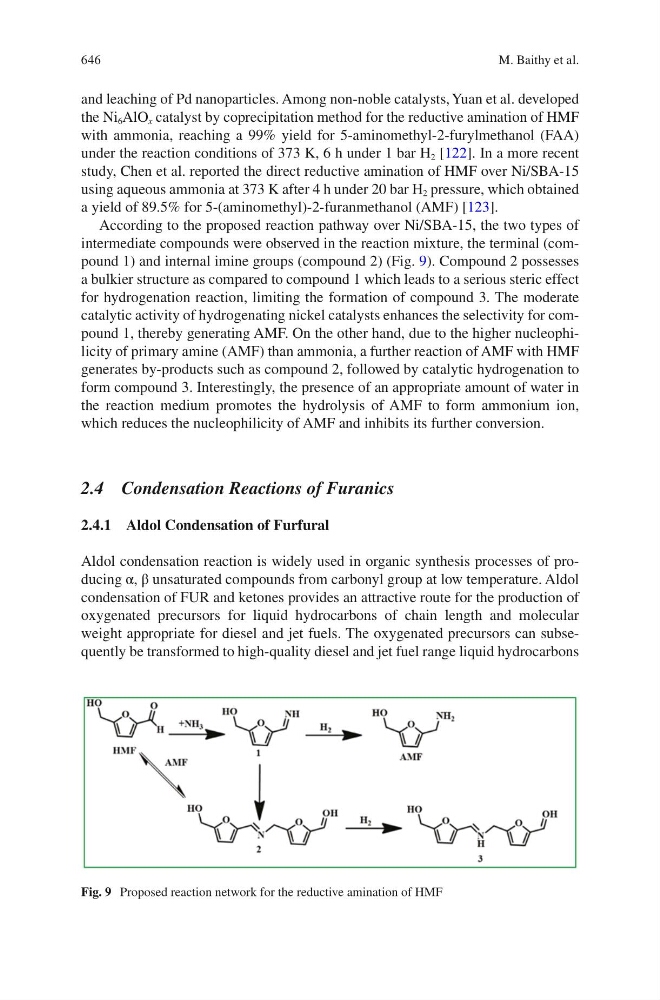
intermediate compounds were observed in the reaction mixture, the terminal (compound 1) and internal imine groups (compound 2) (Fig. 9). Compound 2 possesses
a bulkier structure as compared to compound 1 which leads to a serious steric effect
for hydrogenation reaction, limiting the formation of compound 3. The moderate
catalytic activity of hydrogenating nickel catalysts enhances the selectivity for compound 1, thereby generating AMF. On the other hand, due to the higher nucleophilicity of primary amine (AMF) than ammonia, a further reaction of AMF with HMF
generates by-products such as compound 2, followed by catalytic hydrogenation to
form compound 3. Interestingly, the presence of an appropriate amount of water in
the reaction medium promotes the hydrolysis of AMF to form ammonium ion,
which reduces the nucleophilicity of AMF and inhibits its further conversion.
2.4 Condensation Reactions of Furanics
2.4.1 Aldol Condensation of Furfural
Aldol condensation reaction is widely used in organic synthesis processes of producing α, β unsaturated compounds from carbonyl group at low temperature. Aldol
condensation of FUR and ketones provides an attractive route for the production of
oxygenated precursors for liquid hydrocarbons of chain length and molecular
weight appropriate for diesel and jet fuels. The oxygenated precursors can subsequently be transformed to high-quality diesel and jet fuel range liquid hydrocarbons
Fig. 9 Proposed reaction network for the reductive amination of HMF
M. Baithy et al.