

637
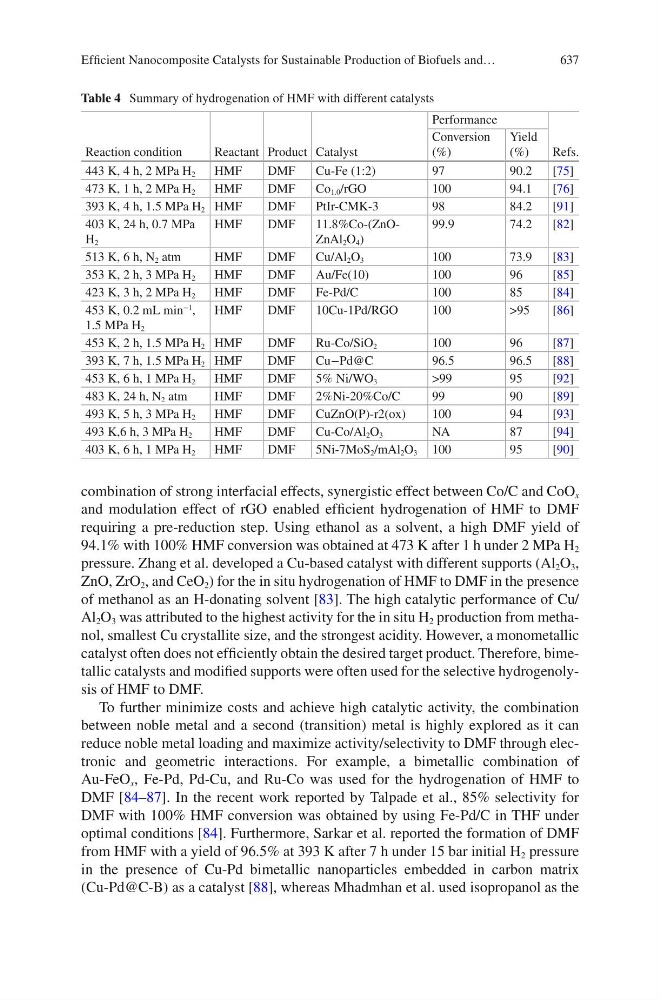
combination of strong interfacial effects, synergistic effect between Co/C and CoO x
and modulation effect of rGO enabled efficient hydrogenation of HMF to DMF
requiring a pre-reduction step. Using ethanol as a solvent, a high DMF yield of
94.1% with 100% HMF conversion was obtained at 473 K after 1 h under 2 MPa H 2
pressure. Zhang et al. developed a Cu-based catalyst with different supports (Al 2 O 3 ,
ZnO, ZrO 2 , and CeO 2 ) for the in situ hydrogenation of HMF to DMF in the presence
of methanol as an H-donating solvent [83]. The high catalytic performance of Cu/
Al 2 O 3 was attributed to the highest activity for the in situ H 2 production from methanol, smallest Cu crystallite size, and the strongest acidity. However, a monometallic
catalyst often does not efficiently obtain the desired target product. Therefore, bimetallic catalysts and modified supports were often used for the selective hydrogenolysis of HMF to DMF.
To further minimize costs and achieve high catalytic activity, the combination
between noble metal and a second (transition) metal is highly explored as it can
reduce noble metal loading and maximize activity/selectivity to DMF through electronic and geometric interactions. For example, a bimetallic combination of
Au-FeO x , Fe-Pd, Pd-Cu, and Ru-Co was used for the hydrogenation of HMF to
DMF [84–87]. In the recent work reported by Talpade et al., 85% selectivity for
DMF with 100% HMF conversion was obtained by using Fe-Pd/C in THF under
optimal conditions [84]. Furthermore, Sarkar et al. reported the formation of DMF
from HMF with a yield of 96.5% at 393 K after 7 h under 15 bar initial H 2 pressure
in the presence of Cu-Pd bimetallic nanoparticles embedded in carbon matrix
(Cu-Pd@C-B) as a catalyst [88], whereas Mhadmhan et al. used isopropanol as the
Table 4 Summary of hydrogenation of HMF with different catalysts
Reaction condition
Reactant Product Catalyst
Performance
Refs.
Conversion
(%)
Yield
(%)
443 K, 4 h, 2 MPa H 2 HMF
DMF
Cu-Fe (1:2)
97
90.2
[75]
473 K, 1 h, 2 MPa H 2 HMF
DMF
Co 1.0 /rGO
100
94.1
[76]
393 K, 4 h, 1.5 MPa H 2 HMF
DMF
PtIr-CMK-3
98
84.2
[91]
403 K, 24 h, 0.7 MPa
H 2
HMF
DMF
11.8%Co-(ZnOZnAl 2 O 4 )
99.9
74.2
[82]
513 K, 6 h, N 2 atm
HMF
DMF
Cu/Al 2 O 3
100
73.9
[83]
353 K, 2 h, 3 MPa H 2 HMF
DMF
Au/Fe(10)
100
96
[85]
423 K, 3 h, 2 MPa H 2 HMF
DMF
Fe-Pd/C
100
85
[84]
453 K, 0.2 mL min
−1 ,
1.5 MPa H 2
HMF
DMF
10Cu-1Pd/RGO
100
>95
[86]
453 K, 2 h, 1.5 MPa H 2 HMF
DMF
Ru-Co/SiO 2
100
96
[87]
393 K, 7 h, 1.5 MPa H 2 HMF
DMF
Cu−Pd@C
96.5
96.5
[88]
453 K, 6 h, 1 MPa H 2 HMF
DMF
5% Ni/WO 3
>99
95
[92]
483 K, 24 h, N 2 atm
HMF
DMF
2%Ni-20%Co/C
99
90
[89]
493 K, 5 h, 3 MPa H 2 HMF
DMF
CuZnO(P)-r2(ox)
100
94
[93]
493 K,6 h, 3 MPa H 2
HMF
DMF
Cu-Co/Al 2 O 3
NA
87
[94]
403 K, 6 h, 1 MPa H 2 HMF
DMF
5Ni-7MoS 2 /mAl 2 O 3 100
95
[90]
Efficient Nanocomposite Catalysts for Sustainable Production of Biofuels and…