

636
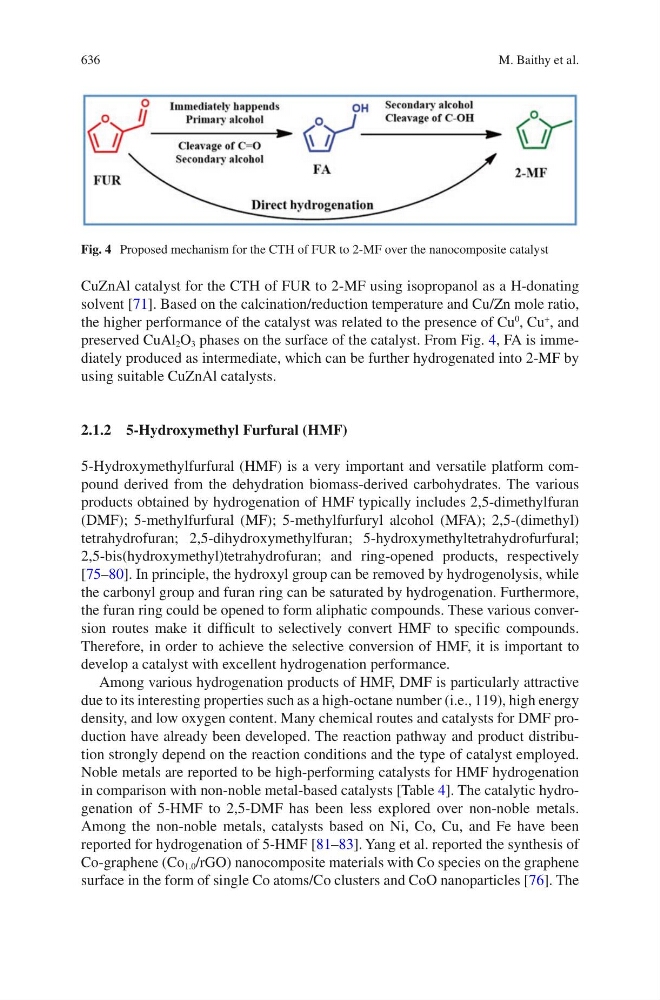
CuZnAl catalyst for the CTH of FUR to 2-MF using isopropanol as a H-donating
solvent [71]. Based on the calcination/reduction temperature and Cu/Zn mole ratio,
the higher performance of the catalyst was related to the presence of Cu
0
, Cu
+
, and
preserved CuAl 2 O 3 phases on the surface of the catalyst. From Fig. 4, FA is immediately produced as intermediate, which can be further hydrogenated into 2-MF by
using suitable CuZnAl catalysts.
2.1.2 5-Hydroxymethyl Furfural (HMF)
5-Hydroxymethylfurfural (HMF) is a very important and versatile platform compound derived from the dehydration biomass-derived carbohydrates. The various
products obtained by hydrogenation of HMF typically includes 2,5-dimethylfuran
(DMF); 5-methylfurfural (MF); 5-methylfurfuryl alcohol (MFA); 2,5-(dimethyl)
tetrahydrofuran; 2,5-dihydroxymethylfuran; 5-hydroxymethyltetrahydrofurfural;
2,5-bis(hydroxymethyl)tetrahydrofuran; and ring-opened products, respectively
[75–80]. In principle, the hydroxyl group can be removed by hydrogenolysis, while
the carbonyl group and furan ring can be saturated by hydrogenation. Furthermore,
the furan ring could be opened to form aliphatic compounds. These various conversion routes make it difficult to selectively convert HMF to specific compounds.
Therefore, in order to achieve the selective conversion of HMF, it is important to
develop a catalyst with excellent hydrogenation performance.
Among various hydrogenation products of HMF, DMF is particularly attractive
due to its interesting properties such as a high-octane number (i.e., 119), high energy
density, and low oxygen content. Many chemical routes and catalysts for DMF production have already been developed. The reaction pathway and product distribution strongly depend on the reaction conditions and the type of catalyst employed.
Noble metals are reported to be high-performing catalysts for HMF hydrogenation
in comparison with non-noble metal-based catalysts [Table 4]. The catalytic hydrogenation of 5-HMF to 2,5-DMF has been less explored over non-noble metals.
Among the non-noble metals, catalysts based on Ni, Co, Cu, and Fe have been
reported for hydrogenation of 5-HMF [81–83]. Yang et al. reported the synthesis of
Co-graphene (Co 1.0 /rGO) nanocomposite materials with Co species on the graphene
surface in the form of single Co atoms/Co clusters and CoO nanoparticles [76]. The
Fig. 4 Proposed mechanism for the CTH of FUR to 2-MF over the nanocomposite catalyst
M. Baithy et al.