

634
polarizing the carbonyl group of FUR and can actively take part in reaction pathways [66].
The use of liquid organic solvents as hydrogen donors (e.g., alcohols and acids)
further reduces the process complexity and cost and improves the safety concerns
regarding the handling high-pressure hydrogen gas. Several supported noble and
non-noble metal catalysts have been reported for the CTH of FUR to FA (Table 3)
[67–69]. Rodiansono et al. developed a very stable nanosized bimetallic Ni-In alloy
catalyst supported over amorphous alumina (Ni-In(x)/AA) for the selective hydrogenation of FUR to FA [62]. Ni-In(2.0)/AA showed the best catalytic performance
due to the presence of Ni 2 In alloy as the main phase, and 96% FUR conversion with
92% FA yield was obtained at 453 K after 3 h under 3 MPa H 2 pressure in the presence of isopropanol as a solvent. In a recent study, Yang et al. reported the selective
hydrogenation of FUR on non-noble intermetallic compound (Ni 3 Sn 1 , Ni 3 Sn 2 , and
Ni 3 Sn 4 ) derived from a layered double hydroxide precursor [63]. The Ni 3 Sn 2 sample
exhibited optimal catalytic behavior, and complete conversion of FUR with 99%
selectivity for FA was attained at 373 K after 3 h under 2 MPa H 2 pressure using
isopropanol as a solvent. It was observed that the introduction of Sn to Ni suppresses the highly active C=C hydrogenation on pristine Ni while at the same time
accelerates C=O hydrogenation to produce FA. The combined experimental and
theoretical results suggested that the specific geometric and electronic properties of
Ni 3 Sn 2 induces a vertical adsorption configuration of FUR molecules via activation
of the C=O group, leading to high selectivity for FA.
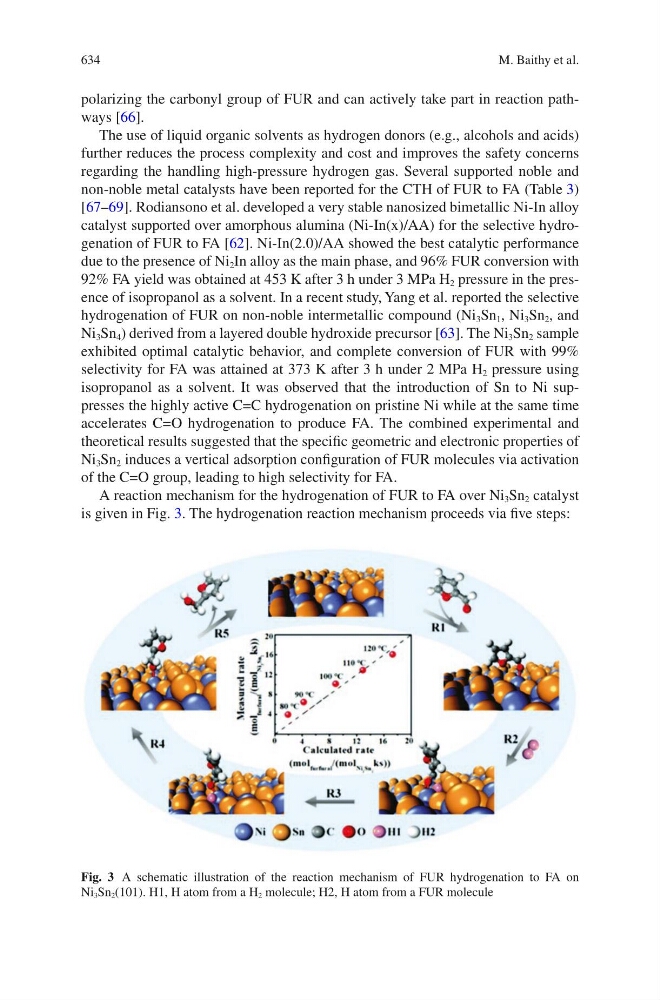
A reaction mechanism for the hydrogenation of FUR to FA over Ni 3 Sn 2 catalyst
is given in Fig. 3. The hydrogenation reaction mechanism proceeds via five steps:
Fig. 3 A schematic illustration of the reaction mechanism of FUR hydrogenation to FA on
Ni 3 Sn 2 (101). H1, H atom from a H 2 molecule; H2, H atom from a FUR molecule
M. Baithy et al.