

619
3.2 DFT Calculation to Measure Deprotonation Energy
Density Functional Theory (DFT) is a key tool to study and understand chemical
reactions computationally. Since acidity plays a crucial role in biomass conversion
processes, measuring DPE of the acidic ILs can give better ideas about reactivity
trends to screen catalyst [23]. DFT calculations were performed in Material Studio
8 (Biovia, San Diego, USA) based on DMol3 [45] module using DNP (double
numerical plus polarization) numerical basis set and generalized gradient approximation (GGA) PW91 functional [46]. Previous studies with PW91 functional have
shown to correlate with experimental trends [9, 47–49]. Energy, force, and atom
displacement convergence criterion of 0.0001 eV, 0.05 eV/Å, and 0.005 Å, respectively, were used for the geometry optimization. Mulliken charges were obtained
using the “population analysis” property tab as implemented in DMol3. DPEs of the
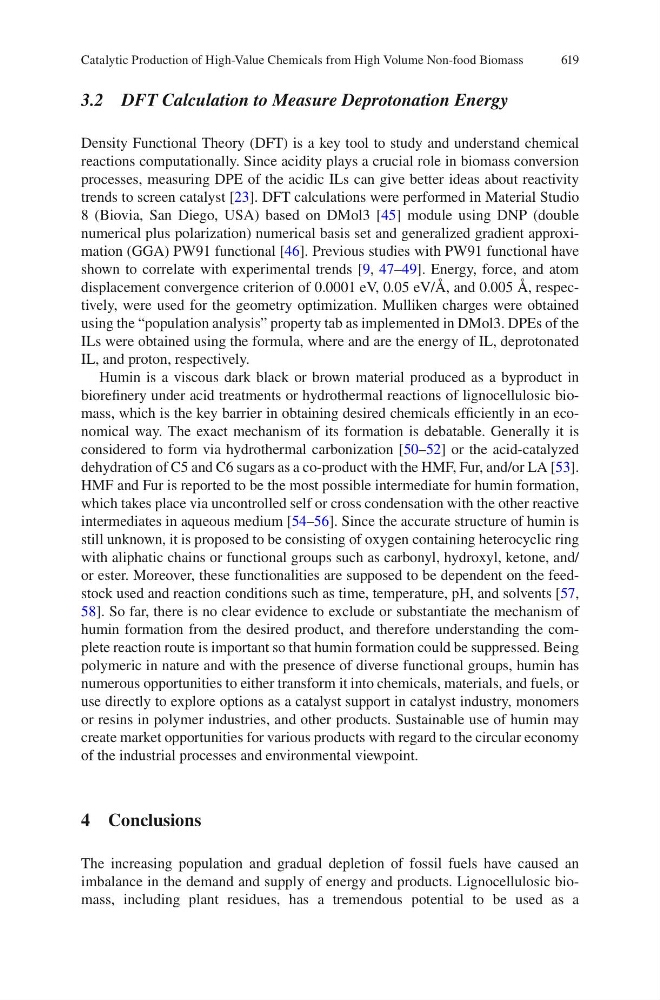
ILs were obtained using the formula, where and are the energy of IL, deprotonated
IL, and proton, respectively.
Humin is a viscous dark black or brown material produced as a byproduct in
biorefinery under acid treatments or hydrothermal reactions of lignocellulosic biomass, which is the key barrier in obtaining desired chemicals efficiently in an economical way. The exact mechanism of its formation is debatable. Generally it is
considered to form via hydrothermal carbonization [50–52] or the acid-catalyzed
dehydration of C5 and C6 sugars as a co-product with the HMF, Fur, and/or LA [53].
HMF and Fur is reported to be the most possible intermediate for humin formation,
which takes place via uncontrolled self or cross condensation with the other reactive
intermediates in aqueous medium [54–56]. Since the accurate structure of humin is
still unknown, it is proposed to be consisting of oxygen containing heterocyclic ring
with aliphatic chains or functional groups such as carbonyl, hydroxyl, ketone, and/
or ester. Moreover, these functionalities are supposed to be dependent on the feedstock used and reaction conditions such as time, temperature, pH, and solvents [57,
58]. So far, there is no clear evidence to exclude or substantiate the mechanism of
humin formation from the desired product, and therefore understanding the complete reaction route is important so that humin formation could be suppressed. Being
polymeric in nature and with the presence of diverse functional groups, humin has
numerous opportunities to either transform it into chemicals, materials, and fuels, or
use directly to explore options as a catalyst support in catalyst industry, monomers
or resins in polymer industries, and other products. Sustainable use of humin may
create market opportunities for various products with regard to the circular economy
of the industrial processes and environmental viewpoint.
4 Conclusions
The increasing population and gradual depletion of fossil fuels have caused an
imbalance in the demand and supply of energy and products. Lignocellulosic biomass, including plant residues, has a tremendous potential to be used as a
Catalytic Production of High-Value Chemicals from High Volume Non-food Biomass