

615
which subsequently transformed into related products, Fur or HMF, by the removal
of three molecules of water. In order to produce HMF, various sources such as
monosaccharaides (e.g., glucose, xylose), disaccharides (e.g., inulin, sucrose), polysaccharide (e.g., cellulose, starch), and untreated biomass (e.g., maize corn, agricultural residues) have been used.
To convert these feedstocks, approaches based on enzymes, mineral acids, transition metal catalysts, ionic liquids, and metal salts have been suitably applied.
However, the limitation such as the use of the corrosive chemicals (mineral acids),
difficult product separation (e.g., in enzyme catalysis), and high cost of the catalyst
makes such process difficult for commercialization.
Moreover, the existing method of utilizing edible biomass (e.g., maize corn and
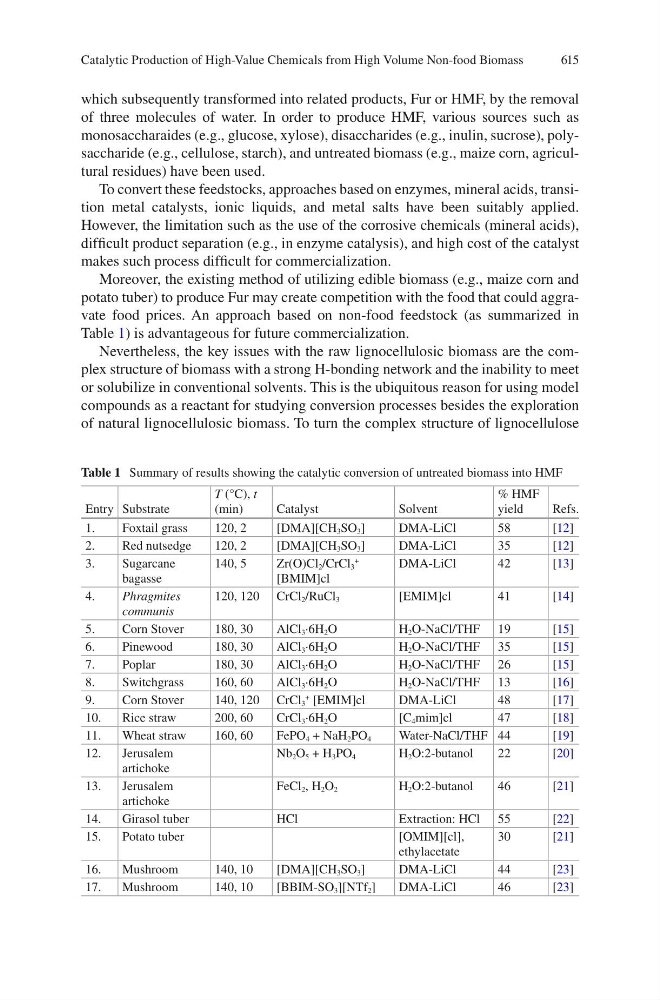
potato tuber) to produce Fur may create competition with the food that could aggravate food prices. An approach based on non-food feedstock (as summarized in
Table 1) is advantageous for future commercialization.
Nevertheless, the key issues with the raw lignocellulosic biomass are the complex structure of biomass with a strong H-bonding network and the inability to meet
or solubilize in conventional solvents. This is the ubiquitous reason for using model
compounds as a reactant for studying conversion processes besides the exploration
of natural lignocellulosic biomass. To turn the complex structure of lignocellulose
Table 1 Summary of results showing the catalytic conversion of untreated biomass into HMF
Entry Substrate
T (°C), t
(min)
Catalyst
Solvent
% HMF
yield
Refs.
1.
Foxtail grass
120, 2
[DMA][CH 3 SO 3 ]
DMA-LiCl
58
[12]
2.
Red nutsedge
120, 2
[DMA][CH 3 SO 3 ]
DMA-LiCl
35
[12]
3.
Sugarcane
bagasse
140, 5
Zr(O)Cl 2 /CrCl 3
+
[BMIM]cl
DMA-LiCl
42
[13]
4.
Phragmites
communis
120, 120 CrCl 2 /RuCl 3
[EMIM]cl
41
[14]
5.
Corn Stover
180, 30
AlCl 3 ·6H 2 O
H 2 O-NaCl/THF 19
[15]
6.
Pinewood
180, 30
AlCl 3 ·6H 2 O
H 2 O-NaCl/THF 35
[15]
7.
Poplar
180, 30
AlCl 3 ·6H 2 O
H 2 O-NaCl/THF 26
[15]
8.
Switchgrass
160, 60
AlCl 3 ·6H 2 O
H 2 O-NaCl/THF 13
[16]
9.
Corn Stover
140, 120 CrCl 3
+ [EMIM]cl
DMA-LiCl
48
[17]
10.
Rice straw
200, 60
CrCl 3 ·6H 2 O
[C 4 mim]cl
47
[18]
11.
Wheat straw
160, 60
FePO 4 + NaH 2 PO 4
Water-NaCl/THF 44
[19]
12.
Jerusalem
artichoke
Nb 2 O 5 + H 3 PO 4
H 2 O:2-butanol
22
[20]
13.
Jerusalem
artichoke
FeCl 2 , H 2 O 2
H 2 O:2-butanol
46
[21]
14.
Girasol tuber
HCl
Extraction: HCl 55
[22]
15.
Potato tuber
[OMIM][cl],
ethylacetate
30
[21]
16.
Mushroom
140, 10
[DMA][CH 3 SO 3 ]
DMA-LiCl
44
[23]
17.
Mushroom
140, 10
[BBIM-SO 3 ][NTf 2 ]
DMA-LiCl
46
[23]
Catalytic Production of High-Value Chemicals from High Volume Non-food Biomass