

614
fuels from alternative (nonfossil) feedstocks. At present, only 13% energy, 10%
chemicals, and below 2% organic materials are estimated to be produced from nonfossil resources [1]. Interestingly, the progress in bio- and chemo-catalytic process
has accelerated the development of novel pathways to obtain commodity chemicals
from biomass as biorenewable feedstocks [2–6]. Biomass is usually a plant- and
animal-sourced carbonaceous material produced by activities such as food, feed,
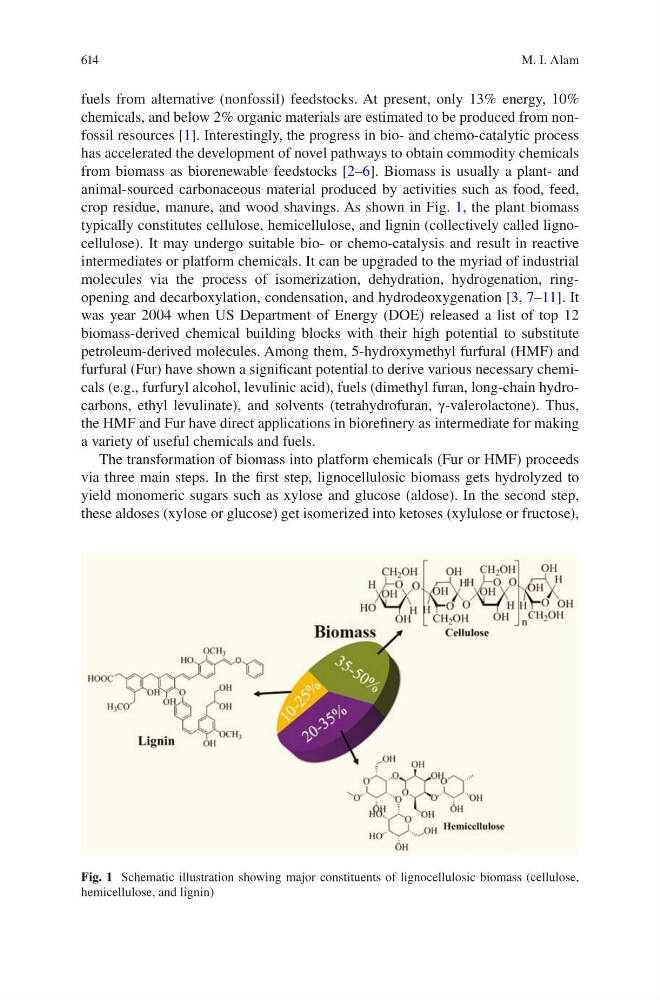
crop residue, manure, and wood shavings. As shown in Fig. 1, the plant biomass
typically constitutes cellulose, hemicellulose, and lignin (collectively called lignocellulose). It may undergo suitable bio- or chemo-catalysis and result in reactive
intermediates or platform chemicals. It can be upgraded to the myriad of industrial
molecules via the process of isomerization, dehydration, hydrogenation, ringopening and decarboxylation, condensation, and hydrodeoxygenation [3, 7–11]. It
was year 2004 when US Department of Energy (DOE) released a list of top 12
biomass-derived chemical building blocks with their high potential to substitute
petroleum-derived molecules. Among them, 5-hydroxymethyl furfural (HMF) and
furfural (Fur) have shown a significant potential to derive various necessary chemicals (e.g., furfuryl alcohol, levulinic acid), fuels (dimethyl furan, long-chain hydrocarbons, ethyl levulinate), and solvents (tetrahydrofuran, γ-valerolactone). Thus,
the HMF and Fur have direct applications in biorefinery as intermediate for making
a variety of useful chemicals and fuels.
The transformation of biomass into platform chemicals (Fur or HMF) proceeds
via three main steps. In the first step, lignocellulosic biomass gets hydrolyzed to
yield monomeric sugars such as xylose and glucose (aldose). In the second step,
these aldoses (xylose or glucose) get isomerized into ketoses (xylulose or fructose),
Fig. 1 Schematic illustration showing major constituents of lignocellulosic biomass (cellulose,
hemicellulose, and lignin)
M. I. Alam