

555
On Amberlyst-15, with acetic acid as acylating agent, 90% glycerol conversion
and 31%, 54% and 13% selectivity towards mono-, di- and triacetins could be realized. However, with acetic anhydride, on the same catalyst, 100% selectivity for
triacetin was observed in 80 min at 60 °C. Iron oxide nanoparticles supported on
mesoporous SBA-15 were highly active for glyceride formation with levulinic acid
in the place of acetic acid, displaying >99% conversion of glycerol and 71% diacetin and 28% triacetin selectivity [331]. Sandesh et al. [332] have reported simultaneous synthesis of biodiesel and acetins using methyl acetate, on a series of novel
solid basic catalysts, based on metal hydroxy stannates, MSn (OH) 6 with M = Mg,
Zn, Sr and Ca. The catalyst with higher basicity, CaSn (OH) 6 , exhibited glycerol
conversion of 78.2%, with 67.3% monocetins and 32.6% diacetins selectivity. While
complete conversion of glycerol could be realized, major research efforts are
directed towards achieving desired acetin selectivity, by employing different catalysts and process conditions [322].
Glycerol ethers are useful as oxygenated fuel additives and solvents. Glycerol
ethers are obtained by etherification of glycerol with olefins/alcohols (isobutene/
tertiary butyl alcohol). Similar to acetins, glycerol mono-, di- and tri-ethers are
formed. Different types of zeolites, clays, ion-exchange resins and supported heteropoly acids have been employed as catalysts [322]. Carbon supports derived from
bio-resources like sugar cane bagasse, coconut husk and coffee grounds, after functionalization with sulphonic acid, proved to be highly effective for etherification of
glycerol. 81.8% glycerol conversion with 60.5% selectivity to mono-ether and
21.8% to di- and tri-ethers could be obtained with carbon derived from sugar cane
bagasse [333]. A comparative evaluation of ion-exchange resins (Amberlyst-15 and
Amberlyst-35) and zeolites (Beta-BEA and USY and MOR) has shown that though
the resin catalysts exhibit higher glycerol conversion at a lower temperature (75 °C)
than zeolite-based catalysts (90–110 °C), the latter group of catalysts display higher
stability, forming preferentially di- and tri-tertiary butyl glycerol. More than 95%
glycerol conversion with 45% and 54% selectivity for di- and tri-tertiary butyl glycerol is realized on nanosize BEA catalyst, due to relatively larger-sized pores [334].
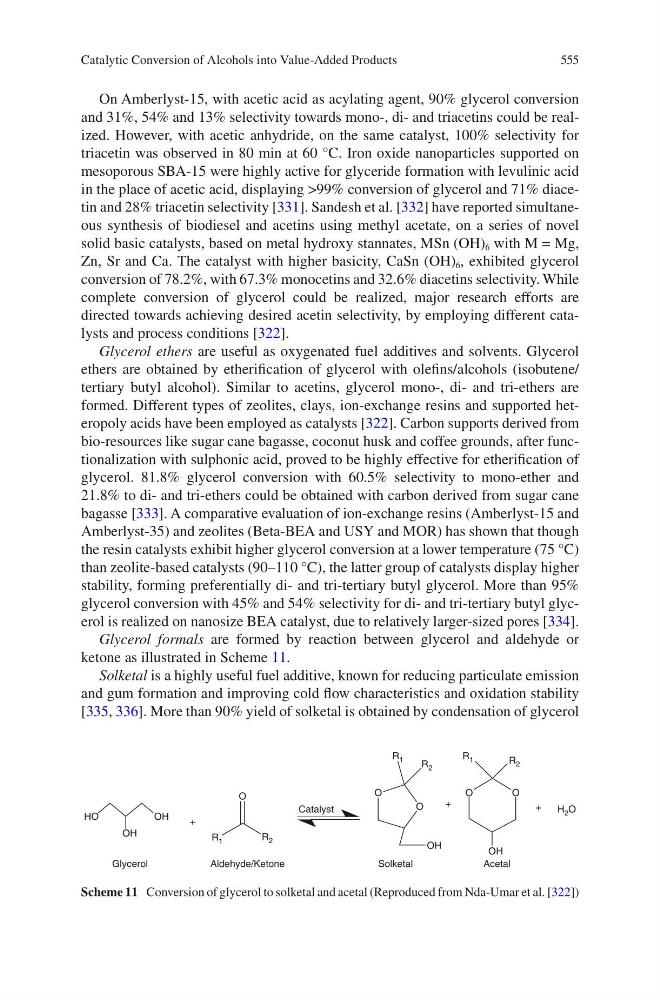
Glycerol formals are formed by reaction between glycerol and aldehyde or
ketone as illustrated in Scheme 11.
Solketal is a highly useful fuel additive, known for reducing particulate emission
and gum formation and improving cold flow characteristics and oxidation stability
[335, 336]. More than 90% yield of solketal is obtained by condensation of glycerol
HO
OH
OH
O
O
O
R 2
R 1
R 1
R 2
H 2 O
O
O
OH
OH
Acetal
Solketal
Aldehyde/Ketone
Glycerol
Catalyst
R 2
R 1
+
+
+
Scheme 11 Conversion of glycerol to solketal and acetal (Reproduced from Nda-Umar et al. [322])
Catalytic Conversion of Alcohols into Value-Added Products