

554
improvements in catalysts for APR of glycerol is required. Conversion of glycerol
to syngas by microwave plasma and supercritical water gasification of glycerol
result in syngas production, which is to be converted further to yield hydrogen.
These processes however require higher temperatures (500–650 °C) and low concentration of glycerol, 5–20% w/w [322].
Fuel additives, when blended with gasoline or diesel, help to improve viscosity
and cold flow properties, anti-knock characteristics and octane rating and reduce
emission of harmful exhaust gases (NOx) and particulates. They also ensure thermal stability and clean combustion of the fuel and prevent corrosion of engines.
Some of the fuel additives that can be obtained from glycerol are acetin (glycerol
esters), glycerol ethers, solketal and acetal.
Esterification of glycerol with acetic acid or acetic anhydride using homogeneous and heterogeneous catalysts [326, 327] and transesterification of glycerides
or glycerol with methyl acetate [328, 329] are known. Being a trihydric alcohol,
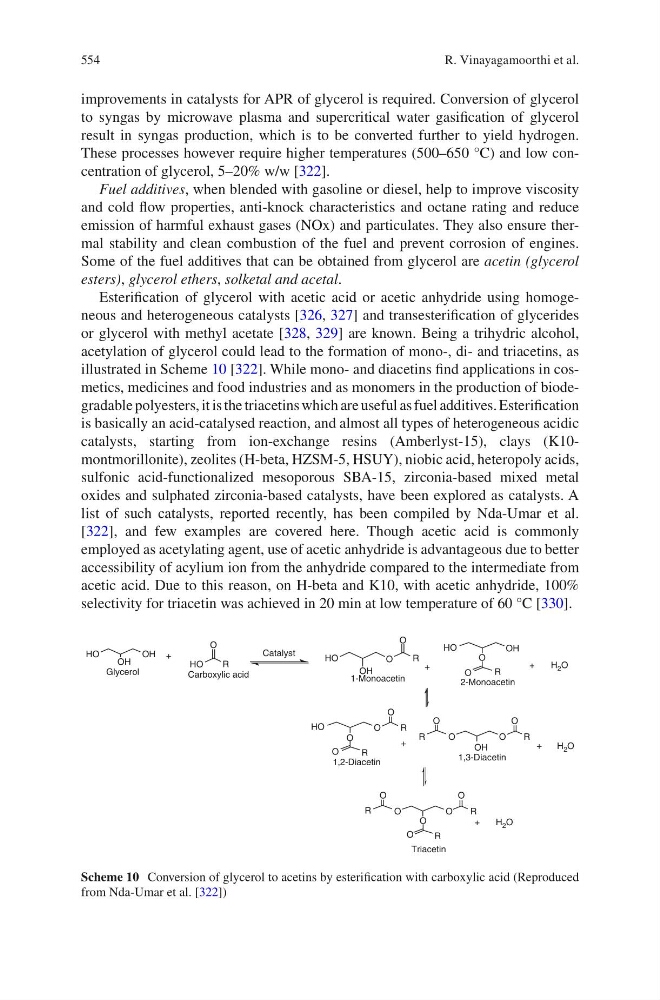
acetylation of glycerol could lead to the formation of mono-, di- and triacetins, as
illustrated in Scheme 10 [322]. While mono- and diacetins find applications in cosmetics, medicines and food industries and as monomers in the production of biodegradable polyesters, it is the triacetins which are useful as fuel additives. Esterification
is basically an acid-catalysed reaction, and almost all types of heterogeneous acidic
catalysts, starting from ion-exchange resins (Amberlyst-15), clays (K10montmorillonite), zeolites (H-beta, HZSM-5, HSUY), niobic acid, heteropoly acids,
sulfonic acid-functionalized mesoporous SBA-15, zirconia-based mixed metal
oxides and sulphated zirconia-based catalysts, have been explored as catalysts. A
list of such catalysts, reported recently, has been compiled by Nda-Umar et al.
[322], and few examples are covered here. Though acetic acid is commonly
employed as acetylating agent, use of acetic anhydride is advantageous due to better
accessibility of acylium ion from the anhydride compared to the intermediate from
acetic acid. Due to this reason, on H-beta and K10, with acetic anhydride, 100%
selectivity for triacetin was achieved in 20 min at low temperature of 60 °C [330].
HO
HO
HO
HO
HO
O
O
O
O
O
R
R
R
R
R
O
O
O
O
O
O
O
O
R
O
O
O
O
O
O
R
R
R
R
OH
OH
OH
OH
H 2 O
H 2 O
H 2 O
1-Monoacetin
2-Monoacetin
1,2-Diacetin
1,3-Diacetin
Triacetin
+
+
+
+
+
+
OH
Glycerol
Carboxylic acid
Catalyst
Scheme 10 Conversion of glycerol to acetins by esterification with carboxylic acid (Reproduced
from Nda-Umar et al. [322])
R. Vinayagamoorthi et al.