

541
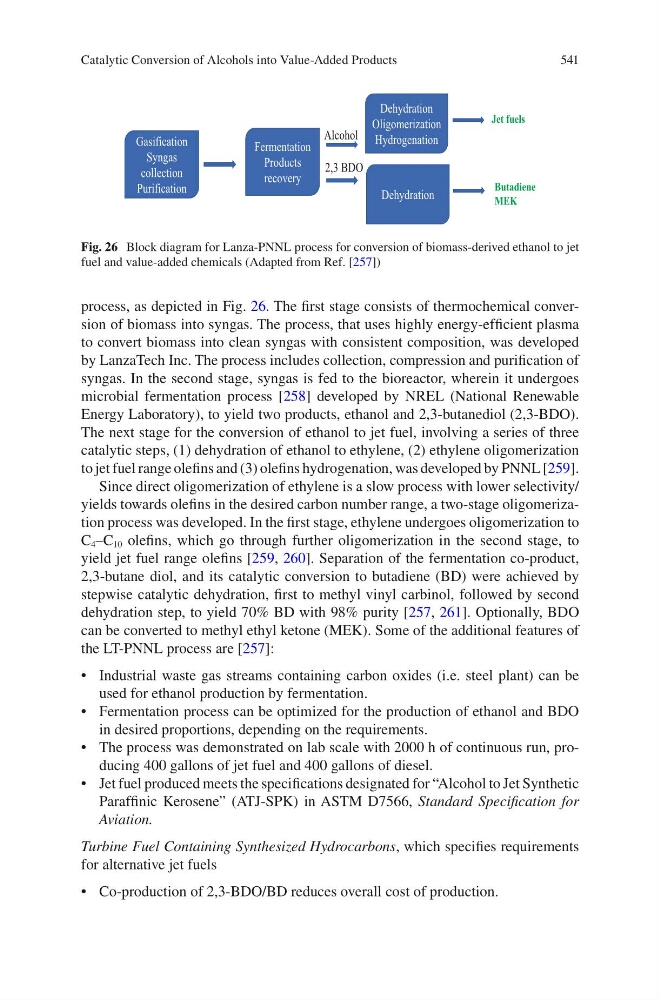
process, as depicted in Fig. 26. The first stage consists of thermochemical conversion of biomass into syngas. The process, that uses highly energy-efficient plasma
to convert biomass into clean syngas with consistent composition, was developed
by LanzaTech Inc. The process includes collection, compression and purification of
syngas. In the second stage, syngas is fed to the bioreactor, wherein it undergoes
microbial fermentation process [258] developed by NREL (National Renewable
Energy Laboratory), to yield two products, ethanol and 2,3-butanediol (2,3-BDO).
The next stage for the conversion of ethanol to jet fuel, involving a series of three
catalytic steps, (1) dehydration of ethanol to ethylene, (2) ethylene oligomerization
to jet fuel range olefins and (3) olefins hydrogenation, was developed by PNNL [259].
Since direct oligomerization of ethylene is a slow process with lower selectivity/
yields towards olefins in the desired carbon number range, a two-stage oligomerization process was developed. In the first stage, ethylene undergoes oligomerization to
C 4 –C 10 olefins, which go through further oligomerization in the second stage, to
yield jet fuel range olefins [259, 260]. Separation of the fermentation co-product,
2,3-butane diol, and its catalytic conversion to butadiene (BD) were achieved by
stepwise catalytic dehydration, first to methyl vinyl carbinol, followed by second
dehydration step, to yield 70% BD with 98% purity [257, 261]. Optionally, BDO
can be converted to methyl ethyl ketone (MEK). Some of the additional features of
the LT-PNNL process are [257]:
• Industrial waste gas streams containing carbon oxides (i.e. steel plant) can be
used for ethanol production by fermentation.
• Fermentation process can be optimized for the production of ethanol and BDO
in desired proportions, depending on the requirements.
• The process was demonstrated on lab scale with 2000 h of continuous run, producing 400 gallons of jet fuel and 400 gallons of diesel.
• Jet fuel produced meets the specifications designated for “Alcohol to Jet Synthetic
Paraffinic Kerosene” (ATJ-SPK) in ASTM D7566, Standard Specification for
Aviation.
Turbine Fuel Containing Synthesized Hydrocarbons, which specifies requirements
for alternative jet fuels
• Co-production of 2,3-BDO/BD reduces overall cost of production.
Gasification
Syngas
collection
Purification
Fermentation
Products
recovery
Dehydration
Oligomerization
Hydrogenation
Dehydration
Alcohol
2,3 BDO
Jet fuels
Butadiene
MEK
Fig. 26 Block diagram for Lanza-PNNL process for conversion of biomass-derived ethanol to jet
fuel and value-added chemicals (Adapted from Ref. [257])
Catalytic Conversion of Alcohols into Value-Added Products