

539
impacts, relentless efforts are on to derive these fuels from renewable resources.
Significant progress has been achieved in the utilizations of bio-fuels (bio-ethanol,
biobutanol, biodiesel, gasoline through MTG process, bio-jet fuels etc.), though
overall contribution of bio-fuels in global total energy consumption (in 2017)
remains low at 13% [253]. Bio-ethanol, besides its application for blending with
gasoline, can be conversted into value-added fuels in middle distillate range and jet
fuels by different catalytic processes. Jet fuel constitutes around 12% of the global
transportation fuels consumption and its contribution towards emission of greenhouse gases (GHG) is 2%. In order to comply with the Paris Climate Control
Accord, 2015, airlines industry is aiming to become carbon-neutral by 2020 and by
2050 reduce emissions by 50% with respect to 2005 emissions level, by gradual
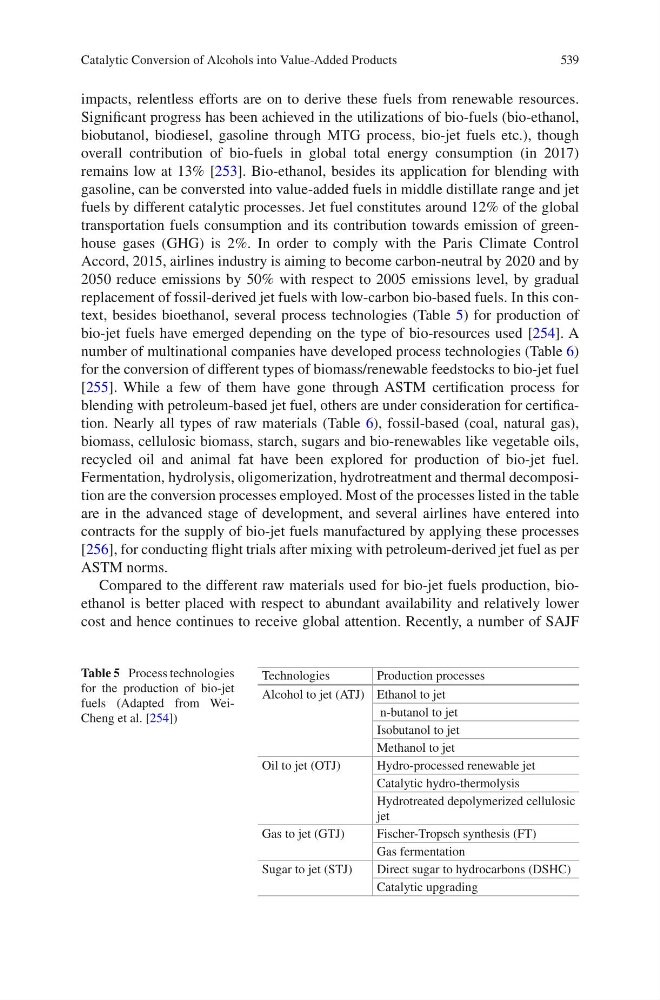
replacement of fossil-derived jet fuels with low-carbon bio-based fuels. In this context, besides bioethanol, several process technologies (Table 5) for production of
bio-jet fuels have emerged depending on the type of bio-resources used [254]. A
number of multinational companies have developed process technologies (Table 6)
for the conversion of different types of biomass/renewable feedstocks to bio-jet fuel
[255]. While a few of them have gone through ASTM certification process for
blending with petroleum- based jet fuel, others are under consideration for certification. Nearly all types of raw materials (Table 6), fossil-based (coal, natural gas),
biomass, cellulosic biomass, starch, sugars and bio-renewables like vegetable oils,
recycled oil and animal fat have been explored for production of bio-jet fuel.
Fermentation, hydrolysis, oligomerization, hydrotreatment and thermal decomposition are the conversion processes employed. Most of the processes listed in the table
are in the advanced stage of development, and several airlines have entered into
contracts for the supply of bio-jet fuels manufactured by applying these processes
[256], for conducting flight trials after mixing with petroleum-derived jet fuel as per
ASTM norms.
Compared to the different raw materials used for bio-jet fuels production, bioethanol is better placed with respect to abundant availability and relatively lower
cost and hence continues to receive global attention. Recently, a number of SAJF
Table 5 Process technologies
for the production of bio-jet
fuels (Adapted from WeiCheng et al. [254])
Technologies
Production processes
Alcohol to jet (ATJ) Ethanol to jet
n-butanol to jet
Isobutanol to jet
Methanol to jet
Oil to jet (OTJ)
Hydro-processed renewable jet
Catalytic hydro-thermolysis
Hydrotreated depolymerized cellulosic
jet
Gas to jet (GTJ)
Fischer-Tropsch synthesis (FT)
Gas fermentation
Sugar to jet (STJ)
Direct sugar to hydrocarbons (DSHC)
Catalytic upgrading
Catalytic Conversion of Alcohols into Value-Added Products