

516
Of the four isomers of butane diol (BDO), 2,3- and 1,4-BDO have a wide range
of applications, while 1,2- and 1,3-BDO have relatively limited range of use. While
1,2-BDO is used for the production of polyester resins and plasticizers, the main
application of 1,3-BDO is as solvent for food flavouring agents and as co-monomer
for some of the polyurethane and polyester resins [103–105].
Amongst the C 4 diols, 2,3-BDO is perhaps one of the most useful bio-based
feedstock chemical intermediates, with applications on several sectors. 2,3-BDO on
dehydration yields 1,3-butadiene, the monomer for synthetic rubber production or
methyl ethyl ketone (MEK), useful as solvent and fuel additive. 2,3-BDO itself can
serve as an “octane booster” for gasoline and, due to its lower freezing point
(−60 °C), anti-freeze agent as well. Diacetyl, a highly valued flavouring agent that
protects against bacterial attack, is made by dehydrogenation of 2,3-BDO [106].
Esters of 2,3-BDO and maleic acid are used for polyurethane/maleimide with cardiovascular applications [107]. 2,3-BDO esters are also useful for pharmaceuticals
and cosmetics applications. Though 2,3-BDO is produced by chemo-catalytic route
via butene-chlorohydrin pathway [56, 108], manufacturing by biotechnological
routes using renewable biomass feedstocks and biomass wastes has recently become
prominent. Several reviews covering significant developments in the microbial production of 2,3-BDO have been published [109–112]. 1,4-BDO is produced through
Reppe chemistry by reaction between acetylene and formaldehyde to form
1,4-butyene diol, which is subsequently hydrogenated to yield 1,4BDO. Hydroformylation of propylene, hydrogenation of maleic anhydride and
dichloro-butene process from 1,3-butadiene or the 1,3-butadiene-acetic acid are the
other processes for the manufacture of 1,4-BDO [109, 113]. With the identification
of succinic acid as one of the platform chemicals from the biomass refinery, synthesis of 1,4-BDO by reduction of succinic acid as a sustainable process has gained
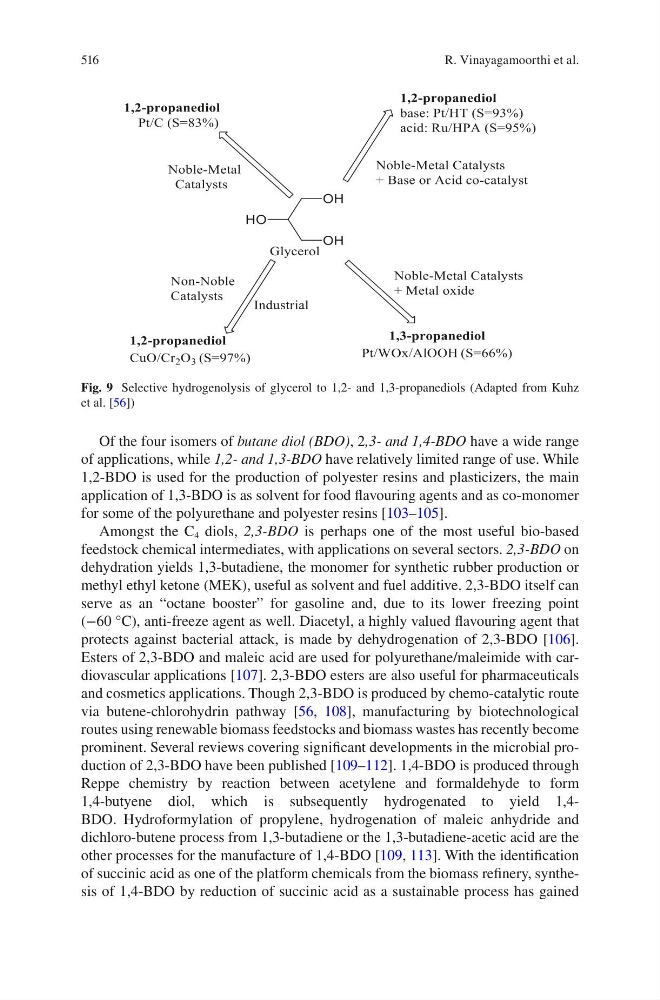
Fig. 9 Selective hydrogenolysis of glycerol to 1,2- and 1,3-propanediols (Adapted from Kuhz
et al. [56])
R. Vinayagamoorthi et al.