

515
propylene oxide in presence of ion-exchange resin catalysts at 150–180 °C [88, 89],
1,3-PDO is manufactured [90–92] either by Shell process from ethylene oxide or
acrolein by DuPont process. Several microbial processes for the production of both
1,2- and 1,3-propane diols [56] using a variety of microorganisms and feedstocks
(glucose, glycerol, sugars) have been reported. Notable amongst them is DuPont/
Tate & Lyle process [93], in which two conversions, glucose to glycerol by recombinant E. coli and conversion of glycerol to 1,3-PDO by Klebsiella strains, are combined. The process was first commercialized in 2006, and the capacity was expanded
to 65,000 MTA. Similarly, microbial process for the conversion of glycerol to 1,2PDO using E. coli [94] as the microorganism was developed.
Emergence of biomass conversion processes to fuels and chemicals and the
large-scale availability of biodiesel-derived glycerol as an important platform molecule paved way for the development of sustainable processes for the production of
a number of important chemicals and chemical intermediates from glycerol
[91, 95–97].
Catalytic processes for the hydrogenolysis of glycerol to yield selectively either
1,2- or 1,3-PDOs have been reported [98–102]. Nakagawa and Tomishige [98]
investigated hydrogenolysis of glycerol on four different types of catalysts, namely,
non-noble metal catalysts, noble metal catalysts with an acid as an additive, noble
metal catalysts combined with a base and metal oxide-modified noble metal catalysts, and observed that only metal oxide-modified noble metal catalysts were selective for 1,3-PDO while the other three catalysts displayed high selectivity for
1,2-PDO. Accordingly, Arundhathi et al. [100] observed that hydrogenolysis of
glycerol on Pt-WO x /AlOOH yields 1,3-PDO with 66% selectivity. Reaction pathways leading to the formation of 1,2- or 1,3-propane diol have been proposed by
Nakagawa and Tomishige [98]. Selection of suitable catalyst and reaction conditions for glycerol hydrogenolysis leads to the formation of 1,2- or 1,3-propanediol
(Fig. 9).
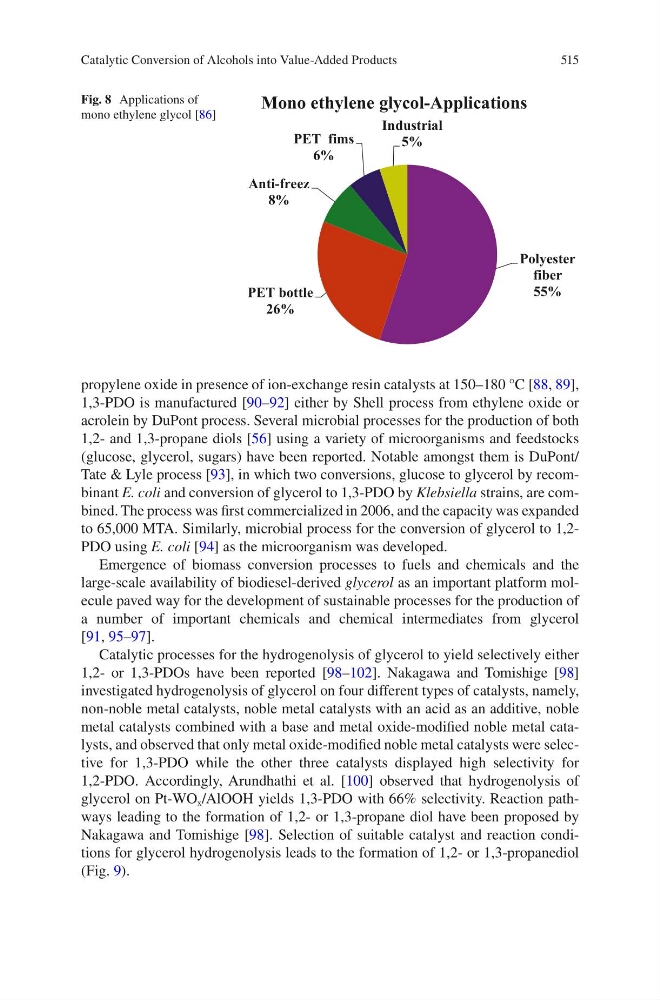
Polyester
fiber
55%
PET bottle
26%
Anti-freez
8%
PET fims
6%
Industrial
5%
Mono ethylene glycol-Applications
Fig. 8 Applications of
mono ethylene glycol [86]
Catalytic Conversion of Alcohols into Value-Added Products