

508
3 Production and Applications of Alcohols
Methanol, with an estimated annual consumption of 97 MMT (million metric tons)
during 2019 [28], is one of the most important bulk chemical and raw materials used
for the production of a number of value-added chemicals (Fig. 3). Leading global
companies engaged in methanol production are BASF SE, Methanex Corporation,
Mitsubishi Chemical, Mitsui & Co., Ltd. and Petroliam Nasional Berhad (Petronas).
Current industrial process for the manufacture of methanol is based on fossilderived (natural gas, coal) syngas (CO + H 2 ) as raw material, mostly through the
low-pressure process developed by ICI (now Johnson Matthey) operating at
35–54 bar pressure and in the temperature range of 200–300 °C [29]. Details on
100 years of history of industrial methanol synthesis process and catalysts, the
developments starting from the wood-based process and the classical high-pressure
BASF catalytic process down to the recent ones, major products from different
methanol conversion processes and their applications and its fuel characteristics and
applications as fuel/fuel additives have been covered in exhaustive reviews [29–31].
As on date, investigations on fundamental aspects and development of superior
methanol synthesis catalysts/process continue to be active areas of research. Such
studies are highly relevant, especially in the current context, wherein the emphasis
is on the use of the most abundant greenhouse gas (GHG) CO 2 in the place of CO
CH 3 OH
CH 3 CH 2 OH
Ethanol
Methanol
CH 3 CH 2 CH 2 OH
CH 3 CHOHCH 3
Propanol
Isopropyl alcohol
CH 2 OH
CH 2 OH
CH 2 OH
CHOH
Glycerol
Ethylene glycol
CH 2 OH
HO
HO
OH
HO
OH
HO
Sorbitol
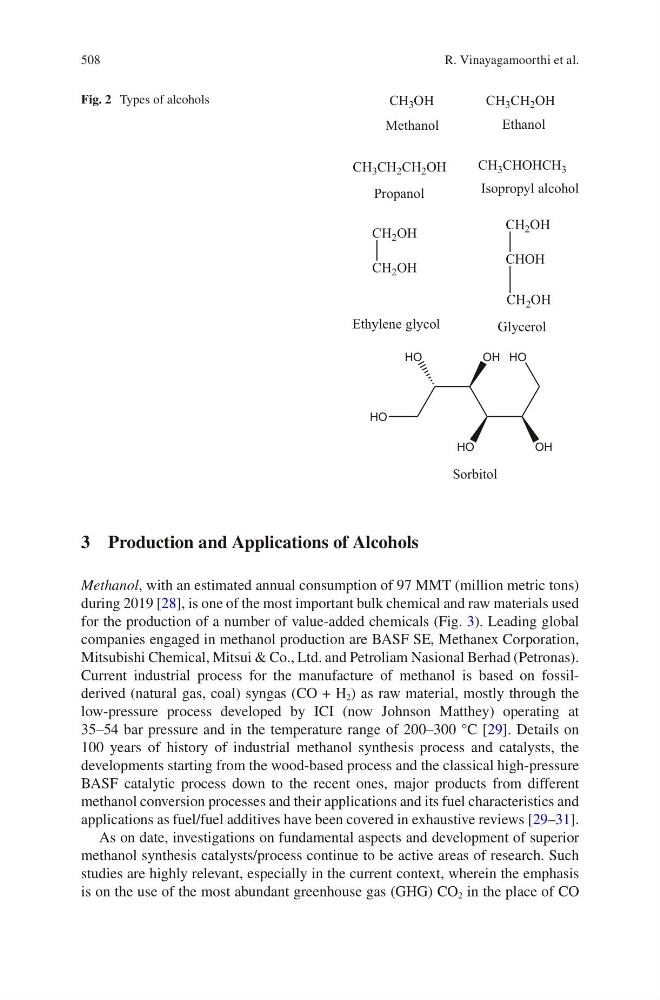
Fig. 2 Types of alcohols
R. Vinayagamoorthi et al.