

455
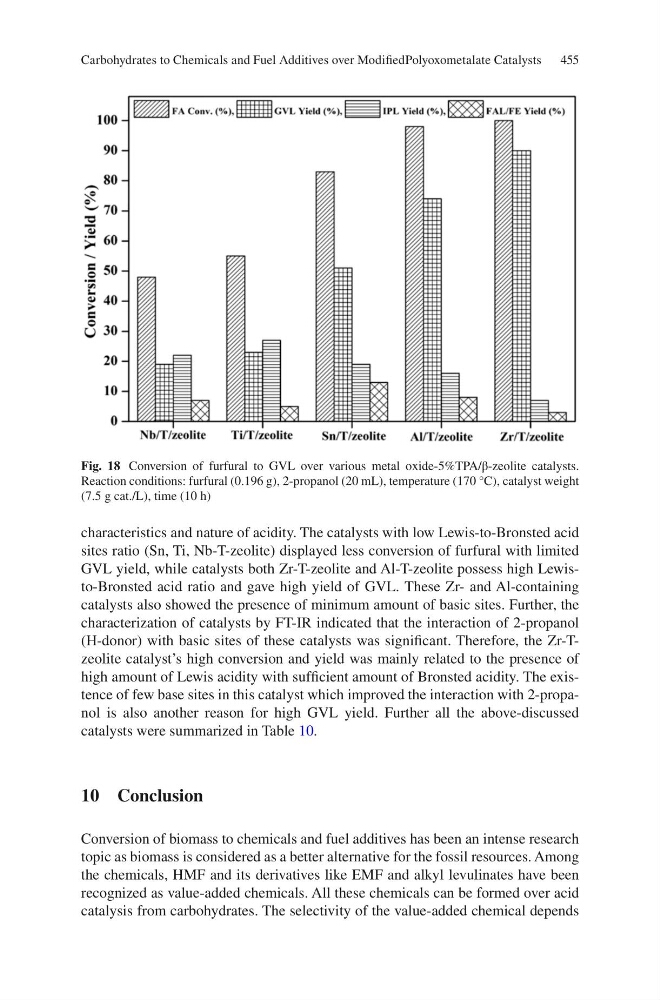
characteristics and nature of acidity. The catalysts with low Lewis-to-Bronsted acid
sites ratio (Sn, Ti, Nb-T-zeolite) displayed less conversion of furfural with limited
GVL yield, while catalysts both Zr-T-zeolite and Al-T-zeolite possess high Lewisto-Bronsted acid ratio and gave high yield of GVL. These Zr- and Al-containing
catalysts also showed the presence of minimum amount of basic sites. Further, the
characterization of catalysts by FT-IR indicated that the interaction of 2-propanol
(H-donor) with basic sites of these catalysts was significant. Therefore, the Zr-Tzeolite catalyst’s high conversion and yield was mainly related to the presence of
high amount of Lewis acidity with sufficient amount of Bronsted acidity. The existence of few base sites in this catalyst which improved the interaction with 2-propanol is also another reason for high GVL yield. Further all the above-discussed
catalysts were summarized in Table 10.
10 Conclusion
Conversion of biomass to chemicals and fuel additives has been an intense research
topic as biomass is considered as a better alternative for the fossil resources. Among
the chemicals, HMF and its derivatives like EMF and alkyl levulinates have been
recognized as value-added chemicals. All these chemicals can be formed over acid
catalysis from carbohydrates. The selectivity of the value-added chemical depends
Fig. 18 Conversion of furfural to GVL over various metal oxide-5%TPA/β-zeolite catalysts.
Reaction conditions: furfural (0.196 g), 2-propanol (20 mL), temperature (170 °C), catalyst weight
(7.5 g cat./L), time (10 h)
Carbohydrates to Chemicals and Fuel Additives over ModifiedPolyoxometalate Catalysts
characteristics and nature of acidity. The catalysts with low Lewis-to-Bronsted acid
sites ratio (Sn, Ti, Nb-T-zeolite) displayed less conversion of furfural with limited
GVL yield, while catalysts both Zr-T-zeolite and Al-T-zeolite possess high Lewisto-Bronsted acid ratio and gave high yield of GVL. These Zr- and Al-containing
catalysts also showed the presence of minimum amount of basic sites. Further, the
characterization of catalysts by FT-IR indicated that the interaction of 2-propanol
(H-donor) with basic sites of these catalysts was significant. Therefore, the Zr-Tzeolite catalyst’s high conversion and yield was mainly related to the presence of
high amount of Lewis acidity with sufficient amount of Bronsted acidity. The existence of few base sites in this catalyst which improved the interaction with 2-propanol is also another reason for high GVL yield. Further all the above-discussed
catalysts were summarized in Table 10.
10 Conclusion
Conversion of biomass to chemicals and fuel additives has been an intense research
topic as biomass is considered as a better alternative for the fossil resources. Among
the chemicals, HMF and its derivatives like EMF and alkyl levulinates have been
recognized as value-added chemicals. All these chemicals can be formed over acid
catalysis from carbohydrates. The selectivity of the value-added chemical depends
Fig. 18 Conversion of furfural to GVL over various metal oxide-5%TPA/β-zeolite catalysts.
Reaction conditions: furfural (0.196 g), 2-propanol (20 mL), temperature (170 °C), catalyst weight
(7.5 g cat./L), time (10 h)
Carbohydrates to Chemicals and Fuel Additives over ModifiedPolyoxometalate Catalysts