

431
Interestingly, lignocellulosic biomass (LB) can be obtained along with the nonagricultural lands, food (e.g. straw and corn) and degraded soils eliminating the
unwanted issues. The advantageous features for utilization of lignocellulosic biomass are due to widespread and easy availability of raw materials. Its utility could
concede the creation of valuable biofuels and chemicals, along with electricity and
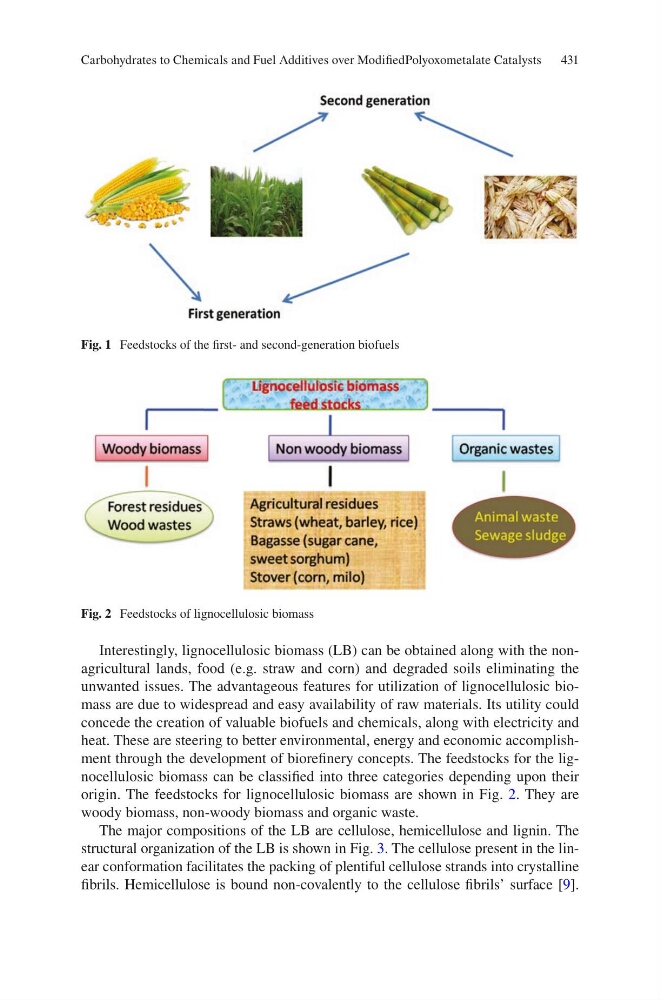
heat. These are steering to better environmental, energy and economic accomplishment through the development of biorefinery concepts. The feedstocks for the lignocellulosic biomass can be classified into three categories depending upon their
origin. The feedstocks for lignocellulosic biomass are shown in Fig. 2. They are
woody biomass, non-woody biomass and organic waste.
The major compositions of the LB are cellulose, hemicellulose and lignin. The
structural organization of the LB is shown in Fig. 3. The cellulose present in the linear conformation facilitates the packing of plentiful cellulose strands into crystalline
fibrils. Hemicellulose is bound non-covalently to the cellulose fibrils’ surface [9].
Fig. 1 Feedstocks of the first- and second-generation biofuels
Fig. 2 Feedstocks of lignocellulosic biomass
Carbohydrates to Chemicals and Fuel Additives over ModifiedPolyoxometalate Catalysts
Interestingly, lignocellulosic biomass (LB) can be obtained along with the nonagricultural lands, food (e.g. straw and corn) and degraded soils eliminating the
unwanted issues. The advantageous features for utilization of lignocellulosic biomass are due to widespread and easy availability of raw materials. Its utility could
concede the creation of valuable biofuels and chemicals, along with electricity and
heat. These are steering to better environmental, energy and economic accomplishment through the development of biorefinery concepts. The feedstocks for the lignocellulosic biomass can be classified into three categories depending upon their
origin. The feedstocks for lignocellulosic biomass are shown in Fig. 2. They are
woody biomass, non-woody biomass and organic waste.
The major compositions of the LB are cellulose, hemicellulose and lignin. The
structural organization of the LB is shown in Fig. 3. The cellulose present in the linear conformation facilitates the packing of plentiful cellulose strands into crystalline
fibrils. Hemicellulose is bound non-covalently to the cellulose fibrils’ surface [9].
Fig. 1 Feedstocks of the first- and second-generation biofuels
Fig. 2 Feedstocks of lignocellulosic biomass
Carbohydrates to Chemicals and Fuel Additives over ModifiedPolyoxometalate Catalysts