

420
Cu
I
catalytic species. When necessitates, the benzoxazole auxiliary can be released
to obtain α-thiolated carboxylic acids that are required to constitute bioactive compounds such as a sphingosine 1-phosphate antagonist 205 (Scheme 66).
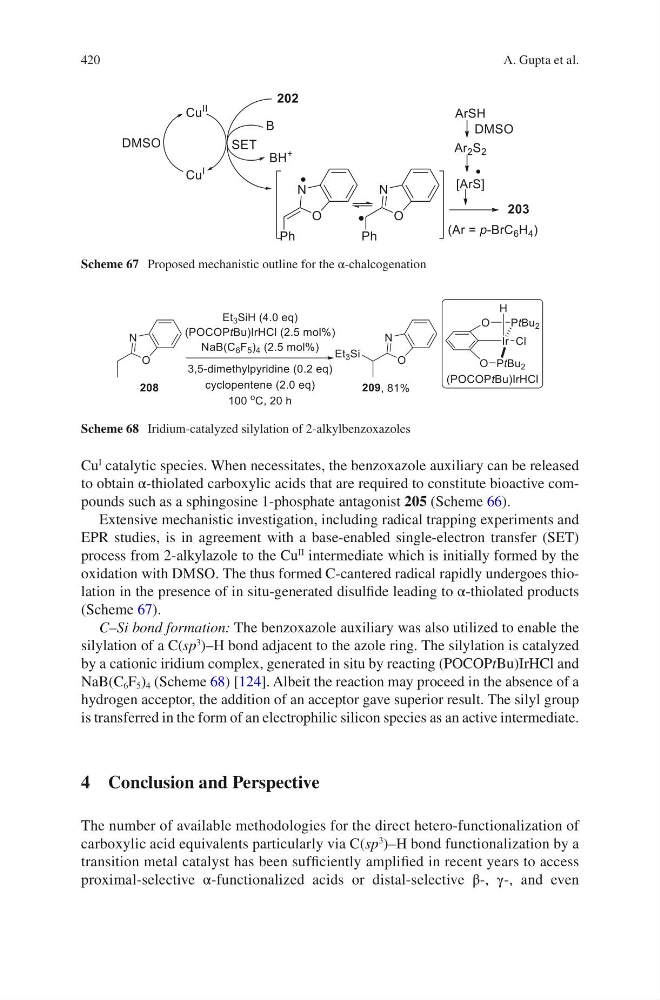
Extensive mechanistic investigation, including radical trapping experiments and
EPR studies, is in agreement with a base-enabled single-electron transfer (SET)
process from 2-alkylazole to the Cu
II
intermediate which is initially formed by the
oxidation with DMSO. The thus formed C-cantered radical rapidly undergoes thiolation in the presence of in situ-generated disulfide leading to α-thiolated products
(Scheme 67).
C–Si bond formation: The benzoxazole auxiliary was also utilized to enable the
silylation of a C(sp
3
)–H bond adjacent to the azole ring. The silylation is catalyzed
by a cationic iridium complex, generated in situ by reacting (POCOPtBu)IrHCl and
NaB(C 6 F 5 ) 4 (Scheme 68) [124]. Albeit the reaction may proceed in the absence of a
hydrogen acceptor, the addition of an acceptor gave superior result. The silyl group
is transferred in the form of an electrophilic silicon species as an active intermediate.
4 Conclusion and Perspective
The number of available methodologies for the direct hetero-functionalization of
carboxylic acid equivalents particularly via C(sp
3
)–H bond functionalization by a
transition metal catalyst has been sufficiently amplified in recent years to access
proximal-selective α-functionalized acids or distal-selective β-, γ-, and even
Scheme 68 Iridium-catalyzed silylation of 2-alkylbenzoxazoles
Scheme 67 Proposed mechanistic outline for the α-chalcogenation
A. Gupta et al.
Cu
I
catalytic species. When necessitates, the benzoxazole auxiliary can be released
to obtain α-thiolated carboxylic acids that are required to constitute bioactive compounds such as a sphingosine 1-phosphate antagonist 205 (Scheme 66).
Extensive mechanistic investigation, including radical trapping experiments and
EPR studies, is in agreement with a base-enabled single-electron transfer (SET)
process from 2-alkylazole to the Cu
II
intermediate which is initially formed by the
oxidation with DMSO. The thus formed C-cantered radical rapidly undergoes thiolation in the presence of in situ-generated disulfide leading to α-thiolated products
(Scheme 67).
C–Si bond formation: The benzoxazole auxiliary was also utilized to enable the
silylation of a C(sp
3
)–H bond adjacent to the azole ring. The silylation is catalyzed
by a cationic iridium complex, generated in situ by reacting (POCOPtBu)IrHCl and
NaB(C 6 F 5 ) 4 (Scheme 68) [124]. Albeit the reaction may proceed in the absence of a
hydrogen acceptor, the addition of an acceptor gave superior result. The silyl group
is transferred in the form of an electrophilic silicon species as an active intermediate.
4 Conclusion and Perspective
The number of available methodologies for the direct hetero-functionalization of
carboxylic acid equivalents particularly via C(sp
3
)–H bond functionalization by a
transition metal catalyst has been sufficiently amplified in recent years to access
proximal-selective α-functionalized acids or distal-selective β-, γ-, and even
Scheme 68 Iridium-catalyzed silylation of 2-alkylbenzoxazoles
Scheme 67 Proposed mechanistic outline for the α-chalcogenation
A. Gupta et al.