

32
HDO works in the presence of a catalyst under H 2 pressure, and it is classified to
be the most efficient way to upgrade pyrolysis bio-oil [229]. This process converts
aldehydes, oxygenated and unsaturated elements, into hydrocarbons because HDO
selectivity cleaves the C-O/C=O bonds (carbonyl group) of the oxygenated compounds and at the same time preserving the C-C/C=C bonds [224, 230]. This step is
quite relevant to improve the oil properties for fuel applications removing aromatics
from the bio-oil and subsequently to increase the affinity between temperature and
viscosity [58, 100].
HDO can be divided into two different classes, high and atmospheric pressure.
The first one applies high H 2 pressure to hydrogenate aromatic rings, reducing the
oxygen content present in acids, phenols, esters and aldehydes [231]. There are
several reactions that take place during this method according to the bio-oil chemical composition, including dehydration, hydrogenation, hydrocracking, decarboxylation and hydrogenolysis [232]. Atmospheric H 2 pressure has similar conditions
compared to high pressure; however, it differs in the type of catalyst, operating
conditions (mainly pressure) and in the role of H 2 on the upgrading reaction [233].
The scientific community has used HDO atmospheric pressure in industrial scales
for lignin compounds to minimize the operation cost [232].
One of the main difficulties of HDO is to have low consumption of H 2 with an
efficient deoxygenation process [231]. In terms of H 2 consumption, HDO can be
defined in two categories: in situ H 2 source and ex situ H 2 source. In situ H 2 source
uses the same autoclave for H 2 production and to treat the pyrolysis oil, avoiding
issues with H 2 storage and transportation [233]. On the other hand, ex situ H 2 source
requires industrial H 2 from water electrolysis or fossil fuels as an H 2 donor, making
this process less desired [234]. This method also needs high H 2 pressures (up to
30 MPa) to solubilize H 2 in the liquid fraction to reduce the oxygen amount of the
pyrolysis oil [235].
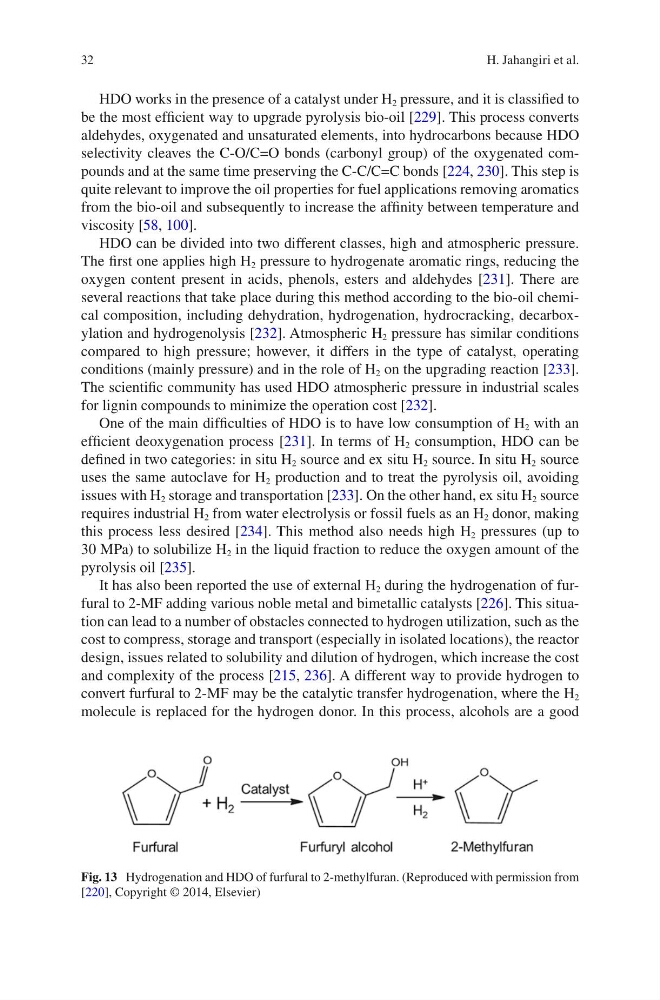
It has also been reported the use of external H 2 during the hydrogenation of furfural to 2-MF adding various noble metal and bimetallic catalysts [226]. This situation can lead to a number of obstacles connected to hydrogen utilization, such as the
cost to compress, storage and transport (especially in isolated locations), the reactor
design, issues related to solubility and dilution of hydrogen, which increase the cost
and complexity of the process [215, 236]. A different way to provide hydrogen to
convert furfural to 2-MF may be the catalytic transfer hydrogenation, where the H 2
molecule is replaced for the hydrogen donor. In this process, alcohols are a good
Fig. 13 Hydrogenation and HDO of furfural to 2-methylfuran. (Reproduced with permission from
[220], Copyright © 2014, Elsevier)
H. Jahangiri et al.
HDO works in the presence of a catalyst under H 2 pressure, and it is classified to
be the most efficient way to upgrade pyrolysis bio-oil [229]. This process converts
aldehydes, oxygenated and unsaturated elements, into hydrocarbons because HDO
selectivity cleaves the C-O/C=O bonds (carbonyl group) of the oxygenated compounds and at the same time preserving the C-C/C=C bonds [224, 230]. This step is
quite relevant to improve the oil properties for fuel applications removing aromatics
from the bio-oil and subsequently to increase the affinity between temperature and
viscosity [58, 100].
HDO can be divided into two different classes, high and atmospheric pressure.
The first one applies high H 2 pressure to hydrogenate aromatic rings, reducing the
oxygen content present in acids, phenols, esters and aldehydes [231]. There are
several reactions that take place during this method according to the bio-oil chemical composition, including dehydration, hydrogenation, hydrocracking, decarboxylation and hydrogenolysis [232]. Atmospheric H 2 pressure has similar conditions
compared to high pressure; however, it differs in the type of catalyst, operating
conditions (mainly pressure) and in the role of H 2 on the upgrading reaction [233].
The scientific community has used HDO atmospheric pressure in industrial scales
for lignin compounds to minimize the operation cost [232].
One of the main difficulties of HDO is to have low consumption of H 2 with an
efficient deoxygenation process [231]. In terms of H 2 consumption, HDO can be
defined in two categories: in situ H 2 source and ex situ H 2 source. In situ H 2 source
uses the same autoclave for H 2 production and to treat the pyrolysis oil, avoiding
issues with H 2 storage and transportation [233]. On the other hand, ex situ H 2 source
requires industrial H 2 from water electrolysis or fossil fuels as an H 2 donor, making
this process less desired [234]. This method also needs high H 2 pressures (up to
30 MPa) to solubilize H 2 in the liquid fraction to reduce the oxygen amount of the
pyrolysis oil [235].
It has also been reported the use of external H 2 during the hydrogenation of furfural to 2-MF adding various noble metal and bimetallic catalysts [226]. This situation can lead to a number of obstacles connected to hydrogen utilization, such as the
cost to compress, storage and transport (especially in isolated locations), the reactor
design, issues related to solubility and dilution of hydrogen, which increase the cost
and complexity of the process [215, 236]. A different way to provide hydrogen to
convert furfural to 2-MF may be the catalytic transfer hydrogenation, where the H 2
molecule is replaced for the hydrogen donor. In this process, alcohols are a good
Fig. 13 Hydrogenation and HDO of furfural to 2-methylfuran. (Reproduced with permission from
[220], Copyright © 2014, Elsevier)
H. Jahangiri et al.