

31
mineral acid [217]. For these reasons, enhancements to the chemical technology
behind the furfural production are necessary to improve the sustainability of furanbased chemical productions.
Irradiation of microwave is suggested as an alternative technique to improve the
dehydration process for furfural production. This process offers fast and efficient
heating which promotes better reaction rates and avoids the production of certain
by-products and so results in higher furfural yields [218, 219]. Heterogeneous catalytic conversion using solid catalysts has taken a relevant role in converting pentose
into furfural due to its high selectivity and high reaction. Moreover, it can be recycled easily, offering more environmentally attractive properties for practical operations [220].
Humins, solid carbonaceous species, are the undesired co-product obtained during the production of furfural from xylose. Humin is responsible for the low furfural
yields (between 45% and 50%) using an industrial batch process [221]. In the last
few years, some works have shown different ways to achieve better furfural yields
by inhibiting the humin production. One technique is to apply organic solvents
(methyl isobutyl ketone and ethyl acetate) to absorb furfural from the aqueous fraction [222]. Supercritical CO 2 has also been used to extract furfural [223]. However,
due to furfural’s affinity to polymerize in storage, it is not a suitable option as a fuel
candidate [224].
The option of transforming furfural to 2-MF is mentioned in several current
works because of its high calorific value and high octane number, making 2-MF a
promising biofuel [95, 225]. To produce 2-MF first, it is necessary to convert furfural to furfuryl alcohol (2-furanmethanol) through hydrogenation and then apply
HDO in the intermediate furfuryl alcohol to get the desired product 2-MF as shown
in Fig. 13 [226, 227].
Developing a new way to produce 2-MF from biomass-derived chemicals is
extremely desirable, not only from the perspective of the green sustainable chemistry but also to mitigate the fossil energy crisis by using a large number of biomass
resources available efficiently [226]. All these reasons can boost furfural production
through the TCR process, followed by an HDO treatment, to achieve the desired
formation of 2-MF. Compared to hydrocarbons, 2-MF has a better combustion efficiency (caused by its oxygen atom) and higher octane number [220]. Therefore,
2-MF can be mixed with gasoline to be applied as fuel for vehicles [228].
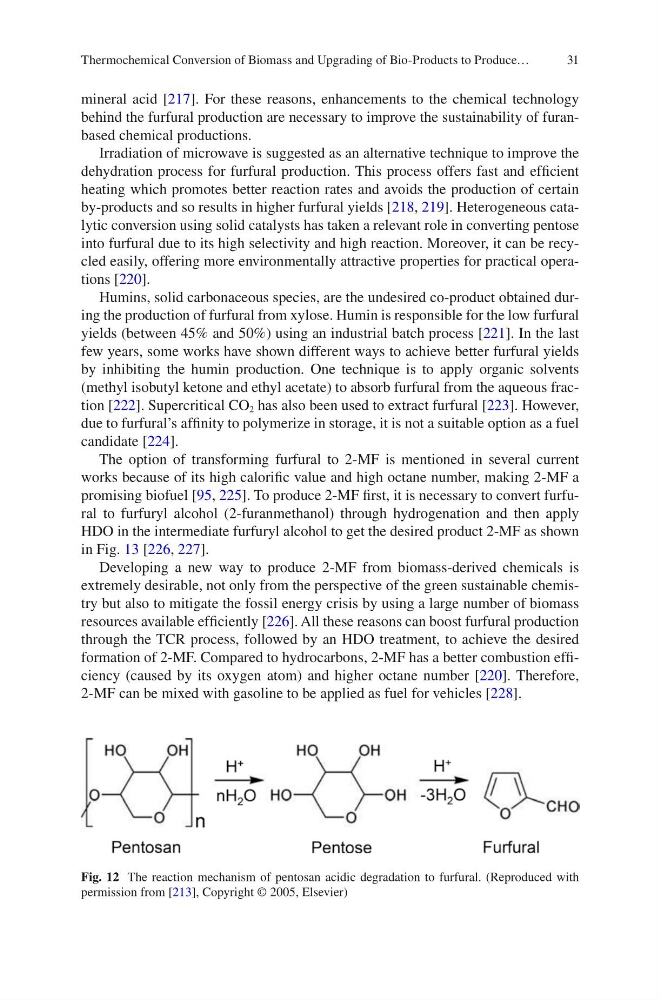
Fig. 12 The reaction mechanism of pentosan acidic degradation to furfural. (Reproduced with
permission from [213], Copyright © 2005, Elsevier)
Thermochemical Conversion of Biomass and Upgrading of Bio-Products to Produce…
mineral acid [217]. For these reasons, enhancements to the chemical technology
behind the furfural production are necessary to improve the sustainability of furanbased chemical productions.
Irradiation of microwave is suggested as an alternative technique to improve the
dehydration process for furfural production. This process offers fast and efficient
heating which promotes better reaction rates and avoids the production of certain
by-products and so results in higher furfural yields [218, 219]. Heterogeneous catalytic conversion using solid catalysts has taken a relevant role in converting pentose
into furfural due to its high selectivity and high reaction. Moreover, it can be recycled easily, offering more environmentally attractive properties for practical operations [220].
Humins, solid carbonaceous species, are the undesired co-product obtained during the production of furfural from xylose. Humin is responsible for the low furfural
yields (between 45% and 50%) using an industrial batch process [221]. In the last
few years, some works have shown different ways to achieve better furfural yields
by inhibiting the humin production. One technique is to apply organic solvents
(methyl isobutyl ketone and ethyl acetate) to absorb furfural from the aqueous fraction [222]. Supercritical CO 2 has also been used to extract furfural [223]. However,
due to furfural’s affinity to polymerize in storage, it is not a suitable option as a fuel
candidate [224].
The option of transforming furfural to 2-MF is mentioned in several current
works because of its high calorific value and high octane number, making 2-MF a
promising biofuel [95, 225]. To produce 2-MF first, it is necessary to convert furfural to furfuryl alcohol (2-furanmethanol) through hydrogenation and then apply
HDO in the intermediate furfuryl alcohol to get the desired product 2-MF as shown
in Fig. 13 [226, 227].
Developing a new way to produce 2-MF from biomass-derived chemicals is
extremely desirable, not only from the perspective of the green sustainable chemistry but also to mitigate the fossil energy crisis by using a large number of biomass
resources available efficiently [226]. All these reasons can boost furfural production
through the TCR process, followed by an HDO treatment, to achieve the desired
formation of 2-MF. Compared to hydrocarbons, 2-MF has a better combustion efficiency (caused by its oxygen atom) and higher octane number [220]. Therefore,
2-MF can be mixed with gasoline to be applied as fuel for vehicles [228].
Fig. 12 The reaction mechanism of pentosan acidic degradation to furfural. (Reproduced with
permission from [213], Copyright © 2005, Elsevier)
Thermochemical Conversion of Biomass and Upgrading of Bio-Products to Produce…