

408
substrate scope, poor product yields, and modest selectivity by giving a combination of mono- and bis-silylated products, this has constituted a novel opportunity in
palladium-catalyzed C–H silylation reaction of aliphatic carboxylates.
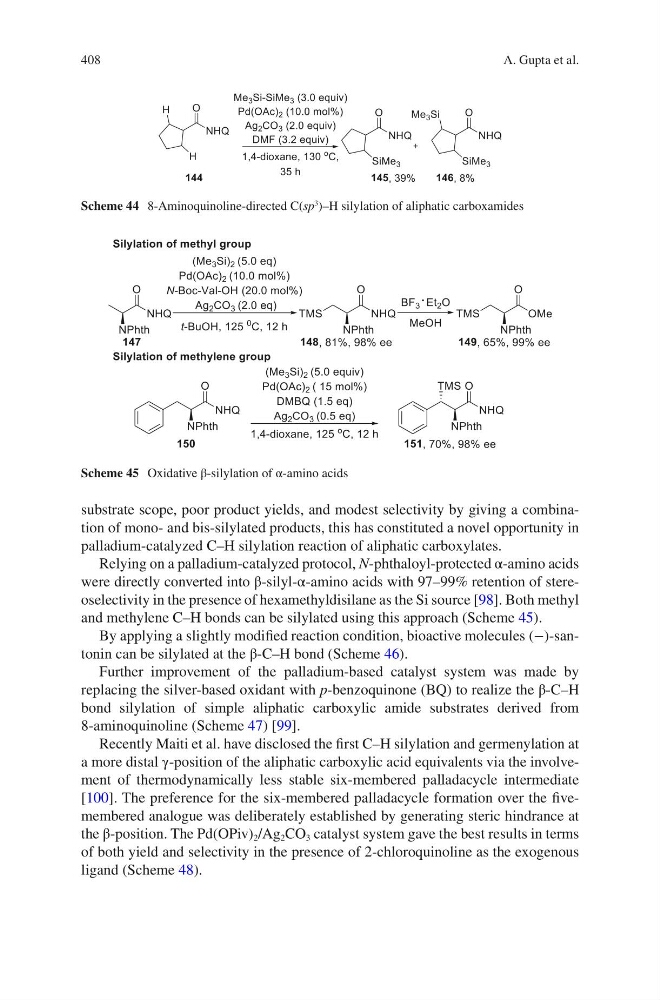
Relying on a palladium-catalyzed protocol, N-phthaloyl-protected α-amino acids
were directly converted into β-silyl-α-amino acids with 97–99% retention of stereoselectivity in the presence of hexamethyldisilane as the Si source [98]. Both methyl
and methylene C–H bonds can be silylated using this approach (Scheme 45).
By applying a slightly modified reaction condition, bioactive molecules (−)-santonin can be silylated at the β-C–H bond (Scheme 46).
Further improvement of the palladium-based catalyst system was made by
replacing the silver-based oxidant with p-benzoquinone (BQ) to realize the β-C–H
bond silylation of simple aliphatic carboxylic amide substrates derived from
8- aminoquinoline (Scheme 47) [99].
Recently Maiti et al. have disclosed the first C–H silylation and germenylation at
a more distal γ-position of the aliphatic carboxylic acid equivalents via the involvement of thermodynamically less stable six-membered palladacycle intermediate
[100]. The preference for the six-membered palladacycle formation over the fivemembered analogue was deliberately established by generating steric hindrance at
the β-position. The Pd(OPiv) 2 /Ag 2 CO 3 catalyst system gave the best results in terms
of both yield and selectivity in the presence of 2-chloroquinoline as the exogenous
ligand (Scheme 48).
Scheme 44 8-Aminoquinoline-directed C(sp
3
)–H silylation of aliphatic carboxamides
Scheme 45 Oxidative β-silylation of α-amino acids
A. Gupta et al.
substrate scope, poor product yields, and modest selectivity by giving a combination of mono- and bis-silylated products, this has constituted a novel opportunity in
palladium-catalyzed C–H silylation reaction of aliphatic carboxylates.
Relying on a palladium-catalyzed protocol, N-phthaloyl-protected α-amino acids
were directly converted into β-silyl-α-amino acids with 97–99% retention of stereoselectivity in the presence of hexamethyldisilane as the Si source [98]. Both methyl
and methylene C–H bonds can be silylated using this approach (Scheme 45).
By applying a slightly modified reaction condition, bioactive molecules (−)-santonin can be silylated at the β-C–H bond (Scheme 46).
Further improvement of the palladium-based catalyst system was made by
replacing the silver-based oxidant with p-benzoquinone (BQ) to realize the β-C–H
bond silylation of simple aliphatic carboxylic amide substrates derived from
8- aminoquinoline (Scheme 47) [99].
Recently Maiti et al. have disclosed the first C–H silylation and germenylation at
a more distal γ-position of the aliphatic carboxylic acid equivalents via the involvement of thermodynamically less stable six-membered palladacycle intermediate
[100]. The preference for the six-membered palladacycle formation over the fivemembered analogue was deliberately established by generating steric hindrance at
the β-position. The Pd(OPiv) 2 /Ag 2 CO 3 catalyst system gave the best results in terms
of both yield and selectivity in the presence of 2-chloroquinoline as the exogenous
ligand (Scheme 48).
Scheme 44 8-Aminoquinoline-directed C(sp
3
)–H silylation of aliphatic carboxamides
Scheme 45 Oxidative β-silylation of α-amino acids
A. Gupta et al.