

406
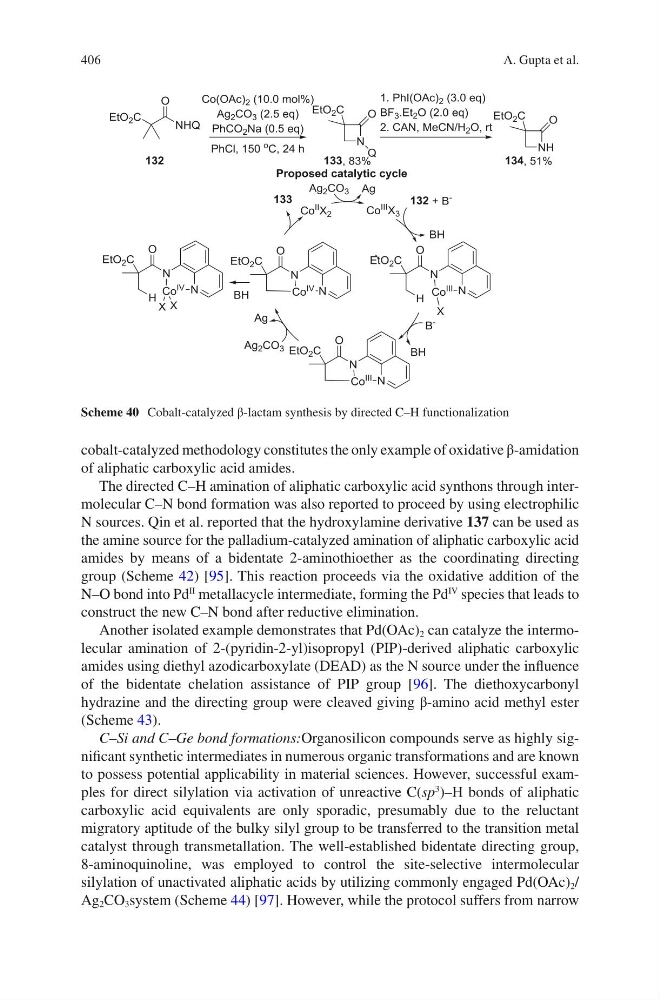
cobalt- catalyzed methodology constitutes the only example of oxidative β-amidation
of aliphatic carboxylic acid amides.
The directed C–H amination of aliphatic carboxylic acid synthons through intermolecular C–N bond formation was also reported to proceed by using electrophilic
N sources. Qin et al. reported that the hydroxylamine derivative 137 can be used as
the amine source for the palladium-catalyzed amination of aliphatic carboxylic acid
amides by means of a bidentate 2-aminothioether as the coordinating directing
group (Scheme 42) [95]. This reaction proceeds via the oxidative addition of the
N–O bond into Pd
II
metallacycle intermediate, forming the Pd
IV
species that leads to
construct the new C–N bond after reductive elimination.
Another isolated example demonstrates that Pd(OAc) 2 can catalyze the intermolecular amination of 2-(pyridin-2-yl)isopropyl (PIP)-derived aliphatic carboxylic
amides using diethyl azodicarboxylate (DEAD) as the N source under the influence
of the bidentate chelation assistance of PIP group [96]. The diethoxycarbonyl
hydrazine and the directing group were cleaved giving β-amino acid methyl ester
(Scheme 43).
C–Si and C–Ge bond formations:Organosilicon compounds serve as highly significant synthetic intermediates in numerous organic transformations and are known
to possess potential applicability in material sciences. However, successful examples for direct silylation via activation of unreactive C(sp
3
)–H bonds of aliphatic
carboxylic acid equivalents are only sporadic, presumably due to the reluctant
migratory aptitude of the bulky silyl group to be transferred to the transition metal
catalyst through transmetallation. The well-established bidentate directing group,
8-aminoquinoline, was employed to control the site-selective intermolecular
silylation of unactivated aliphatic acids by utilizing commonly engaged Pd(OAc) 2 /
Ag 2 CO 3 system (Scheme 44) [97]. However, while the protocol suffers from narrow
Scheme 40 Cobalt-catalyzed β-lactam synthesis by directed C–H functionalization
A. Gupta et al.
cobalt- catalyzed methodology constitutes the only example of oxidative β-amidation
of aliphatic carboxylic acid amides.
The directed C–H amination of aliphatic carboxylic acid synthons through intermolecular C–N bond formation was also reported to proceed by using electrophilic
N sources. Qin et al. reported that the hydroxylamine derivative 137 can be used as
the amine source for the palladium-catalyzed amination of aliphatic carboxylic acid
amides by means of a bidentate 2-aminothioether as the coordinating directing
group (Scheme 42) [95]. This reaction proceeds via the oxidative addition of the
N–O bond into Pd
II
metallacycle intermediate, forming the Pd
IV
species that leads to
construct the new C–N bond after reductive elimination.
Another isolated example demonstrates that Pd(OAc) 2 can catalyze the intermolecular amination of 2-(pyridin-2-yl)isopropyl (PIP)-derived aliphatic carboxylic
amides using diethyl azodicarboxylate (DEAD) as the N source under the influence
of the bidentate chelation assistance of PIP group [96]. The diethoxycarbonyl
hydrazine and the directing group were cleaved giving β-amino acid methyl ester
(Scheme 43).
C–Si and C–Ge bond formations:Organosilicon compounds serve as highly significant synthetic intermediates in numerous organic transformations and are known
to possess potential applicability in material sciences. However, successful examples for direct silylation via activation of unreactive C(sp
3
)–H bonds of aliphatic
carboxylic acid equivalents are only sporadic, presumably due to the reluctant
migratory aptitude of the bulky silyl group to be transferred to the transition metal
catalyst through transmetallation. The well-established bidentate directing group,
8-aminoquinoline, was employed to control the site-selective intermolecular
silylation of unactivated aliphatic acids by utilizing commonly engaged Pd(OAc) 2 /
Ag 2 CO 3 system (Scheme 44) [97]. However, while the protocol suffers from narrow
Scheme 40 Cobalt-catalyzed β-lactam synthesis by directed C–H functionalization
A. Gupta et al.