

367
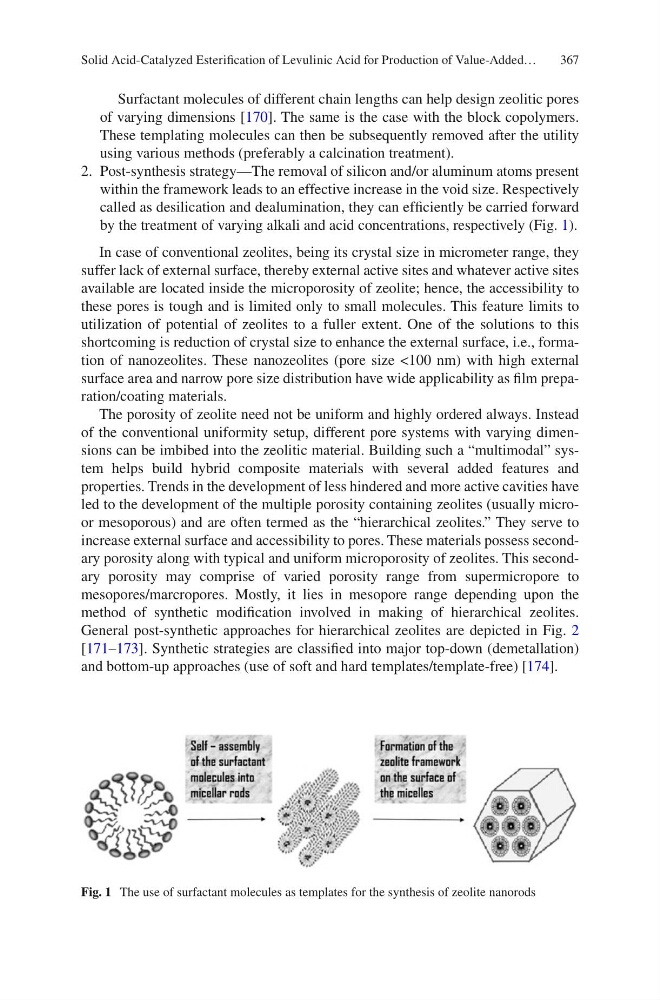
Surfactant molecules of different chain lengths can help design zeolitic pores
of varying dimensions [170]. The same is the case with the block copolymers.
These templating molecules can then be subsequently removed after the utility
using various methods (preferably a calcination treatment).
2. Post-synthesis strategy—The removal of silicon and/or aluminum atoms present
within the framework leads to an effective increase in the void size. Respectively
called as desilication and dealumination, they can efficiently be carried forward
by the treatment of varying alkali and acid concentrations, respectively (Fig. 1).
In case of conventional zeolites, being its crystal size in micrometer range, they
suffer lack of external surface, thereby external active sites and whatever active sites
available are located inside the microporosity of zeolite; hence, the accessibility to
these pores is tough and is limited only to small molecules. This feature limits to
utilization of potential of zeolites to a fuller extent. One of the solutions to this
shortcoming is reduction of crystal size to enhance the external surface, i.e., formation of nanozeolites. These nanozeolites (pore size <100 nm) with high external
surface area and narrow pore size distribution have wide applicability as film preparation/coating materials.
The porosity of zeolite need not be uniform and highly ordered always. Instead
of the conventional uniformity setup, different pore systems with varying dimensions can be imbibed into the zeolitic material. Building such a “multimodal” system helps build hybrid composite materials with several added features and
properties. Trends in the development of less hindered and more active cavities have
led to the development of the multiple porosity containing zeolites (usually microor mesoporous) and are often termed as the “hierarchical zeolites.” They serve to
increase external surface and accessibility to pores. These materials possess secondary porosity along with typical and uniform microporosity of zeolites. This secondary porosity may comprise of varied porosity range from supermicropore to
mesopores/marcropores. Mostly, it lies in mesopore range depending upon the
method of synthetic modification involved in making of hierarchical zeolites.
General post-synthetic approaches for hierarchical zeolites are depicted in Fig. 2
[171–173]. Synthetic strategies are classified into major top-down (demetallation)
and bottom-up approaches (use of soft and hard templates/template-free) [174].
Fig. 1 The use of surfactant molecules as templates for the synthesis of zeolite nanorods
Solid Acid-Catalyzed Esterification of Levulinic Acid for Production of Value-Added…
Surfactant molecules of different chain lengths can help design zeolitic pores
of varying dimensions [170]. The same is the case with the block copolymers.
These templating molecules can then be subsequently removed after the utility
using various methods (preferably a calcination treatment).
2. Post-synthesis strategy—The removal of silicon and/or aluminum atoms present
within the framework leads to an effective increase in the void size. Respectively
called as desilication and dealumination, they can efficiently be carried forward
by the treatment of varying alkali and acid concentrations, respectively (Fig. 1).
In case of conventional zeolites, being its crystal size in micrometer range, they
suffer lack of external surface, thereby external active sites and whatever active sites
available are located inside the microporosity of zeolite; hence, the accessibility to
these pores is tough and is limited only to small molecules. This feature limits to
utilization of potential of zeolites to a fuller extent. One of the solutions to this
shortcoming is reduction of crystal size to enhance the external surface, i.e., formation of nanozeolites. These nanozeolites (pore size <100 nm) with high external
surface area and narrow pore size distribution have wide applicability as film preparation/coating materials.
The porosity of zeolite need not be uniform and highly ordered always. Instead
of the conventional uniformity setup, different pore systems with varying dimensions can be imbibed into the zeolitic material. Building such a “multimodal” system helps build hybrid composite materials with several added features and
properties. Trends in the development of less hindered and more active cavities have
led to the development of the multiple porosity containing zeolites (usually microor mesoporous) and are often termed as the “hierarchical zeolites.” They serve to
increase external surface and accessibility to pores. These materials possess secondary porosity along with typical and uniform microporosity of zeolites. This secondary porosity may comprise of varied porosity range from supermicropore to
mesopores/marcropores. Mostly, it lies in mesopore range depending upon the
method of synthetic modification involved in making of hierarchical zeolites.
General post-synthetic approaches for hierarchical zeolites are depicted in Fig. 2
[171–173]. Synthetic strategies are classified into major top-down (demetallation)
and bottom-up approaches (use of soft and hard templates/template-free) [174].
Fig. 1 The use of surfactant molecules as templates for the synthesis of zeolite nanorods
Solid Acid-Catalyzed Esterification of Levulinic Acid for Production of Value-Added…