

355
3.6 Levulinic Acid-Derived Levulinic Esters: Properties
and Applications
Levulinic esters, like methyl levulinates, ethyl levulinates, and n-butyl levulinates,
can be efficiently produced from the esterification reaction of levulinic acid with
various alcohols. Levulinic esters are the most promising and versatile compounds
which are regarded as the alternate energy source and a promising replacement of
fossil fuels. Various organic transformations (condensation, addition, etc.) are realized in synthetic pathways of biochemicals, due to the presence of keto ester groups
of levulinic esters, creating possibility for them to be used as significant platform
chemicals in the list of futuristic biorefinery. They can be used as an important intermediate in flavoring and fragrance industries, plasticizer, solvent biofuel additives,
etc. In recent times, the utilization of the long alkyl-chain levulinate as the green
solvent is explored widely, due to its low cytotoxicity and mutagenicity properties
[54]. Levulinates possess remarkable fuel blending properties like low toxicity,
stable flash point, higher lubricant property, and moderate flow properties, and
because of these properties, they can be efficiently utilized as additives for diesel
and gasoline [55]. Grove and co-workers have studied the properties of the diesel
blends with various levulinates and other esters as well [56].The study carried out
by Lake and Burton for the blend of ultralow sulfur diesel, biodiesel, and ethyl levulinate in a turbocharged engine (3.1 L) indicates possibilities of utilization of ethyl
levulinate as the fuel blend. The study shows that the particulate matter and oxides
of nitrogen emission were reduced in the EL blend (80% ULSD +13.33% biodiesel
+6.47% ethyl levulinate) as compared to the 20% biodiesel blend [57]. Similar
kinds of studies have been carried out by Janssen and coworkers; they have investigated the combustion study of the higher blend ratio of BL (60–80%) with ntetradecane, in the single-cylinder diesel engine [58]. They observed soot-free
O
O
OH
Levulinic acid
+
R 1
NH 2
-H 2 O
Condensation
O
N
R 1
OH
OH
O
NH
R 1
H 2
Intramolecular
amidation
N
0
R 1
Pyrrolidinones
Gamma-amino-pentanoic acid
Hydrogenation
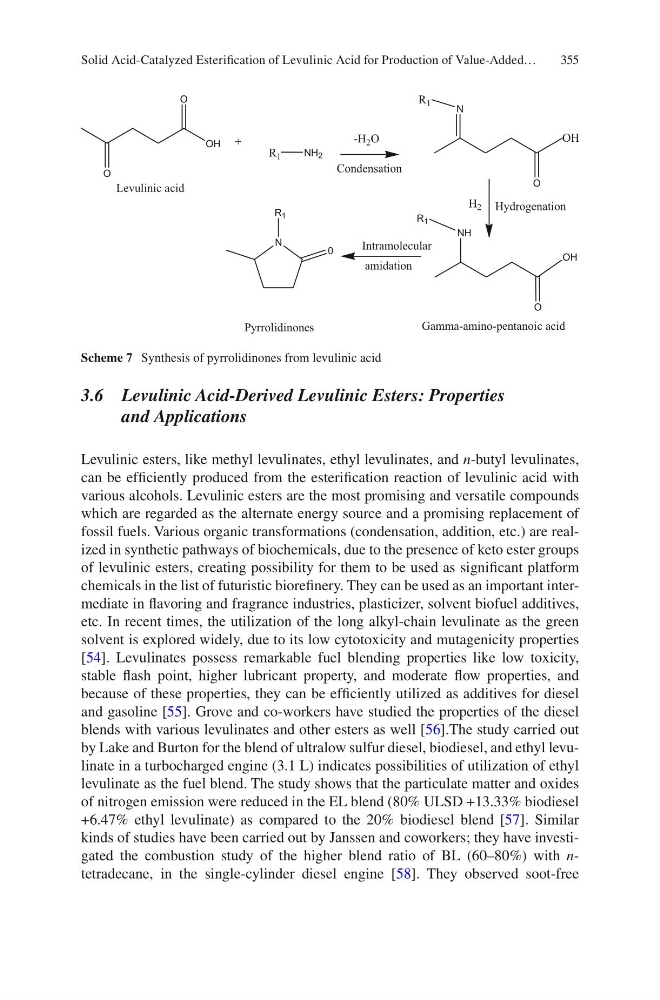
Scheme 7 Synthesis of pyrrolidinones from levulinic acid
Solid Acid-Catalyzed Esterification of Levulinic Acid for Production of Value-Added…
3.6 Levulinic Acid-Derived Levulinic Esters: Properties
and Applications
Levulinic esters, like methyl levulinates, ethyl levulinates, and n-butyl levulinates,
can be efficiently produced from the esterification reaction of levulinic acid with
various alcohols. Levulinic esters are the most promising and versatile compounds
which are regarded as the alternate energy source and a promising replacement of
fossil fuels. Various organic transformations (condensation, addition, etc.) are realized in synthetic pathways of biochemicals, due to the presence of keto ester groups
of levulinic esters, creating possibility for them to be used as significant platform
chemicals in the list of futuristic biorefinery. They can be used as an important intermediate in flavoring and fragrance industries, plasticizer, solvent biofuel additives,
etc. In recent times, the utilization of the long alkyl-chain levulinate as the green
solvent is explored widely, due to its low cytotoxicity and mutagenicity properties
[54]. Levulinates possess remarkable fuel blending properties like low toxicity,
stable flash point, higher lubricant property, and moderate flow properties, and
because of these properties, they can be efficiently utilized as additives for diesel
and gasoline [55]. Grove and co-workers have studied the properties of the diesel
blends with various levulinates and other esters as well [56].The study carried out
by Lake and Burton for the blend of ultralow sulfur diesel, biodiesel, and ethyl levulinate in a turbocharged engine (3.1 L) indicates possibilities of utilization of ethyl
levulinate as the fuel blend. The study shows that the particulate matter and oxides
of nitrogen emission were reduced in the EL blend (80% ULSD +13.33% biodiesel
+6.47% ethyl levulinate) as compared to the 20% biodiesel blend [57]. Similar
kinds of studies have been carried out by Janssen and coworkers; they have investigated the combustion study of the higher blend ratio of BL (60–80%) with ntetradecane, in the single-cylinder diesel engine [58]. They observed soot-free
O
O
OH
Levulinic acid
+
R 1
NH 2
-H 2 O
Condensation
O
N
R 1
OH
OH
O
NH
R 1
H 2
Intramolecular
amidation
N
0
R 1
Pyrrolidinones
Gamma-amino-pentanoic acid
Hydrogenation
Scheme 7 Synthesis of pyrrolidinones from levulinic acid
Solid Acid-Catalyzed Esterification of Levulinic Acid for Production of Value-Added…