

330
3.2.2 Selective Oxidation of 5-Hydroxymethylfurfural
to 2,5-Furandicarboxylic Acid
Several furanic derivatives can be obtained via catalytic oxidation of HMF, including 2,5-diformylfuran (DFF), 5-formyl-2-furancarboxylic acid (FFCA), 5- hydroxy
methyl- 2-furancarboxylic acid (HFCA) and 2,5-furandicarboxylic acid (FDCA).
Among these multiple oxidation products, an efficient and selective preparation of
FDCA is a challenging task. The reaction scheme of HMF to FDCA is mentioned in
Scheme 19.
Selective oxidation of HMF to FDCA is advantageous because it is a one-pot
synthesis. Conversion of HMF to FDCA was demonstrated using several homogeneous catalysts such as KMnO 4 , HNO 3 , Co(OAc) 2 , Mn(OAc) 2 , Zn(OAc) 2 ,
CuCl 2 , etc. [145]. Working with homogeneous catalyst has some drawbacks
like reduced FDCA yield, side products, cumbersome separation and purification of product from reaction mixture, use of additives and reusability of the
catalyst.
Oxidation of HMF to FDCA was demonstrated extensively using various heterogeneous catalysts with molecular oxygen (O 2 ), air, H 2 O 2, t-BuOOH and
KMnO 4 as oxidants, but researchers mostly prefer molecular oxygen due to its
high oxidation potential, low cost and environmentally benign nature. Non-noble
mono-metal or its mixed metal oxide heterogeneous catalysts from Mn, Co, Fe,
Ce, Cu and Li are reported for this oxidation reaction with base or under basefree conditions (Table 10, entry 1-15). Among the non-noble metal-containing
catalysts, Fe, Mn and Ce metal oxides were exclusively reported for this conversion in organic, aqueous and ionic liquid medium with moderate to good yields
of FDCA. For further improvement in FDCA selectivity, researchers developed
many noble metal (Au, Rh, Pt, Pd and Ru) catalytic systems under base or basefree aqueous medium using O 2 /air oxidant (Table 10, entry 16-19 and Table 11).
Even though good yields were achieved using Rh and Pt, these expensive materials increased the cost of the end product. Au, Pd and a combination of these metals as catalysts showed high activity using base additive at mild reaction
conditions and short time as compared with base-free reaction set-ups. Moreover,
according to the recent analysis, the Pd metal price raised by 400%, and this precious metal is now $1351.40 for 25 g, and hence more expensive than platinum
($792.30).
Recently, Ru-based catalysts are becoming attractive towards this oxidation, as
there are several advantages behind it: stability in aqueous medium, high selectivity
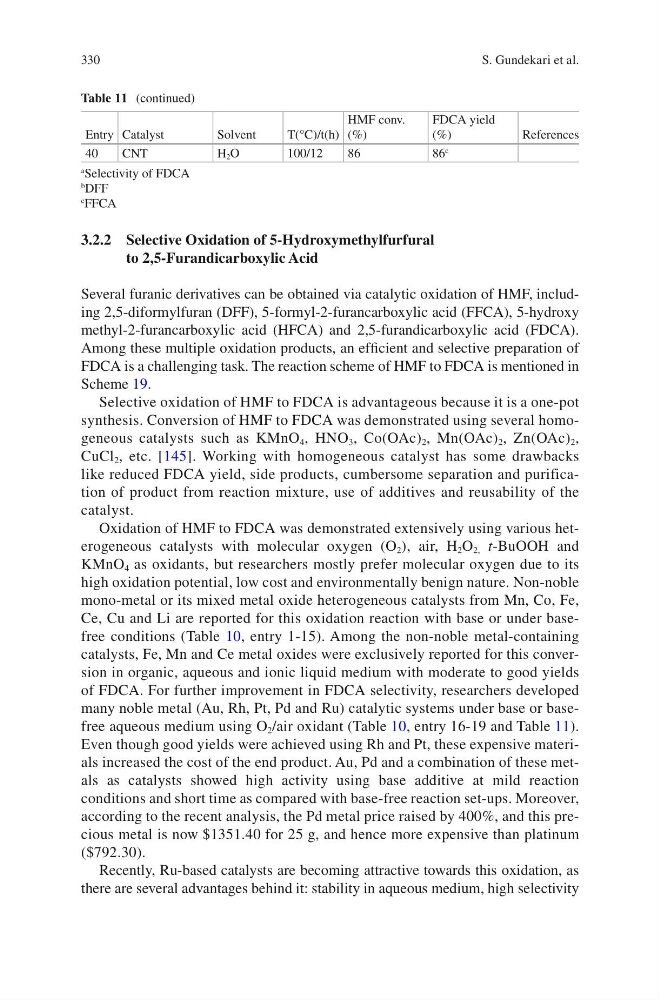
Table 11 (continued)
Entry Catalyst
Solvent
T(°C)/t(h)
HMF conv.
(%)
FDCA yield
(%)
References
40
CNT
H 2 O
100/12
86
86
c
a
Selectivity of FDCA
b
DFF
c
FFCA
S. Gundekari et al.
3.2.2 Selective Oxidation of 5-Hydroxymethylfurfural
to 2,5-Furandicarboxylic Acid
Several furanic derivatives can be obtained via catalytic oxidation of HMF, including 2,5-diformylfuran (DFF), 5-formyl-2-furancarboxylic acid (FFCA), 5- hydroxy
methyl- 2-furancarboxylic acid (HFCA) and 2,5-furandicarboxylic acid (FDCA).
Among these multiple oxidation products, an efficient and selective preparation of
FDCA is a challenging task. The reaction scheme of HMF to FDCA is mentioned in
Scheme 19.
Selective oxidation of HMF to FDCA is advantageous because it is a one-pot
synthesis. Conversion of HMF to FDCA was demonstrated using several homogeneous catalysts such as KMnO 4 , HNO 3 , Co(OAc) 2 , Mn(OAc) 2 , Zn(OAc) 2 ,
CuCl 2 , etc. [145]. Working with homogeneous catalyst has some drawbacks
like reduced FDCA yield, side products, cumbersome separation and purification of product from reaction mixture, use of additives and reusability of the
catalyst.
Oxidation of HMF to FDCA was demonstrated extensively using various heterogeneous catalysts with molecular oxygen (O 2 ), air, H 2 O 2, t-BuOOH and
KMnO 4 as oxidants, but researchers mostly prefer molecular oxygen due to its
high oxidation potential, low cost and environmentally benign nature. Non-noble
mono-metal or its mixed metal oxide heterogeneous catalysts from Mn, Co, Fe,
Ce, Cu and Li are reported for this oxidation reaction with base or under basefree conditions (Table 10, entry 1-15). Among the non-noble metal-containing
catalysts, Fe, Mn and Ce metal oxides were exclusively reported for this conversion in organic, aqueous and ionic liquid medium with moderate to good yields
of FDCA. For further improvement in FDCA selectivity, researchers developed
many noble metal (Au, Rh, Pt, Pd and Ru) catalytic systems under base or basefree aqueous medium using O 2 /air oxidant (Table 10, entry 16-19 and Table 11).
Even though good yields were achieved using Rh and Pt, these expensive materials increased the cost of the end product. Au, Pd and a combination of these metals as catalysts showed high activity using base additive at mild reaction
conditions and short time as compared with base-free reaction set-ups. Moreover,
according to the recent analysis, the Pd metal price raised by 400%, and this precious metal is now $1351.40 for 25 g, and hence more expensive than platinum
($792.30).
Recently, Ru-based catalysts are becoming attractive towards this oxidation, as
there are several advantages behind it: stability in aqueous medium, high selectivity
Table 11 (continued)
Entry Catalyst
Solvent
T(°C)/t(h)
HMF conv.
(%)
FDCA yield
(%)
References
40
CNT
H 2 O
100/12
86
86
c
a
Selectivity of FDCA
b
DFF
c
FFCA
S. Gundekari et al.