

312
The product from HAA reaction, i.e. 4,4-bis(5-methylfuran-2-yl)pentanoic acid,
is converted into 4,4-bis(5-methyl-tetrahydrofuran-2-yl)pentan-1-ol intermediate
by hydrogenation over 5% Pd/C catalyst. The substituted pentanol is converted into
liquid alkanes ((C 9 –C 15 diesel range alkanes (81–82%), C 5 –C 8 gasoline range
alkenes (10–11%) and C 1 –C 4 alkanes (1–2%)) through hydrodeoxygenation using
again 5% Pd/C catalyst under continuous flow (Scheme 12) [92].
Preparation of (4,4-Bis(5-Methylthiophen-2-yl)pentanoic Acid
Our group reported the preparation of (4,4-bis(5-methylthiophen-2-yl)pentanoic
acid denoted as bisthiophenic acid-methyl (BTA-M)) from levulinic acid with
2-methylthiophene for the first time using solid acid catalysts (Scheme 13). Among
the catalysts used such as zeolites, clay and resins, the resin catalysts (Indion-190
and Amberlyst-15) were more active. Indion-190, an inexpensive resin catalyst,
showed 98% selectivity and 99% conversion (based on LA) of BTA-M under optimized solvent-free reaction conditions, i.e. levulinic acid to 2-methylthiophene
molar ratio is 2.5, 30 wt% of Indion-190 catalyst w.r.t LA, 110 °C for 6 h. The
recyclability of Indion-190 for the preparation of BTA-M was demonstrated for
three reaction cycles with a slight decrease in the conversion of reactants.
Preparation of alkyl 4,4-bis(5-methylthiophen-2-yl)pentanoate (bisthiophenic
alkyl esters-methyl (BTAE-M)) from levulinic esters (methyl, ethyl and butyl) with
2-methylthiophene using Indion-190 catalyst was also attempted (Scheme 13). In
the presence of methyl and ethyl levulinates, high conversion (99 and 94%) and
good selectivities of related products methyl 4,4-bis(5-methylthiophen-2-yl)pentanoate (96%) and ethyl 4,4-bis(5-methylthiophen-2-yl)pentanoate (95%) were
observed. Under similar conditions, butyl levulinate showed less conversion (13%)
with poor selectivity of butyl 4,4-bis(5-methylthiophen-2-yl)pentanoate (38%).
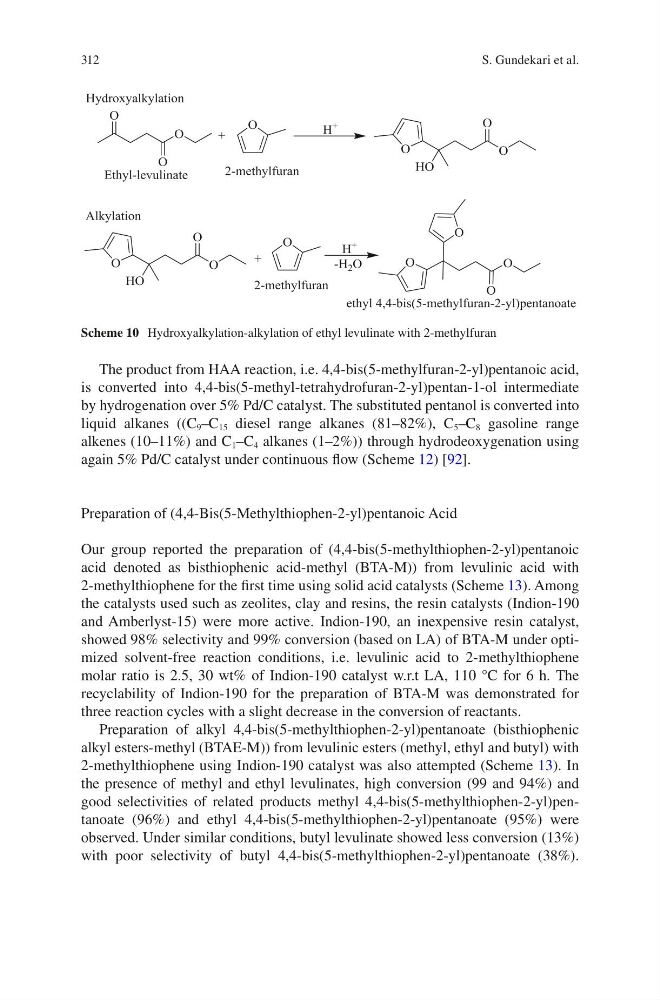
Scheme 10 Hydroxyalkylation-alkylation of ethyl levulinate with 2-methylfuran
S. Gundekari et al.
The product from HAA reaction, i.e. 4,4-bis(5-methylfuran-2-yl)pentanoic acid,
is converted into 4,4-bis(5-methyl-tetrahydrofuran-2-yl)pentan-1-ol intermediate
by hydrogenation over 5% Pd/C catalyst. The substituted pentanol is converted into
liquid alkanes ((C 9 –C 15 diesel range alkanes (81–82%), C 5 –C 8 gasoline range
alkenes (10–11%) and C 1 –C 4 alkanes (1–2%)) through hydrodeoxygenation using
again 5% Pd/C catalyst under continuous flow (Scheme 12) [92].
Preparation of (4,4-Bis(5-Methylthiophen-2-yl)pentanoic Acid
Our group reported the preparation of (4,4-bis(5-methylthiophen-2-yl)pentanoic
acid denoted as bisthiophenic acid-methyl (BTA-M)) from levulinic acid with
2-methylthiophene for the first time using solid acid catalysts (Scheme 13). Among
the catalysts used such as zeolites, clay and resins, the resin catalysts (Indion-190
and Amberlyst-15) were more active. Indion-190, an inexpensive resin catalyst,
showed 98% selectivity and 99% conversion (based on LA) of BTA-M under optimized solvent-free reaction conditions, i.e. levulinic acid to 2-methylthiophene
molar ratio is 2.5, 30 wt% of Indion-190 catalyst w.r.t LA, 110 °C for 6 h. The
recyclability of Indion-190 for the preparation of BTA-M was demonstrated for
three reaction cycles with a slight decrease in the conversion of reactants.
Preparation of alkyl 4,4-bis(5-methylthiophen-2-yl)pentanoate (bisthiophenic
alkyl esters-methyl (BTAE-M)) from levulinic esters (methyl, ethyl and butyl) with
2-methylthiophene using Indion-190 catalyst was also attempted (Scheme 13). In
the presence of methyl and ethyl levulinates, high conversion (99 and 94%) and
good selectivities of related products methyl 4,4-bis(5-methylthiophen-2-yl)pentanoate (96%) and ethyl 4,4-bis(5-methylthiophen-2-yl)pentanoate (95%) were
observed. Under similar conditions, butyl levulinate showed less conversion (13%)
with poor selectivity of butyl 4,4-bis(5-methylthiophen-2-yl)pentanoate (38%).
Scheme 10 Hydroxyalkylation-alkylation of ethyl levulinate with 2-methylfuran
S. Gundekari et al.