

18
incondensable vapours and short-chain compounds due to the linkage disintegration
between the monomers and polymer [119]. Charring reactions cause the condensation of benzene rings during the pyrolytic process, stimulating the production of
char [120].
The components obtained during primary reactions are not chemically stable,
and for that reason, they suffer recombination and cracking reactions (secondary
reactions). During recombination reactions, heavier elements are produced or
placed on biochar surface, while lighter elements are formed by the cracking of
primary compounds [121]. Additionally, the biochar formed can also promote secondary reactions. Morf et al. [119] showed that the secondary reactions are the
dominant reactions, affecting the properties and the quality of the pyrolysis products.
Under 500 °C, the main reactions occurring in pyrolysis are mostly decarbonylation, depolymerization, dehydration and decarboxylation [122]. The biomass
structure is not significantly changed until 200 °C [102]. The production of C 2
hydrocarbons and CH 4 is attributed to the rupture of the alkyl components in the
C-H bonds [89]. Between 250 and 500 °C, the decomposition of hemicellulose
(220–350 °C) and cellulose (315–400 °C) occurs, where the depolymerization
activity is quite intense, achieving the best bio-oil yield from 400 to 500 °C [111].
The main reactions are dehydrogenation, fragmentation and aromatization when the
temperature is above 500 °C [77]. Above 550 °C, more gas is formed due to the
fragmentation process, and close to 600 °C, there are more aromatic rings in the
biochar, demonstrating the existence of aromatization reactions [111]. The most
stable compound is lignin, but it is the hardest biomass element to be degraded. Its
chemical decomposition occurs from 160 to 900 °C; however, the most relevant
weight loss is between 350 and 600 °C [123].
Lignin contributes to a larger formation of biochar, while a higher percentage of
cellulose and hemicellulose in the biomass produces more bio-oil [124]. Biomass
rich in lignin has a negative impact on bio-oil quality, causing high viscosity, low
stability, high average molecular weight and worse combustion performance [125].
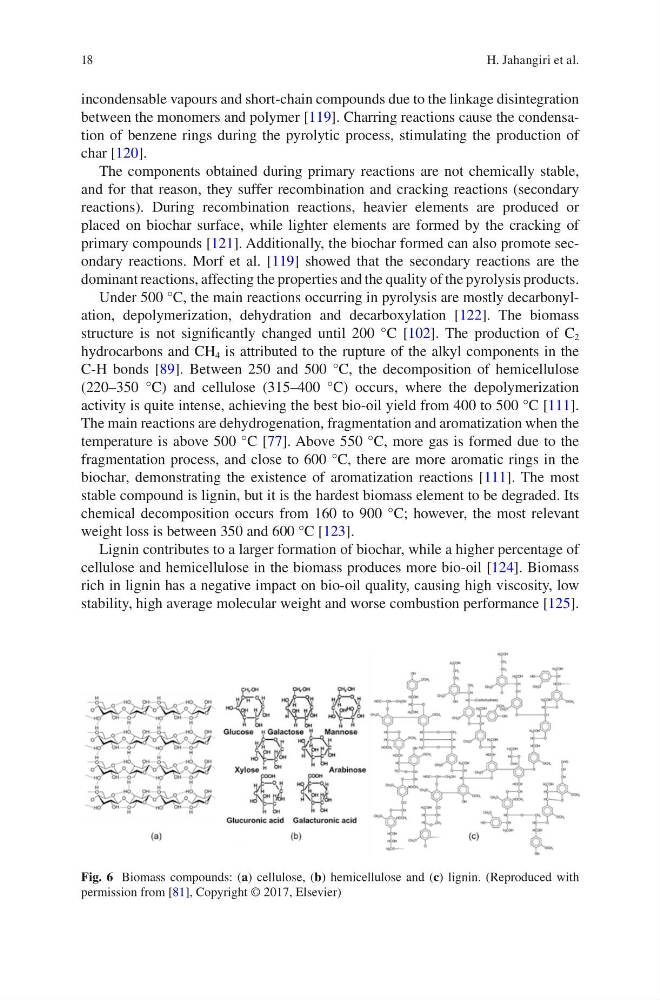
Fig. 6 Biomass compounds: (a) cellulose, (b) hemicellulose and (c) lignin. (Reproduced with
permission from [81], Copyright © 2017, Elsevier)
H. Jahangiri et al.
incondensable vapours and short-chain compounds due to the linkage disintegration
between the monomers and polymer [119]. Charring reactions cause the condensation of benzene rings during the pyrolytic process, stimulating the production of
char [120].
The components obtained during primary reactions are not chemically stable,
and for that reason, they suffer recombination and cracking reactions (secondary
reactions). During recombination reactions, heavier elements are produced or
placed on biochar surface, while lighter elements are formed by the cracking of
primary compounds [121]. Additionally, the biochar formed can also promote secondary reactions. Morf et al. [119] showed that the secondary reactions are the
dominant reactions, affecting the properties and the quality of the pyrolysis products.
Under 500 °C, the main reactions occurring in pyrolysis are mostly decarbonylation, depolymerization, dehydration and decarboxylation [122]. The biomass
structure is not significantly changed until 200 °C [102]. The production of C 2
hydrocarbons and CH 4 is attributed to the rupture of the alkyl components in the
C-H bonds [89]. Between 250 and 500 °C, the decomposition of hemicellulose
(220–350 °C) and cellulose (315–400 °C) occurs, where the depolymerization
activity is quite intense, achieving the best bio-oil yield from 400 to 500 °C [111].
The main reactions are dehydrogenation, fragmentation and aromatization when the
temperature is above 500 °C [77]. Above 550 °C, more gas is formed due to the
fragmentation process, and close to 600 °C, there are more aromatic rings in the
biochar, demonstrating the existence of aromatization reactions [111]. The most
stable compound is lignin, but it is the hardest biomass element to be degraded. Its
chemical decomposition occurs from 160 to 900 °C; however, the most relevant
weight loss is between 350 and 600 °C [123].
Lignin contributes to a larger formation of biochar, while a higher percentage of
cellulose and hemicellulose in the biomass produces more bio-oil [124]. Biomass
rich in lignin has a negative impact on bio-oil quality, causing high viscosity, low
stability, high average molecular weight and worse combustion performance [125].
Fig. 6 Biomass compounds: (a) cellulose, (b) hemicellulose and (c) lignin. (Reproduced with
permission from [81], Copyright © 2017, Elsevier)
H. Jahangiri et al.