

221
6.5 Epoxidation
Epoxidation reactions in which peracid is used either pre-formed or produced during the reaction as acetic acid is used as a carrier of oxygen with hydrogen peroxide
as a donor of oxygen. Castor oil fatty acids or their alkyl esters are reacted with
peracids when catalysts to produce epoxides. Castor oil can be epoxidized with
hydrogen peroxide at both 30% and 70%. The reactions to be subjected to 30%
hydrogen peroxide with 60 °C are added during a 4 h period when the mixture of
castor and methyltri-n-octylammonium(MTTP) is undergoing a reaction. The reaction mixture is mixed vigorously for another 4 h before cooling to room temperature
and addition of toluene for extraction and separating of organic layer and dried by
anhydrous sodium sulfate. Epoxidized castor oil (ECO) was recovered in 94% yield
after the elimination of the solvent on a rotary evaporator. In addition, powdered
calcium carbonate was added and agitated in the alternate process by which castor
oil and MTTP combine the mixture thoroughly at 60 °C. Using a syringe pump,
70% Hydrogen peroxide was introduced dropwise by stirring over 2 h. The mixture
has been kept at 60 °C for 9 h under intense agitation conditions before cooling to
room temperature. In 70% hydrogen peroxide chloroform is used for the extraction
and drying remaining product dried over sodium sulfate. 90% yield of ECO was
obtained when the solvent was drained from a rotary evaporator [1, 43, 65]. Acid
catalysts, enzymes, tungsten-based catalysts, transition metal complexes, ion
exchange resin, Ti (IV)-grafted silica catalyst [66] and methyl-tri-n-octyl ammonium diperoxotungstophosphate [67] are various forms of catalysts for epoxidation
reactions.
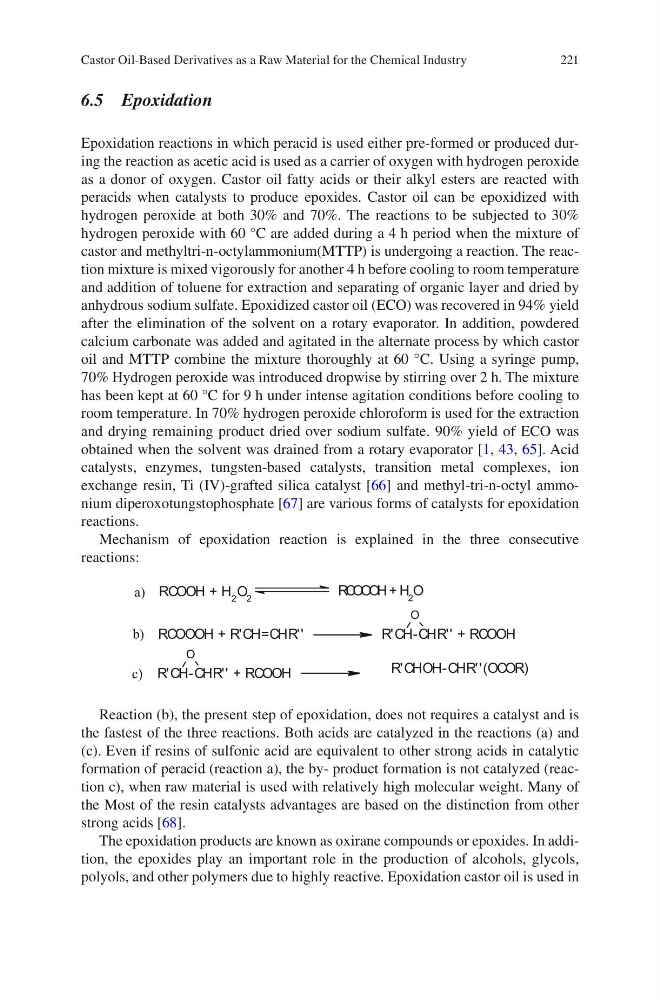
Mechanism of epoxidation reaction is explained in the three consecutive
reactions:
RCOOH + H 2 O 2
RCOOOH + H 2 O
RCOOOH + R'CH=CHR''
R'CH-CHR'' + RCOOH
O
R'CH-CHR'' + RCOOH
O
R'CHOH-CHR''(OCOR)
a)
b)
c)
Reaction (b), the present step of epoxidation, does not requires a catalyst and is
the fastest of the three reactions. Both acids are catalyzed in the reactions (a) and
(c). Even if resins of sulfonic acid are equivalent to other strong acids in catalytic
formation of peracid (reaction a), the by- product formation is not catalyzed (reaction c), when raw material is used with relatively high molecular weight. Many of
the Most of the resin catalysts advantages are based on the distinction from other
strong acids [68].
The epoxidation products are known as oxirane compounds or epoxides. In addition, the epoxides play an important role in the production of alcohols, glycols,
polyols, and other polymers due to highly reactive. Epoxidation castor oil is used in
Castor Oil-Based Derivatives as a Raw Material for the Chemical Industry
6.5 Epoxidation
Epoxidation reactions in which peracid is used either pre-formed or produced during the reaction as acetic acid is used as a carrier of oxygen with hydrogen peroxide
as a donor of oxygen. Castor oil fatty acids or their alkyl esters are reacted with
peracids when catalysts to produce epoxides. Castor oil can be epoxidized with
hydrogen peroxide at both 30% and 70%. The reactions to be subjected to 30%
hydrogen peroxide with 60 °C are added during a 4 h period when the mixture of
castor and methyltri-n-octylammonium(MTTP) is undergoing a reaction. The reaction mixture is mixed vigorously for another 4 h before cooling to room temperature
and addition of toluene for extraction and separating of organic layer and dried by
anhydrous sodium sulfate. Epoxidized castor oil (ECO) was recovered in 94% yield
after the elimination of the solvent on a rotary evaporator. In addition, powdered
calcium carbonate was added and agitated in the alternate process by which castor
oil and MTTP combine the mixture thoroughly at 60 °C. Using a syringe pump,
70% Hydrogen peroxide was introduced dropwise by stirring over 2 h. The mixture
has been kept at 60 °C for 9 h under intense agitation conditions before cooling to
room temperature. In 70% hydrogen peroxide chloroform is used for the extraction
and drying remaining product dried over sodium sulfate. 90% yield of ECO was
obtained when the solvent was drained from a rotary evaporator [1, 43, 65]. Acid
catalysts, enzymes, tungsten-based catalysts, transition metal complexes, ion
exchange resin, Ti (IV)-grafted silica catalyst [66] and methyl-tri-n-octyl ammonium diperoxotungstophosphate [67] are various forms of catalysts for epoxidation
reactions.
Mechanism of epoxidation reaction is explained in the three consecutive
reactions:
RCOOH + H 2 O 2
RCOOOH + H 2 O
RCOOOH + R'CH=CHR''
R'CH-CHR'' + RCOOH
O
R'CH-CHR'' + RCOOH
O
R'CHOH-CHR''(OCOR)
a)
b)
c)
Reaction (b), the present step of epoxidation, does not requires a catalyst and is
the fastest of the three reactions. Both acids are catalyzed in the reactions (a) and
(c). Even if resins of sulfonic acid are equivalent to other strong acids in catalytic
formation of peracid (reaction a), the by- product formation is not catalyzed (reaction c), when raw material is used with relatively high molecular weight. Many of
the Most of the resin catalysts advantages are based on the distinction from other
strong acids [68].
The epoxidation products are known as oxirane compounds or epoxides. In addition, the epoxides play an important role in the production of alcohols, glycols,
polyols, and other polymers due to highly reactive. Epoxidation castor oil is used in
Castor Oil-Based Derivatives as a Raw Material for the Chemical Industry