

214
5 Composition and Physicochemical Parameters
of Castor Oil
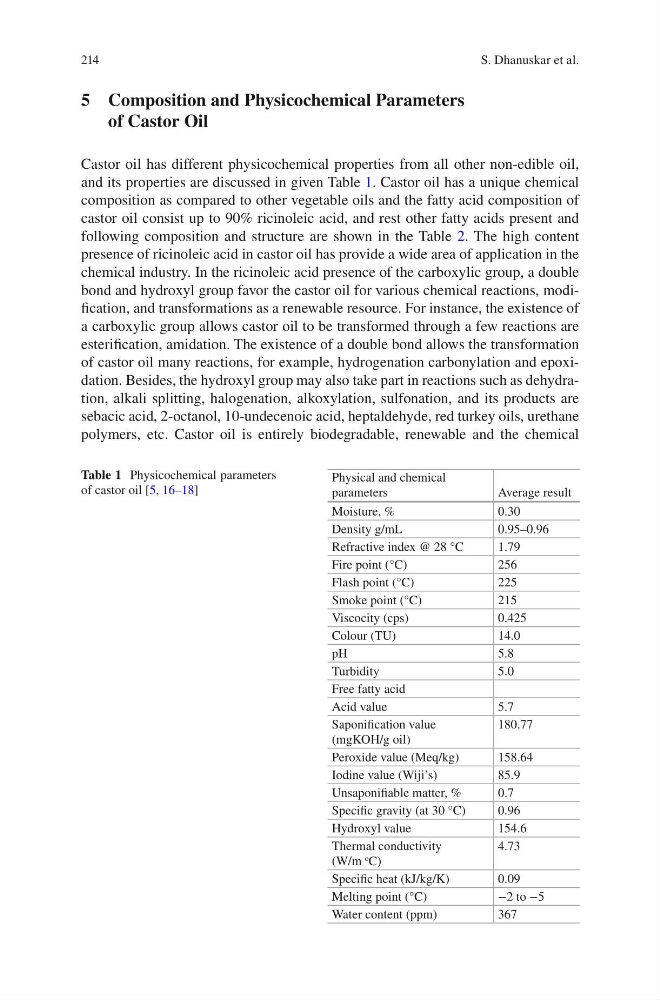
Castor oil has different physicochemical properties from all other non-edible oil,
and its properties are discussed in given Table 1. Castor oil has a unique chemical
composition as compared to other vegetable oils and the fatty acid composition of
castor oil consist up to 90% ricinoleic acid, and rest other fatty acids present and
following composition and structure are shown in the Table 2. The high content
presence of ricinoleic acid in castor oil has provide a wide area of application in the
chemical industry. In the ricinoleic acid presence of the carboxylic group, a double
bond and hydroxyl group favor the castor oil for various chemical reactions, modification, and transformations as a renewable resource. For instance, the existence of
a carboxylic group allows castor oil to be transformed through a few reactions are
esterification, amidation. The existence of a double bond allows the transformation
of castor oil many reactions, for example, hydrogenation carbonylation and epoxidation. Besides, the hydroxyl group may also take part in reactions such as dehydration, alkali splitting, halogenation, alkoxylation, sulfonation, and its products are
sebacic acid, 2-octanol, 10-undecenoic acid, heptaldehyde, red turkey oils, urethane
polymers, etc. Castor oil is entirely biodegradable, renewable and the chemical
Table 1 Physicochemical parameters
of castor oil [5, 16–18]
Physical and chemical
parameters
Average result
Moisture, %
0.30
Density g/mL
0.95–0.96
Refractive index @ 28 °C
1.79
Fire point (°C)
256
Flash point (°C)
225
Smoke point (°C)
215
Viscocity (cps)
0.425
Colour (TU)
14.0
pH
5.8
Turbidity
5.0
Free fatty acid
Acid value
5.7
Saponification value
(mgKOH/g oil)
180.77
Peroxide value (Meq/kg)
158.64
Iodine value (Wiji’s)
85.9
Unsaponifiable matter, %
0.7
Specific gravity (at 30 °C)
0.96
Hydroxyl value
154.6
Thermal conductivity
(W/m
o C)
4.73
Specific heat (kJ/kg/K)
0.09
Melting point (°C)
−2 to −5
Water content (ppm)
367
S. Dhanuskar et al.
5 Composition and Physicochemical Parameters
of Castor Oil
Castor oil has different physicochemical properties from all other non-edible oil,
and its properties are discussed in given Table 1. Castor oil has a unique chemical
composition as compared to other vegetable oils and the fatty acid composition of
castor oil consist up to 90% ricinoleic acid, and rest other fatty acids present and
following composition and structure are shown in the Table 2. The high content
presence of ricinoleic acid in castor oil has provide a wide area of application in the
chemical industry. In the ricinoleic acid presence of the carboxylic group, a double
bond and hydroxyl group favor the castor oil for various chemical reactions, modification, and transformations as a renewable resource. For instance, the existence of
a carboxylic group allows castor oil to be transformed through a few reactions are
esterification, amidation. The existence of a double bond allows the transformation
of castor oil many reactions, for example, hydrogenation carbonylation and epoxidation. Besides, the hydroxyl group may also take part in reactions such as dehydration, alkali splitting, halogenation, alkoxylation, sulfonation, and its products are
sebacic acid, 2-octanol, 10-undecenoic acid, heptaldehyde, red turkey oils, urethane
polymers, etc. Castor oil is entirely biodegradable, renewable and the chemical
Table 1 Physicochemical parameters
of castor oil [5, 16–18]
Physical and chemical
parameters
Average result
Moisture, %
0.30
Density g/mL
0.95–0.96
Refractive index @ 28 °C
1.79
Fire point (°C)
256
Flash point (°C)
225
Smoke point (°C)
215
Viscocity (cps)
0.425
Colour (TU)
14.0
pH
5.8
Turbidity
5.0
Free fatty acid
Acid value
5.7
Saponification value
(mgKOH/g oil)
180.77
Peroxide value (Meq/kg)
158.64
Iodine value (Wiji’s)
85.9
Unsaponifiable matter, %
0.7
Specific gravity (at 30 °C)
0.96
Hydroxyl value
154.6
Thermal conductivity
(W/m
o C)
4.73
Specific heat (kJ/kg/K)
0.09
Melting point (°C)
−2 to −5
Water content (ppm)
367
S. Dhanuskar et al.