

211
epoxidation, or vulcanization can modify the single point of unsaturation. On the
other hand, the carbon-12 hydroxy functional group, which may be acetylated or
alkoxylated, can be eliminated through dehydration to improve the unsaturation of
oil [6].
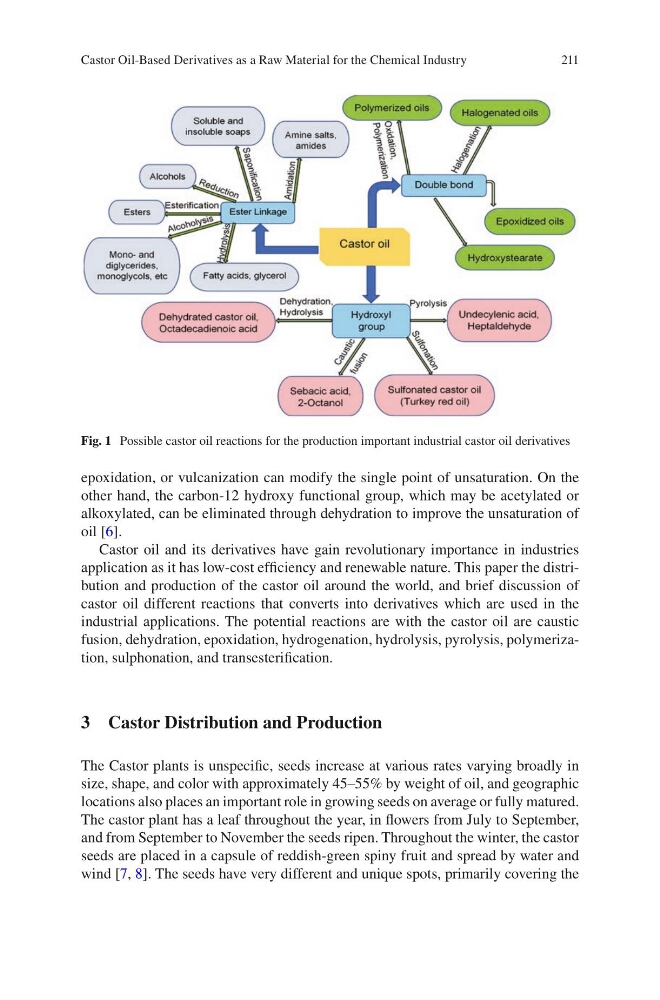
Castor oil and its derivatives have gain revolutionary importance in industries
application as it has low-cost efficiency and renewable nature. This paper the distribution and production of the castor oil around the world, and brief discussion of
castor oil different reactions that converts into derivatives which are used in the
industrial applications. The potential reactions are with the castor oil are caustic
fusion, dehydration, epoxidation, hydrogenation, hydrolysis, pyrolysis, polymerization, sulphonation, and transesterification.
3 Castor Distribution and Production
The Castor plants is unspecific, seeds increase at various rates varying broadly in
size, shape, and color with approximately 45–55% by weight of oil, and geographic
locations also places an important role in growing seeds on average or fully matured.
The castor plant has a leaf throughout the year, in flowers from July to September,
and from September to November the seeds ripen. Throughout the winter, the castor
seeds are placed in a capsule of reddish-green spiny fruit and spread by water and
wind [7, 8]. The seeds have very different and unique spots, primarily covering the
Fig. 1 Possible castor oil reactions for the production important industrial castor oil derivatives
Castor Oil-Based Derivatives as a Raw Material for the Chemical Industry
epoxidation, or vulcanization can modify the single point of unsaturation. On the
other hand, the carbon-12 hydroxy functional group, which may be acetylated or
alkoxylated, can be eliminated through dehydration to improve the unsaturation of
oil [6].
Castor oil and its derivatives have gain revolutionary importance in industries
application as it has low-cost efficiency and renewable nature. This paper the distribution and production of the castor oil around the world, and brief discussion of
castor oil different reactions that converts into derivatives which are used in the
industrial applications. The potential reactions are with the castor oil are caustic
fusion, dehydration, epoxidation, hydrogenation, hydrolysis, pyrolysis, polymerization, sulphonation, and transesterification.
3 Castor Distribution and Production
The Castor plants is unspecific, seeds increase at various rates varying broadly in
size, shape, and color with approximately 45–55% by weight of oil, and geographic
locations also places an important role in growing seeds on average or fully matured.
The castor plant has a leaf throughout the year, in flowers from July to September,
and from September to November the seeds ripen. Throughout the winter, the castor
seeds are placed in a capsule of reddish-green spiny fruit and spread by water and
wind [7, 8]. The seeds have very different and unique spots, primarily covering the
Fig. 1 Possible castor oil reactions for the production important industrial castor oil derivatives
Castor Oil-Based Derivatives as a Raw Material for the Chemical Industry