

203
3.2.1 Kinetic Parameters
The experimental results show that a conversion value of FFA nearly 96.21% can be
achieved in 7 h at 220 °C using 1:6 oil/methanol ratio (w/v). Then the experimental
data were fitted in Eq. (11), and nonlinear regression was done to calculate the
kinetic parameters at each temperature. The proposed model was fitted well with
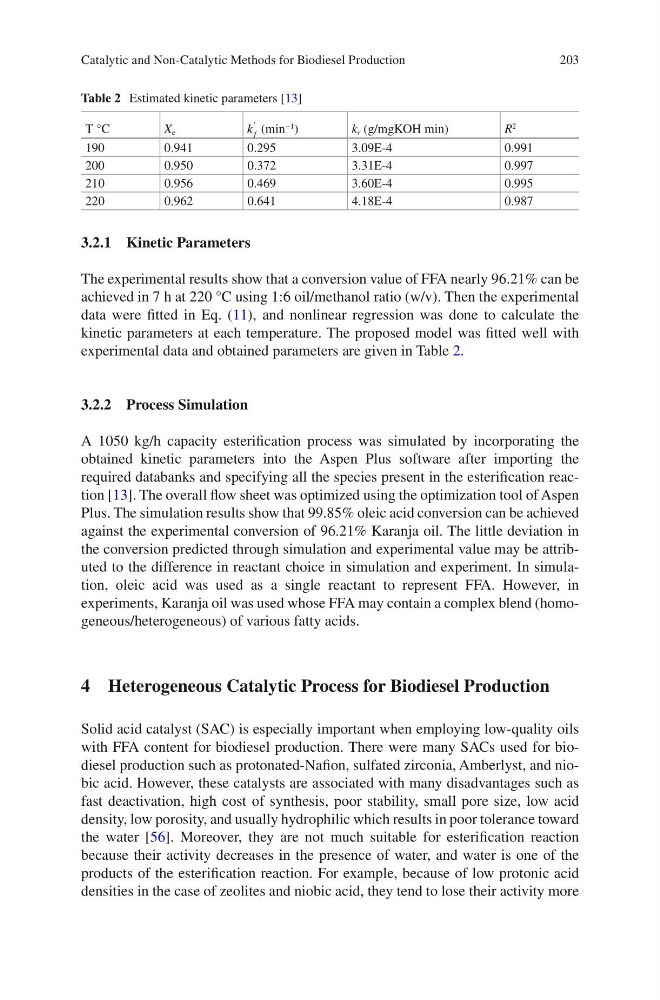
experimental data and obtained parameters are given in Table 2.
3.2.2 Process Simulation
A 1050 kg/h capacity esterification process was simulated by incorporating the
obtained kinetic parameters into the Aspen Plus software after importing the
required databanks and specifying all the species present in the esterification reaction [13]. The overall flow sheet was optimized using the optimization tool of Aspen
Plus. The simulation results show that 99.85% oleic acid conversion can be achieved
against the experimental conversion of 96.21% Karanja oil. The little deviation in
the conversion predicted through simulation and experimental value may be attributed to the difference in reactant choice in simulation and experiment. In simulation, oleic acid was used as a single reactant to represent FFA. However, in
experiments, Karanja oil was used whose FFA may contain a complex blend (homogeneous/heterogeneous) of various fatty acids.
4 Heterogeneous Catalytic Process for Biodiesel Production
Solid acid catalyst (SAC) is especially important when employing low-quality oils
with FFA content for biodiesel production. There were many SACs used for biodiesel production such as protonated-Nafion, sulfated zirconia, Amberlyst, and niobic acid. However, these catalysts are associated with many disadvantages such as
fast deactivation, high cost of synthesis, poor stability, small pore size, low acid
density, low porosity, and usually hydrophilic which results in poor tolerance toward
the water [56]. Moreover, they are not much suitable for esterification reaction
because their activity decreases in the presence of water, and water is one of the
products of the esterification reaction. For example, because of low protonic acid
densities in the case of zeolites and niobic acid, they tend to lose their activity more
Table 2 Estimated kinetic parameters [13]
T °C
X e
k f
¢ (min
−1 )
k r (g/mgKOH min)
R
2
190
0.941
0.295
3.09E-4
0.991
200
0.950
0.372
3.31E-4
0.997
210
0.956
0.469
3.60E-4
0.995
220
0.962
0.641
4.18E-4
0.987
Catalytic and Non-Catalytic Methods for Biodiesel Production
3.2.1 Kinetic Parameters
The experimental results show that a conversion value of FFA nearly 96.21% can be
achieved in 7 h at 220 °C using 1:6 oil/methanol ratio (w/v). Then the experimental
data were fitted in Eq. (11), and nonlinear regression was done to calculate the
kinetic parameters at each temperature. The proposed model was fitted well with
experimental data and obtained parameters are given in Table 2.
3.2.2 Process Simulation
A 1050 kg/h capacity esterification process was simulated by incorporating the
obtained kinetic parameters into the Aspen Plus software after importing the
required databanks and specifying all the species present in the esterification reaction [13]. The overall flow sheet was optimized using the optimization tool of Aspen
Plus. The simulation results show that 99.85% oleic acid conversion can be achieved
against the experimental conversion of 96.21% Karanja oil. The little deviation in
the conversion predicted through simulation and experimental value may be attributed to the difference in reactant choice in simulation and experiment. In simulation, oleic acid was used as a single reactant to represent FFA. However, in
experiments, Karanja oil was used whose FFA may contain a complex blend (homogeneous/heterogeneous) of various fatty acids.
4 Heterogeneous Catalytic Process for Biodiesel Production
Solid acid catalyst (SAC) is especially important when employing low-quality oils
with FFA content for biodiesel production. There were many SACs used for biodiesel production such as protonated-Nafion, sulfated zirconia, Amberlyst, and niobic acid. However, these catalysts are associated with many disadvantages such as
fast deactivation, high cost of synthesis, poor stability, small pore size, low acid
density, low porosity, and usually hydrophilic which results in poor tolerance toward
the water [56]. Moreover, they are not much suitable for esterification reaction
because their activity decreases in the presence of water, and water is one of the
products of the esterification reaction. For example, because of low protonic acid
densities in the case of zeolites and niobic acid, they tend to lose their activity more
Table 2 Estimated kinetic parameters [13]
T °C
X e
k f
¢ (min
−1 )
k r (g/mgKOH min)
R
2
190
0.941
0.295
3.09E-4
0.991
200
0.950
0.372
3.31E-4
0.997
210
0.956
0.469
3.60E-4
0.995
220
0.962
0.641
4.18E-4
0.987
Catalytic and Non-Catalytic Methods for Biodiesel Production