

202
that coexist at reaction conditions. The value of “f” must be selected in such a way
that the reactants remain in the homogeneous phase. A higher value of “f” should be
maintained to have a liquid-phase reaction under subcritical conditions. Phase equilibrium calculations were performed using the “Flash2” subroutine of Aspen Plus
software [11, 13]. The required input for the phase equilibrium calculation in
“Flash2” subroutine was the composition of feed streams, temperature, and pressure or vapor fraction. The required pressure of the reactor to maintain the reactants
in a single phase at a fixed temperature was obtained from the simulation result.
The reactor was charged with appropriate amounts of reactants. Inert gas (argon)
was used to maintain the desired pressure inside the reactor. The effect of temperature, reaction time, agitation speed, and oil to methanol ratio on the conversion was
studied. The samples were withdrawn at various intervals to analyze acid values
(Eq. 8) and the corresponding conversion (Eq. 9) [9, 13]:
Acid Value =
´ ´
56 1
. N V
W
(8)
where
N is the normality of standard potassium hydroxide solution
V is the volume of standard potassium hydroxide used, mL
W is the weight of the sample, gram
Conversion
Acid Value
Acid Value
Acid Value
%
( ) =
(
) - (
)
(
)
´
=
=
=
t
t t
t
0
0
1 100
(9)
3.2 Kinetic Modeling and Simulation
The simulation studies have been done for the non-catalytic biodiesel production
process to check the commercial viability [13, 53–55]. The required kinetic parameters to simulate the process were calculated by modeling the experimental data.
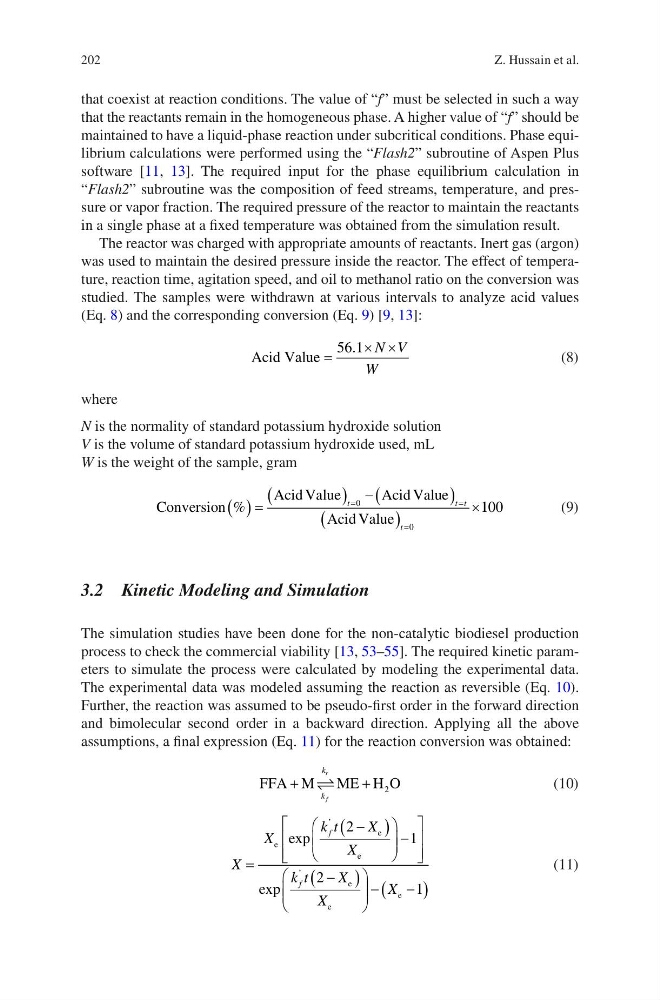
The experimental data was modeled assuming the reaction as reversible (Eq. 10).
Further, the reaction was assumed to be pseudo-first order in the forward direction
and bimolecular second order in a backward direction. Applying all the above
assumptions, a final expression (Eq. 11) for the reaction conversion was obtained:
FFA M ME H O
+
+
k
k
f
r
2
(10)
X
X
k t
X
X
k t
X
X
f
f
=
-
(
)
æ
è
ç ç
ö
ø
÷ ÷
-
é
ë
ê
ê
ù
û
ú
ú
-
(
)
æ
è
ç ç
ö
ø
e
e
e
e
e
exp
exp
’
’
2
1
2
÷ ÷ ÷
-
-
(
)
X e 1
(11)
Z. Hussain et al.
that coexist at reaction conditions. The value of “f” must be selected in such a way
that the reactants remain in the homogeneous phase. A higher value of “f” should be
maintained to have a liquid-phase reaction under subcritical conditions. Phase equilibrium calculations were performed using the “Flash2” subroutine of Aspen Plus
software [11, 13]. The required input for the phase equilibrium calculation in
“Flash2” subroutine was the composition of feed streams, temperature, and pressure or vapor fraction. The required pressure of the reactor to maintain the reactants
in a single phase at a fixed temperature was obtained from the simulation result.
The reactor was charged with appropriate amounts of reactants. Inert gas (argon)
was used to maintain the desired pressure inside the reactor. The effect of temperature, reaction time, agitation speed, and oil to methanol ratio on the conversion was
studied. The samples were withdrawn at various intervals to analyze acid values
(Eq. 8) and the corresponding conversion (Eq. 9) [9, 13]:
Acid Value =
´ ´
56 1
. N V
W
(8)
where
N is the normality of standard potassium hydroxide solution
V is the volume of standard potassium hydroxide used, mL
W is the weight of the sample, gram
Conversion
Acid Value
Acid Value
Acid Value
%
( ) =
(
) - (
)
(
)
´
=
=
=
t
t t
t
0
0
1 100
(9)
3.2 Kinetic Modeling and Simulation
The simulation studies have been done for the non-catalytic biodiesel production
process to check the commercial viability [13, 53–55]. The required kinetic parameters to simulate the process were calculated by modeling the experimental data.
The experimental data was modeled assuming the reaction as reversible (Eq. 10).
Further, the reaction was assumed to be pseudo-first order in the forward direction
and bimolecular second order in a backward direction. Applying all the above
assumptions, a final expression (Eq. 11) for the reaction conversion was obtained:
FFA M ME H O
+
+
k
k
f
r
2
(10)
X
X
k t
X
X
k t
X
X
f
f
=
-
(
)
æ
è
ç ç
ö
ø
÷ ÷
-
é
ë
ê
ê
ù
û
ú
ú
-
(
)
æ
è
ç ç
ö
ø
e
e
e
e
e
exp
exp
’
’
2
1
2
÷ ÷ ÷
-
-
(
)
X e 1
(11)
Z. Hussain et al.