

200
2.1 Effect of TMAB
The transesterification of waste vegetable oil was conducted in the presence of
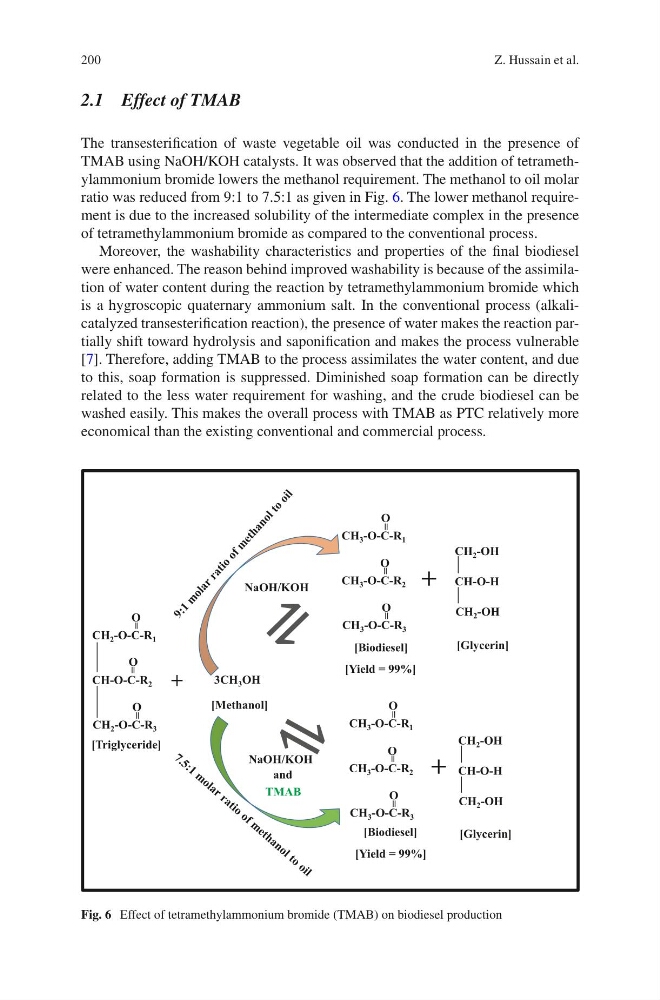
TMAB using NaOH/KOH catalysts. It was observed that the addition of tetramethylammonium bromide lowers the methanol requirement. The methanol to oil molar
ratio was reduced from 9:1 to 7.5:1 as given in Fig. 6. The lower methanol requirement is due to the increased solubility of the intermediate complex in the presence
of tetramethylammonium bromide as compared to the conventional process.
Moreover, the washability characteristics and properties of the final biodiesel
were enhanced. The reason behind improved washability is because of the assimilation of water content during the reaction by tetramethylammonium bromide which
is a hygroscopic quaternary ammonium salt. In the conventional process (alkalicatalyzed transesterification reaction), the presence of water makes the reaction partially shift toward hydrolysis and saponification and makes the process vulnerable
[7]. Therefore, adding TMAB to the process assimilates the water content, and due
to this, soap formation is suppressed. Diminished soap formation can be directly
related to the less water requirement for washing, and the crude biodiesel can be
washed easily. This makes the overall process with TMAB as PTC relatively more
economical than the existing conventional and commercial process.
CH 2 -O-C-R 1
=
O
CH-O-C-R 2
=
O
CH 2 -O-C-R 3
=
O
+
3CH 3 OH
CH 3 -O-C-R 1
=
O
CH 3 -O-C-R 2
=
O
CH 3 -O-C-R 3
=
O
CH 2 -OH
CH-O-H
CH 2 -OH
+
NaOH/KOH
[Triglyceride]
[Methanol]
[Biodiesel]
[Glycerin]
TMAB
CH 3 -O-C-R 1
=
O
CH 3 -O-C-R 2
=
O
CH 3 -O-C-R 3
=
O
[Biodiesel]
CH 2 -OH
CH-O-H
CH 2 -OH
[Glycerin]
[Yield = 99%]
[Yield = 99%]
NaOH/KOH
+
and
Fig. 6 Effect of tetramethylammonium bromide (TMAB) on biodiesel production
Z. Hussain et al.
2.1 Effect of TMAB
The transesterification of waste vegetable oil was conducted in the presence of
TMAB using NaOH/KOH catalysts. It was observed that the addition of tetramethylammonium bromide lowers the methanol requirement. The methanol to oil molar
ratio was reduced from 9:1 to 7.5:1 as given in Fig. 6. The lower methanol requirement is due to the increased solubility of the intermediate complex in the presence
of tetramethylammonium bromide as compared to the conventional process.
Moreover, the washability characteristics and properties of the final biodiesel
were enhanced. The reason behind improved washability is because of the assimilation of water content during the reaction by tetramethylammonium bromide which
is a hygroscopic quaternary ammonium salt. In the conventional process (alkalicatalyzed transesterification reaction), the presence of water makes the reaction partially shift toward hydrolysis and saponification and makes the process vulnerable
[7]. Therefore, adding TMAB to the process assimilates the water content, and due
to this, soap formation is suppressed. Diminished soap formation can be directly
related to the less water requirement for washing, and the crude biodiesel can be
washed easily. This makes the overall process with TMAB as PTC relatively more
economical than the existing conventional and commercial process.
CH 2 -O-C-R 1
=
O
CH-O-C-R 2
=
O
CH 2 -O-C-R 3
=
O
+
3CH 3 OH
CH 3 -O-C-R 1
=
O
CH 3 -O-C-R 2
=
O
CH 3 -O-C-R 3
=
O
CH 2 -OH
CH-O-H
CH 2 -OH
+
NaOH/KOH
[Triglyceride]
[Methanol]
[Biodiesel]
[Glycerin]
TMAB
CH 3 -O-C-R 1
=
O
CH 3 -O-C-R 2
=
O
CH 3 -O-C-R 3
=
O
[Biodiesel]
CH 2 -OH
CH-O-H
CH 2 -OH
[Glycerin]
[Yield = 99%]
[Yield = 99%]
NaOH/KOH
+
and
Fig. 6 Effect of tetramethylammonium bromide (TMAB) on biodiesel production
Z. Hussain et al.