

199
production and properties of the biodiesel. However, tetramethylammonium bromide (TMAB) was never used for this purpose as per our knowledge, and we propose TMAB as a new PTC to enhance the conventional transesterification process.
2 Biodiesel from Waste Vegetable Oil
The waste vegetable oil contains contaminants that are removed by fiber cloth
placed on a Buchner funnel. Thereafter, the oil was heated at 120 °C for 45 min with
continuous stirring to remove the moisture present in the oil. A typical experimental
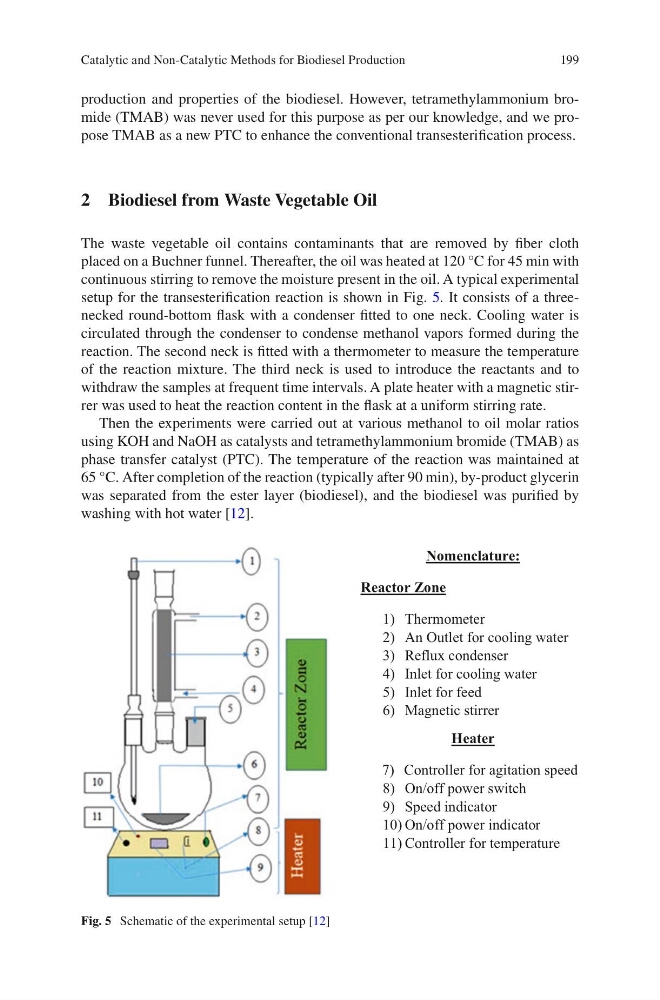
setup for the transesterification reaction is shown in Fig. 5. It consists of a threenecked round-bottom flask with a condenser fitted to one neck. Cooling water is
circulated through the condenser to condense methanol vapors formed during the
reaction. The second neck is fitted with a thermometer to measure the temperature
of the reaction mixture. The third neck is used to introduce the reactants and to
withdraw the samples at frequent time intervals. A plate heater with a magnetic stirrer was used to heat the reaction content in the flask at a uniform stirring rate.
Then the experiments were carried out at various methanol to oil molar ratios
using KOH and NaOH as catalysts and tetramethylammonium bromide (TMAB) as
phase transfer catalyst (PTC). The temperature of the reaction was maintained at
65 °C. After completion of the reaction (typically after 90 min), by-product glycerin
was separated from the ester layer (biodiesel), and the biodiesel was purified by
washing with hot water [12].
Nomenclature:
Reactor Zone
1) Thermometer
2) An Outlet for cooling water
3) Reflux condenser
4) Inlet for cooling water
5) Inlet for feed
6) Magnetic stirrer
Heater
7) Controller for agitation speed
8) On/off power switch
9) Speed indicator
10) On/off power indicator
11) Controller for temperature
Fig. 5 Schematic of the experimental setup [12]
Catalytic and Non-Catalytic Methods for Biodiesel Production
production and properties of the biodiesel. However, tetramethylammonium bromide (TMAB) was never used for this purpose as per our knowledge, and we propose TMAB as a new PTC to enhance the conventional transesterification process.
2 Biodiesel from Waste Vegetable Oil
The waste vegetable oil contains contaminants that are removed by fiber cloth
placed on a Buchner funnel. Thereafter, the oil was heated at 120 °C for 45 min with
continuous stirring to remove the moisture present in the oil. A typical experimental
setup for the transesterification reaction is shown in Fig. 5. It consists of a threenecked round-bottom flask with a condenser fitted to one neck. Cooling water is
circulated through the condenser to condense methanol vapors formed during the
reaction. The second neck is fitted with a thermometer to measure the temperature
of the reaction mixture. The third neck is used to introduce the reactants and to
withdraw the samples at frequent time intervals. A plate heater with a magnetic stirrer was used to heat the reaction content in the flask at a uniform stirring rate.
Then the experiments were carried out at various methanol to oil molar ratios
using KOH and NaOH as catalysts and tetramethylammonium bromide (TMAB) as
phase transfer catalyst (PTC). The temperature of the reaction was maintained at
65 °C. After completion of the reaction (typically after 90 min), by-product glycerin
was separated from the ester layer (biodiesel), and the biodiesel was purified by
washing with hot water [12].
Nomenclature:
Reactor Zone
1) Thermometer
2) An Outlet for cooling water
3) Reflux condenser
4) Inlet for cooling water
5) Inlet for feed
6) Magnetic stirrer
Heater
7) Controller for agitation speed
8) On/off power switch
9) Speed indicator
10) On/off power indicator
11) Controller for temperature
Fig. 5 Schematic of the experimental setup [12]
Catalytic and Non-Catalytic Methods for Biodiesel Production