

197
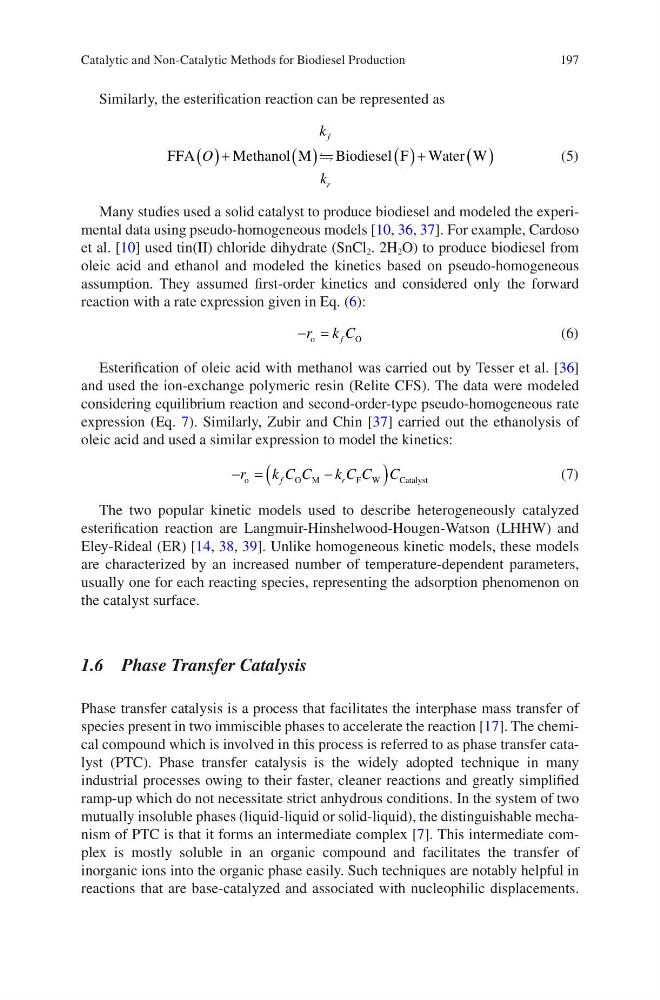
Similarly, the esterification reaction can be represented as
FFA
Methanol M
Biodiesel F Water W
O
k
k
f
r
( )+
( )
( )+
( )
(5)
Many studies used a solid catalyst to produce biodiesel and modeled the experimental data using pseudo-homogeneous models [10, 36, 37]. For example, Cardoso
et al. [10] used tin(II) chloride dihydrate (SnCl 2 . 2H 2 O) to produce biodiesel from
oleic acid and ethanol and modeled the kinetics based on pseudo-homogeneous
assumption. They assumed first-order kinetics and considered only the forward
reaction with a rate expression given in Eq. (6):
- =
r k C
f
o
O
(6)
Esterification of oleic acid with methanol was carried out by Tesser et al. [36]
and used the ion-exchange polymeric resin (Relite CFS). The data were modeled
considering equilibrium reaction and second-order-type pseudo-homogeneous rate
expression (Eq. 7). Similarly, Zubir and Chin [37] carried out the ethanolysis of
oleic acid and used a similar expression to model the kinetics:
- =
-
(
)
r
k C C
k C C C
f
r
o
O M
F W
C atalyst
(7)
The two popular kinetic models used to describe heterogeneously catalyzed
esterification reaction are Langmuir-Hinshelwood-Hougen-Watson (LHHW) and
Eley-Rideal (ER) [14, 38, 39]. Unlike homogeneous kinetic models, these models
are characterized by an increased number of temperature-dependent parameters,
usually one for each reacting species, representing the adsorption phenomenon on
the catalyst surface.
1.6 Phase Transfer Catalysis
Phase transfer catalysis is a process that facilitates the interphase mass transfer of
species present in two immiscible phases to accelerate the reaction [17]. The chemical compound which is involved in this process is referred to as phase transfer catalyst (PTC). Phase transfer catalysis is the widely adopted technique in many
industrial processes owing to their faster, cleaner reactions and greatly simplified
ramp-up which do not necessitate strict anhydrous conditions. In the system of two
mutually insoluble phases (liquid-liquid or solid-liquid), the distinguishable mechanism of PTC is that it forms an intermediate complex [7]. This intermediate complex is mostly soluble in an organic compound and facilitates the transfer of
inorganic ions into the organic phase easily. Such techniques are notably helpful in
reactions that are base-catalyzed and associated with nucleophilic displacements.
Catalytic and Non-Catalytic Methods for Biodiesel Production
Similarly, the esterification reaction can be represented as
FFA
Methanol M
Biodiesel F Water W
O
k
k
f
r
( )+
( )
( )+
( )
(5)
Many studies used a solid catalyst to produce biodiesel and modeled the experimental data using pseudo-homogeneous models [10, 36, 37]. For example, Cardoso
et al. [10] used tin(II) chloride dihydrate (SnCl 2 . 2H 2 O) to produce biodiesel from
oleic acid and ethanol and modeled the kinetics based on pseudo-homogeneous
assumption. They assumed first-order kinetics and considered only the forward
reaction with a rate expression given in Eq. (6):
- =
r k C
f
o
O
(6)
Esterification of oleic acid with methanol was carried out by Tesser et al. [36]
and used the ion-exchange polymeric resin (Relite CFS). The data were modeled
considering equilibrium reaction and second-order-type pseudo-homogeneous rate
expression (Eq. 7). Similarly, Zubir and Chin [37] carried out the ethanolysis of
oleic acid and used a similar expression to model the kinetics:
- =
-
(
)
r
k C C
k C C C
f
r
o
O M
F W
C atalyst
(7)
The two popular kinetic models used to describe heterogeneously catalyzed
esterification reaction are Langmuir-Hinshelwood-Hougen-Watson (LHHW) and
Eley-Rideal (ER) [14, 38, 39]. Unlike homogeneous kinetic models, these models
are characterized by an increased number of temperature-dependent parameters,
usually one for each reacting species, representing the adsorption phenomenon on
the catalyst surface.
1.6 Phase Transfer Catalysis
Phase transfer catalysis is a process that facilitates the interphase mass transfer of
species present in two immiscible phases to accelerate the reaction [17]. The chemical compound which is involved in this process is referred to as phase transfer catalyst (PTC). Phase transfer catalysis is the widely adopted technique in many
industrial processes owing to their faster, cleaner reactions and greatly simplified
ramp-up which do not necessitate strict anhydrous conditions. In the system of two
mutually insoluble phases (liquid-liquid or solid-liquid), the distinguishable mechanism of PTC is that it forms an intermediate complex [7]. This intermediate complex is mostly soluble in an organic compound and facilitates the transfer of
inorganic ions into the organic phase easily. Such techniques are notably helpful in
reactions that are base-catalyzed and associated with nucleophilic displacements.
Catalytic and Non-Catalytic Methods for Biodiesel Production