

196
formed and results in a tetrahedral intermediate (Fig. 4c). Finally, the formed tetrahedral intermediate results in biodiesel and water with a series of protonation and
deprotonation steps (Fig. 4d).
It is possible to produce biodiesel using non-edible oils having high FFA content
using an acid-catalyzed esterification process which can catalyze both esterification
and transesterification simultaneously [5, 31]. Conventionally, concentrated sulfuric
acid in a homogeneous form is used as the esterification catalyst. However, homogeneous acid is usually non-recoverable and nonrecyclable; hence, utilization of
this acid imposes severe environmental issues and corrosion problems, generates
large volumes of unprocessed effluents, and causes loss of product during washing
[5, 13]. To mitigate these disadvantages, a non-catalytic esterification route and heterogeneous catalytic processes can be explored.
1.5 Kinetics of Biodiesel Production
The kinetics of the conventional homogeneous base-catalyzed transesterification
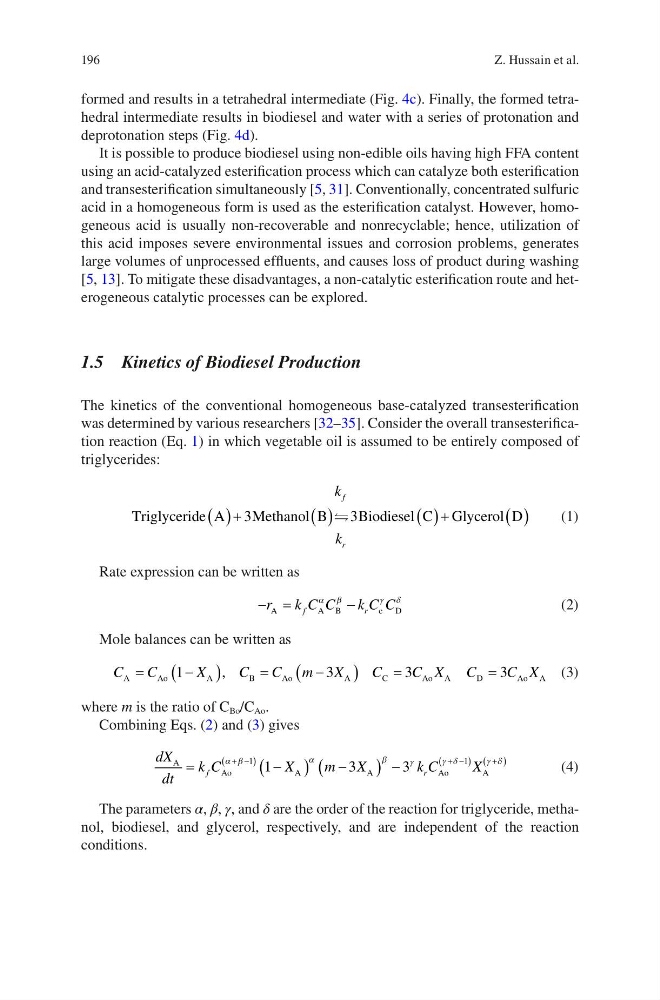
was determined by various researchers [32–35]. Consider the overall transesterification reaction (Eq. 1) in which vegetable oil is assumed to be entirely composed of
triglycerides:
Triglyceride A
Methanol B
Biodiesel C Glycerol D
( )+
( )
( )+
( )
3
3
k
k
f
r
(1)
Rate expression can be written as
- =
-
r
k C C
k C C
f
r
A
A B
c D
a b
g d
(2)
Mole balances can be written as
C
C
X
C
C m X
C
C X
C
C X
A
A o
A
B
A o
A
C
A o A
D
A o A
=
-
(
)
=
-
(
)
=
=
1
3
3
3
,
(3)
where m is the ratio of C Bo /C Ao .
Combining Eqs. (2) and (3) gives
dX
dt
k C
X
m X
kC
X
f
r
A
Ao
A
A
Ao
A
=
-
(
) -
(
) -
+ -
(
)
+ -
(
)
+
( )
a b
a
b
g
g d
g d
1
1
1
3
3
(4)
The parameters α, β, γ, and δ are the order of the reaction for triglyceride, methanol, biodiesel, and glycerol, respectively, and are independent of the reaction
conditions.
Z. Hussain et al.
formed and results in a tetrahedral intermediate (Fig. 4c). Finally, the formed tetrahedral intermediate results in biodiesel and water with a series of protonation and
deprotonation steps (Fig. 4d).
It is possible to produce biodiesel using non-edible oils having high FFA content
using an acid-catalyzed esterification process which can catalyze both esterification
and transesterification simultaneously [5, 31]. Conventionally, concentrated sulfuric
acid in a homogeneous form is used as the esterification catalyst. However, homogeneous acid is usually non-recoverable and nonrecyclable; hence, utilization of
this acid imposes severe environmental issues and corrosion problems, generates
large volumes of unprocessed effluents, and causes loss of product during washing
[5, 13]. To mitigate these disadvantages, a non-catalytic esterification route and heterogeneous catalytic processes can be explored.
1.5 Kinetics of Biodiesel Production
The kinetics of the conventional homogeneous base-catalyzed transesterification
was determined by various researchers [32–35]. Consider the overall transesterification reaction (Eq. 1) in which vegetable oil is assumed to be entirely composed of
triglycerides:
Triglyceride A
Methanol B
Biodiesel C Glycerol D
( )+
( )
( )+
( )
3
3
k
k
f
r
(1)
Rate expression can be written as
- =
-
r
k C C
k C C
f
r
A
A B
c D
a b
g d
(2)
Mole balances can be written as
C
C
X
C
C m X
C
C X
C
C X
A
A o
A
B
A o
A
C
A o A
D
A o A
=
-
(
)
=
-
(
)
=
=
1
3
3
3
,
(3)
where m is the ratio of C Bo /C Ao .
Combining Eqs. (2) and (3) gives
dX
dt
k C
X
m X
kC
X
f
r
A
Ao
A
A
Ao
A
=
-
(
) -
(
) -
+ -
(
)
+ -
(
)
+
( )
a b
a
b
g
g d
g d
1
1
1
3
3
(4)
The parameters α, β, γ, and δ are the order of the reaction for triglyceride, methanol, biodiesel, and glycerol, respectively, and are independent of the reaction
conditions.
Z. Hussain et al.