

9
4.2 Gasification
Biomass partial combustion at a high temperature (800–1200 °C) with a low oxygen
level produces combustible gases that mainly consist of CO, CO 2 , N 2 , H 2 O, H 2 and
CH 4 [43, 44]. This gas mixture is called “synthesis gas” or “syngas” which has several applications in furnace oil, direct heat, internal combustion engines and methanol
production in an economically beneficial way [43]. Furthermore, Fischer-Tropsch
synthesis process can convert syngas into liquid hydrocarbons [45–47]. The three
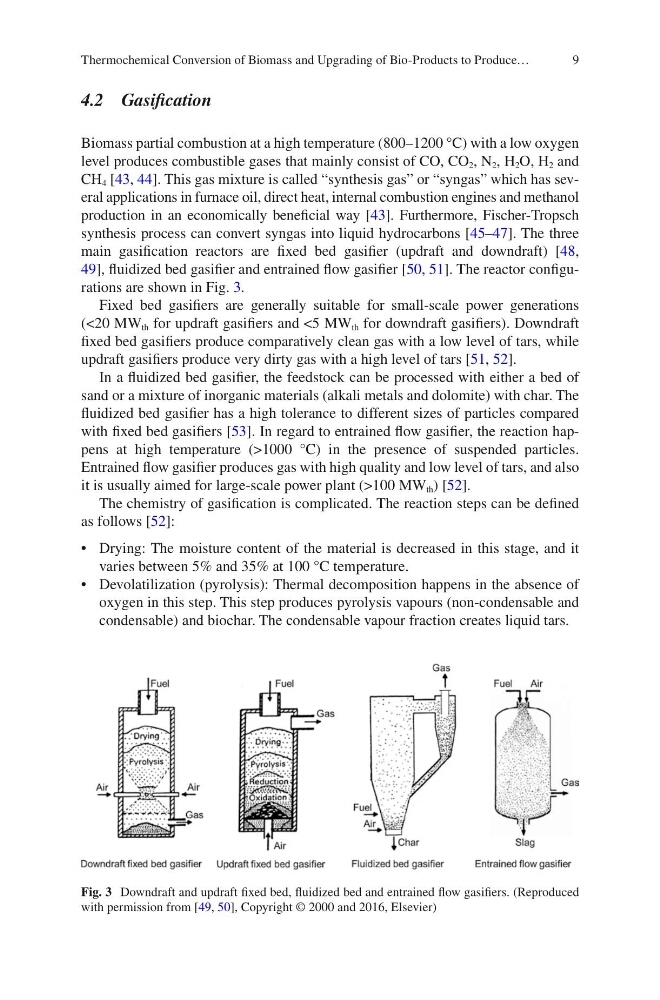
main gasification reactors are fixed bed gasifier (updraft and downdraft) [48,
49], fluidized bed gasifier and entrained flow gasifier [50, 51]. The reactor configurations are shown in Fig. 3.
Fixed bed gasifiers are generally suitable for small-scale power generations
(<20 MW th for updraft gasifiers and <5 MW th for downdraft gasifiers). Downdraft
fixed bed gasifiers produce comparatively clean gas with a low level of tars, while
updraft gasifiers produce very dirty gas with a high level of tars [51, 52].
In a fluidized bed gasifier, the feedstock can be processed with either a bed of
sand or a mixture of inorganic materials (alkali metals and dolomite) with char. The
fluidized bed gasifier has a high tolerance to different sizes of particles compared
with fixed bed gasifiers [53]. In regard to entrained flow gasifier, the reaction happens at high temperature (>1000 °C) in the presence of suspended particles.
Entrained flow gasifier produces gas with high quality and low level of tars, and also
it is usually aimed for large-scale power plant (>100 MW th ) [52].
The chemistry of gasification is complicated. The reaction steps can be defined
as follows [52]:
• Drying: The moisture content of the material is decreased in this stage, and it
varies between 5% and 35% at 100 °C temperature.
• Devolatilization (pyrolysis): Thermal decomposition happens in the absence of
oxygen in this step. This step produces pyrolysis vapours (non-condensable and
condensable) and biochar. The condensable vapour fraction creates liquid tars.
Fig. 3 Downdraft and updraft fixed bed, fluidized bed and entrained flow gasifiers. (Reproduced
with permission from [49, 50], Copyright © 2000 and 2016, Elsevier)
Thermochemical Conversion of Biomass and Upgrading of Bio-Products to Produce…
4.2 Gasification
Biomass partial combustion at a high temperature (800–1200 °C) with a low oxygen
level produces combustible gases that mainly consist of CO, CO 2 , N 2 , H 2 O, H 2 and
CH 4 [43, 44]. This gas mixture is called “synthesis gas” or “syngas” which has several applications in furnace oil, direct heat, internal combustion engines and methanol
production in an economically beneficial way [43]. Furthermore, Fischer-Tropsch
synthesis process can convert syngas into liquid hydrocarbons [45–47]. The three
main gasification reactors are fixed bed gasifier (updraft and downdraft) [48,
49], fluidized bed gasifier and entrained flow gasifier [50, 51]. The reactor configurations are shown in Fig. 3.
Fixed bed gasifiers are generally suitable for small-scale power generations
(<20 MW th for updraft gasifiers and <5 MW th for downdraft gasifiers). Downdraft
fixed bed gasifiers produce comparatively clean gas with a low level of tars, while
updraft gasifiers produce very dirty gas with a high level of tars [51, 52].
In a fluidized bed gasifier, the feedstock can be processed with either a bed of
sand or a mixture of inorganic materials (alkali metals and dolomite) with char. The
fluidized bed gasifier has a high tolerance to different sizes of particles compared
with fixed bed gasifiers [53]. In regard to entrained flow gasifier, the reaction happens at high temperature (>1000 °C) in the presence of suspended particles.
Entrained flow gasifier produces gas with high quality and low level of tars, and also
it is usually aimed for large-scale power plant (>100 MW th ) [52].
The chemistry of gasification is complicated. The reaction steps can be defined
as follows [52]:
• Drying: The moisture content of the material is decreased in this stage, and it
varies between 5% and 35% at 100 °C temperature.
• Devolatilization (pyrolysis): Thermal decomposition happens in the absence of
oxygen in this step. This step produces pyrolysis vapours (non-condensable and
condensable) and biochar. The condensable vapour fraction creates liquid tars.
Fig. 3 Downdraft and updraft fixed bed, fluidized bed and entrained flow gasifiers. (Reproduced
with permission from [49, 50], Copyright © 2000 and 2016, Elsevier)
Thermochemical Conversion of Biomass and Upgrading of Bio-Products to Produce…