

8
4 Biomass Conversion Methods
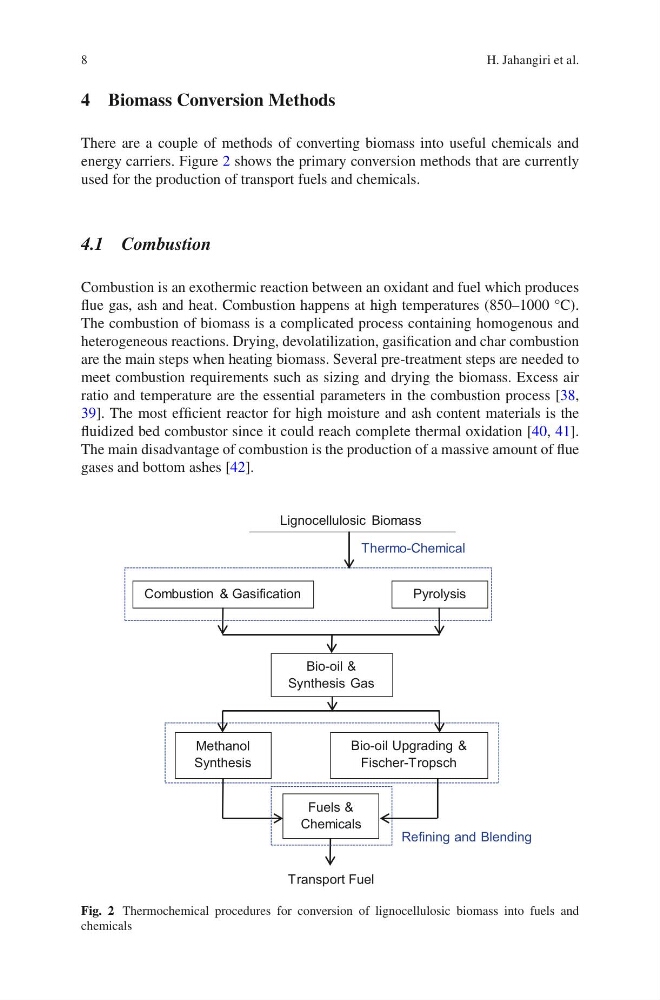
There are a couple of methods of converting biomass into useful chemicals and
energy carriers. Figure 2 shows the primary conversion methods that are currently
used for the production of transport fuels and chemicals.
4.1 Combustion
Combustion is an exothermic reaction between an oxidant and fuel which produces
flue gas, ash and heat. Combustion happens at high temperatures (850–1000 °C).
The combustion of biomass is a complicated process containing homogenous and
heterogeneous reactions. Drying, devolatilization, gasification and char combustion
are the main steps when heating biomass. Several pre-treatment steps are needed to
meet combustion requirements such as sizing and drying the biomass. Excess air
ratio and temperature are the essential parameters in the combustion process [38,
39]. The most efficient reactor for high moisture and ash content materials is the
fluidized bed combustor since it could reach complete thermal oxidation [40, 41].
The main disadvantage of combustion is the production of a massive amount of flue
gases and bottom ashes [42].
Methanol
Synthesis
Bio-oil Upgrading &
Fischer-Tropsch
Fuels &
Chemicals
Refining and Blending
Transport Fuel
Combustion & Gasification
Pyrolysis
Thermo-Chemical
Lignocellulosic Biomass
Bio-oil &
Synthesis Gas
Fig. 2 Thermochemical procedures for conversion of lignocellulosic biomass into fuels and
chemicals
H. Jahangiri et al.
4 Biomass Conversion Methods
There are a couple of methods of converting biomass into useful chemicals and
energy carriers. Figure 2 shows the primary conversion methods that are currently
used for the production of transport fuels and chemicals.
4.1 Combustion
Combustion is an exothermic reaction between an oxidant and fuel which produces
flue gas, ash and heat. Combustion happens at high temperatures (850–1000 °C).
The combustion of biomass is a complicated process containing homogenous and
heterogeneous reactions. Drying, devolatilization, gasification and char combustion
are the main steps when heating biomass. Several pre-treatment steps are needed to
meet combustion requirements such as sizing and drying the biomass. Excess air
ratio and temperature are the essential parameters in the combustion process [38,
39]. The most efficient reactor for high moisture and ash content materials is the
fluidized bed combustor since it could reach complete thermal oxidation [40, 41].
The main disadvantage of combustion is the production of a massive amount of flue
gases and bottom ashes [42].
Methanol
Synthesis
Bio-oil Upgrading &
Fischer-Tropsch
Fuels &
Chemicals
Refining and Blending
Transport Fuel
Combustion & Gasification
Pyrolysis
Thermo-Chemical
Lignocellulosic Biomass
Bio-oil &
Synthesis Gas
Fig. 2 Thermochemical procedures for conversion of lignocellulosic biomass into fuels and
chemicals
H. Jahangiri et al.