

116
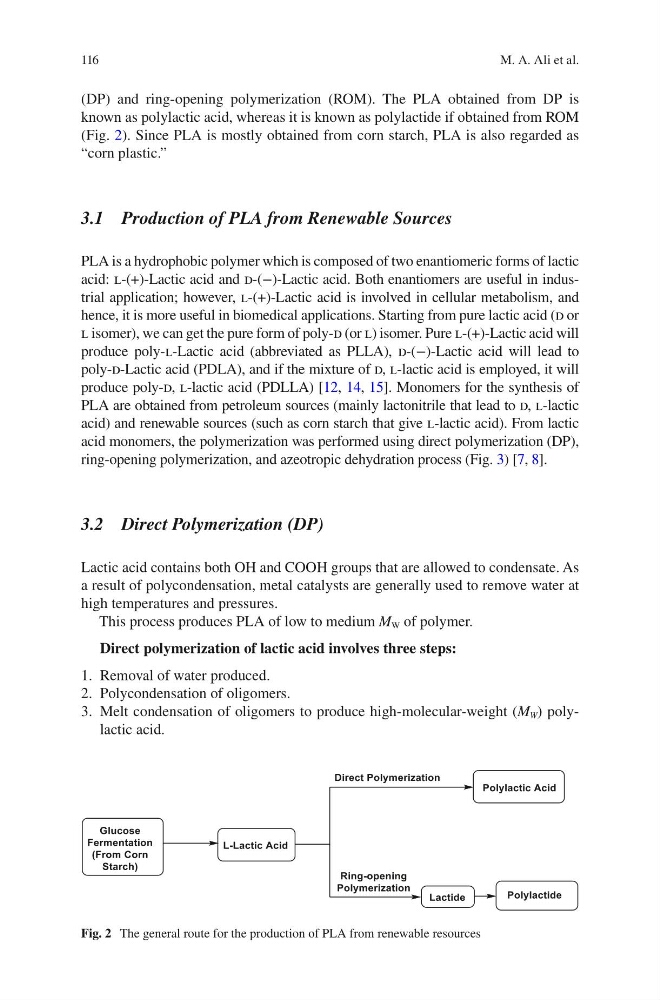
(DP) and ring-opening polymerization (ROM). The PLA obtained from DP is
known as polylactic acid, whereas it is known as polylactide if obtained from ROM
(Fig. 2). Since PLA is mostly obtained from corn starch, PLA is also regarded as
“corn plastic.”
3.1 Production of PLA from Renewable Sources
PLA is a hydrophobic polymer which is composed of two enantiomeric forms of lactic
acid: l-(+)-Lactic acid and d-(−)-Lactic acid. Both enantiomers are useful in industrial application; however, l-(+)-Lactic acid is involved in cellular metabolism, and
hence, it is more useful in biomedical applications. Starting from pure lactic acid (d or
l isomer), we can get the pure form of poly-d (or l) isomer. Pure l-(+)-Lactic acid will
produce poly-l-Lactic acid (abbreviated as PLLA), d-(−)-Lactic acid will lead to
poly-d-Lactic acid (PDLA), and if the mixture of d, l-lactic acid is employed, it will
produce poly-d, l-lactic acid (PDLLA) [12, 14, 15]. Monomers for the synthesis of
PLA are obtained from petroleum sources (mainly lactonitrile that lead to d, l-lactic
acid) and renewable sources (such as corn starch that give l-lactic acid). From lactic
acid monomers, the polymerization was performed using direct polymerization (DP),
ring-opening polymerization, and azeotropic dehydration process (Fig. 3) [7, 8].
3.2 Direct Polymerization (DP)
Lactic acid contains both OH and COOH groups that are allowed to condensate. As
a result of polycondensation, metal catalysts are generally used to remove water at
high temperatures and pressures.
This process produces PLA of low to medium M W of polymer.
Direct polymerization of lactic acid involves three steps:
1. Removal of water produced.
2. Polycondensation of oligomers.
3. Melt condensation of oligomers to produce high-molecular-weight (M W ) polylactic acid.
Fig. 2 The general route for the production of PLA from renewable resources
M. A. Ali et al.
(DP) and ring-opening polymerization (ROM). The PLA obtained from DP is
known as polylactic acid, whereas it is known as polylactide if obtained from ROM
(Fig. 2). Since PLA is mostly obtained from corn starch, PLA is also regarded as
“corn plastic.”
3.1 Production of PLA from Renewable Sources
PLA is a hydrophobic polymer which is composed of two enantiomeric forms of lactic
acid: l-(+)-Lactic acid and d-(−)-Lactic acid. Both enantiomers are useful in industrial application; however, l-(+)-Lactic acid is involved in cellular metabolism, and
hence, it is more useful in biomedical applications. Starting from pure lactic acid (d or
l isomer), we can get the pure form of poly-d (or l) isomer. Pure l-(+)-Lactic acid will
produce poly-l-Lactic acid (abbreviated as PLLA), d-(−)-Lactic acid will lead to
poly-d-Lactic acid (PDLA), and if the mixture of d, l-lactic acid is employed, it will
produce poly-d, l-lactic acid (PDLLA) [12, 14, 15]. Monomers for the synthesis of
PLA are obtained from petroleum sources (mainly lactonitrile that lead to d, l-lactic
acid) and renewable sources (such as corn starch that give l-lactic acid). From lactic
acid monomers, the polymerization was performed using direct polymerization (DP),
ring-opening polymerization, and azeotropic dehydration process (Fig. 3) [7, 8].
3.2 Direct Polymerization (DP)
Lactic acid contains both OH and COOH groups that are allowed to condensate. As
a result of polycondensation, metal catalysts are generally used to remove water at
high temperatures and pressures.
This process produces PLA of low to medium M W of polymer.
Direct polymerization of lactic acid involves three steps:
1. Removal of water produced.
2. Polycondensation of oligomers.
3. Melt condensation of oligomers to produce high-molecular-weight (M W ) polylactic acid.
Fig. 2 The general route for the production of PLA from renewable resources
M. A. Ali et al.