

103
Polystyrene is produced in different forms for different applications. For example, solid polystyrene is used to manufacture medical devices such as test tubes,
petri dishes, CD cases, smoke detectors, containers for food, etc. [112] Polystyrene
film is used to manufacture packaging and glazing materials and light diffusers,
take-out containers, cassette cases, etc. Polystyrene foam is used for the production
of cups for hot beverages, insulator for refrigerators, protective packaging, food
packaging, etc.
5.1 Bio-catalytic Routes to Styrene
Due to the high potential of styrene (ST), bio-catalytic transformation to produce
ST has received considerable attention in recent years [113, 114]. Glucose is predominantly used as an initial precursor for the biological production of ST [115]. In
2011, Mckenna et al. screened numerous enzymes for the biological production of
ST from glucose [116]. In the biosynthesis pathway to ST, L-phenylalanine was first
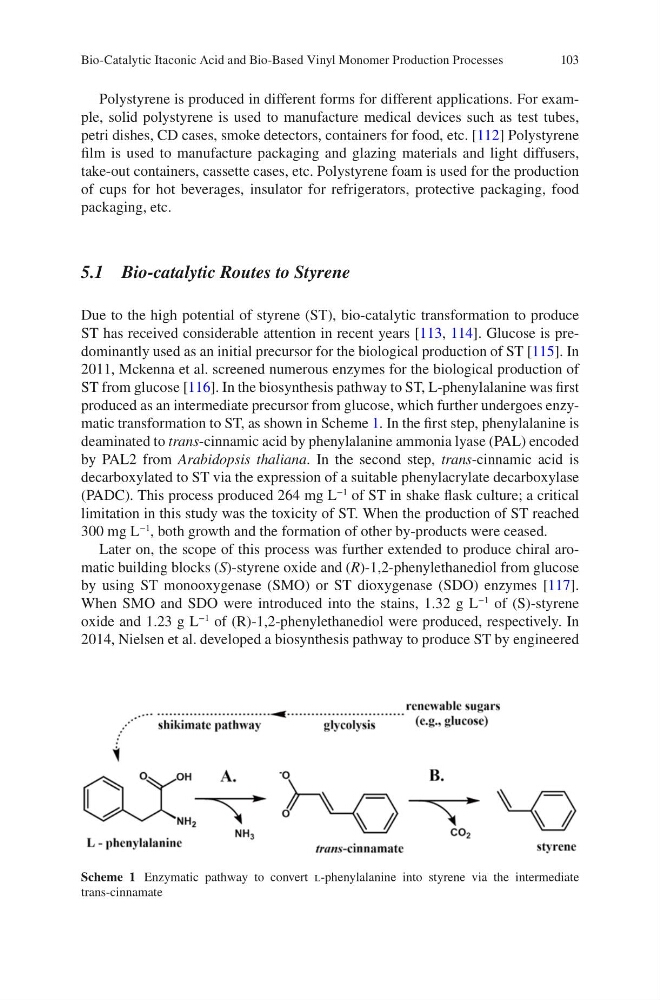
produced as an intermediate precursor from glucose, which further undergoes enzymatic transformation to ST, as shown in Scheme 1. In the first step, phenylalanine is
deaminated to trans-cinnamic acid by phenylalanine ammonia lyase (PAL) encoded
by PAL2 from Arabidopsis thaliana. In the second step, trans-cinnamic acid is
decarboxylated to ST via the expression of a suitable phenylacrylate decarboxylase
(PADC). This process produced 264 mg L
−1
of ST in shake flask culture; a critical
limitation in this study was the toxicity of ST. When the production of ST reached
300 mg L
−1
, both growth and the formation of other by-products were ceased.
Later on, the scope of this process was further extended to produce chiral aromatic building blocks (S)-styrene oxide and (R)-1,2-phenylethanediol from glucose
by using ST monooxygenase (SMO) or ST dioxygenase (SDO) enzymes [117].
When SMO and SDO were introduced into the stains, 1.32 g L
−1
of (S)-styrene
oxide and 1.23 g L
−1
of (R)-1,2-phenylethanediol were produced, respectively. In
2014, Nielsen et al. developed a biosynthesis pathway to produce ST by engineered
Scheme 1 Enzymatic pathway to convert l-phenylalanine into styrene via the intermediate
trans-cinnamate
Bio-Catalytic Itaconic Acid and Bio-Based Vinyl Monomer Production Processes
Polystyrene is produced in different forms for different applications. For example, solid polystyrene is used to manufacture medical devices such as test tubes,
petri dishes, CD cases, smoke detectors, containers for food, etc. [112] Polystyrene
film is used to manufacture packaging and glazing materials and light diffusers,
take-out containers, cassette cases, etc. Polystyrene foam is used for the production
of cups for hot beverages, insulator for refrigerators, protective packaging, food
packaging, etc.
5.1 Bio-catalytic Routes to Styrene
Due to the high potential of styrene (ST), bio-catalytic transformation to produce
ST has received considerable attention in recent years [113, 114]. Glucose is predominantly used as an initial precursor for the biological production of ST [115]. In
2011, Mckenna et al. screened numerous enzymes for the biological production of
ST from glucose [116]. In the biosynthesis pathway to ST, L-phenylalanine was first
produced as an intermediate precursor from glucose, which further undergoes enzymatic transformation to ST, as shown in Scheme 1. In the first step, phenylalanine is
deaminated to trans-cinnamic acid by phenylalanine ammonia lyase (PAL) encoded
by PAL2 from Arabidopsis thaliana. In the second step, trans-cinnamic acid is
decarboxylated to ST via the expression of a suitable phenylacrylate decarboxylase
(PADC). This process produced 264 mg L
−1
of ST in shake flask culture; a critical
limitation in this study was the toxicity of ST. When the production of ST reached
300 mg L
−1
, both growth and the formation of other by-products were ceased.
Later on, the scope of this process was further extended to produce chiral aromatic building blocks (S)-styrene oxide and (R)-1,2-phenylethanediol from glucose
by using ST monooxygenase (SMO) or ST dioxygenase (SDO) enzymes [117].
When SMO and SDO were introduced into the stains, 1.32 g L
−1
of (S)-styrene
oxide and 1.23 g L
−1
of (R)-1,2-phenylethanediol were produced, respectively. In
2014, Nielsen et al. developed a biosynthesis pathway to produce ST by engineered
Scheme 1 Enzymatic pathway to convert l-phenylalanine into styrene via the intermediate
trans-cinnamate
Bio-Catalytic Itaconic Acid and Bio-Based Vinyl Monomer Production Processes