

56
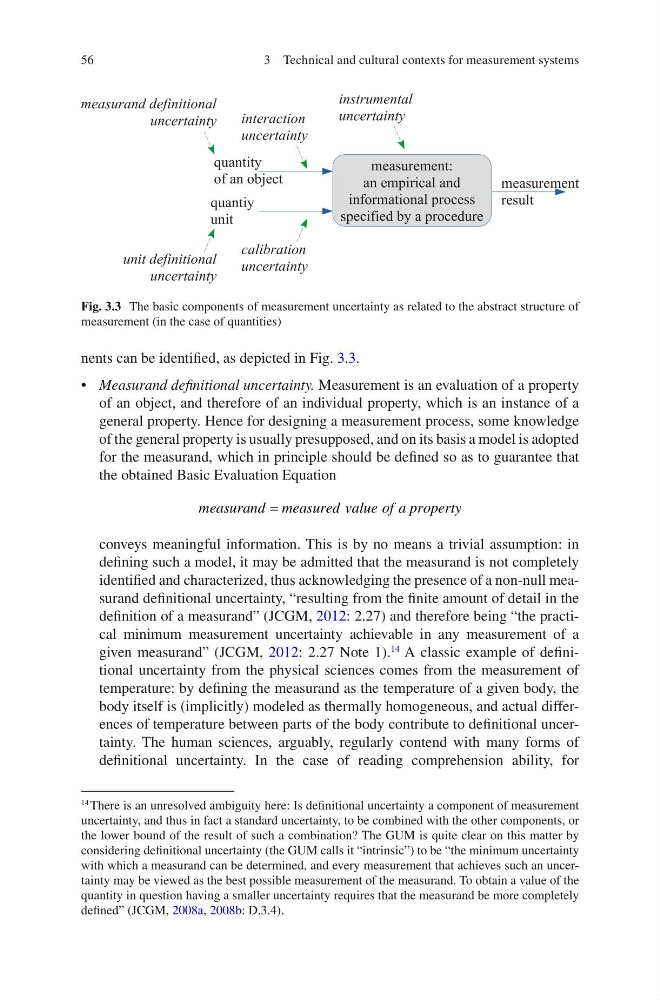
nents can be identified, as depicted in Fig. 3.3.
• Measurand definitional uncertainty. Measurement is an evaluation of a property
of an object, and therefore of an individual property, which is an instance of a
general property. Hence for designing a measurement process, some knowledge
of the general property is usually presupposed, and on its basis a model is adopted
for the measurand, which in principle should be defined so as to guarantee that
the obtained Basic Evaluation Equation
measurand measured value of a property
=
conveys meaningful information. This is by no means a trivial assumption: in
defining such a model, it may be admitted that the measurand is not completely
identified and characterized, thus acknowledging the presence of a non-null measurand definitional uncertainty, “resulting from the finite amount of detail in the
definition of a measurand” (JCGM, 2012: 2.27) and therefore being “the practical minimum measurement uncertainty achievable in any measurement of a
given measurand” (JCGM, 2012: 2.27 Note 1).
14
A classic example of definitional uncertainty from the physical sciences comes from the measurement of
temperature: by defining the measurand as the temperature of a given body, the
body itself is (implicitly) modeled as thermally homogeneous, and actual differences of temperature between parts of the body contribute to definitional uncertainty. The human sciences, arguably, regularly contend with many forms of
definitional uncertainty. In the case of reading comprehension ability, for
14 There is an unresolved ambiguity here: Is definitional uncertainty a component of measurement
uncertainty, and thus in fact a standard uncertainty, to be combined with the other components, or
the lower bound of the result of such a combination? The GUM is quite clear on this matter by
considering definitional uncertainty (the GUM calls it “intrinsic”) to be “the minimum uncertainty
with which a measurand can be determined, and every measurement that achieves such an uncertainty may be viewed as the best possible measurement of the measurand. To obtain a value of the
quantity in question having a smaller uncertainty requires that the measurand be more completely
defined” (JCGM, 2008a, 2008b: D.3.4).
Fig. 3.3 The basic components of measurement uncertainty as related to the abstract structure of
measurement (in the case of quantities)
3 Technical and cultural contexts for measurement systems
nents can be identified, as depicted in Fig. 3.3.
• Measurand definitional uncertainty. Measurement is an evaluation of a property
of an object, and therefore of an individual property, which is an instance of a
general property. Hence for designing a measurement process, some knowledge
of the general property is usually presupposed, and on its basis a model is adopted
for the measurand, which in principle should be defined so as to guarantee that
the obtained Basic Evaluation Equation
measurand measured value of a property
=
conveys meaningful information. This is by no means a trivial assumption: in
defining such a model, it may be admitted that the measurand is not completely
identified and characterized, thus acknowledging the presence of a non-null measurand definitional uncertainty, “resulting from the finite amount of detail in the
definition of a measurand” (JCGM, 2012: 2.27) and therefore being “the practical minimum measurement uncertainty achievable in any measurement of a
given measurand” (JCGM, 2012: 2.27 Note 1).
14
A classic example of definitional uncertainty from the physical sciences comes from the measurement of
temperature: by defining the measurand as the temperature of a given body, the
body itself is (implicitly) modeled as thermally homogeneous, and actual differences of temperature between parts of the body contribute to definitional uncertainty. The human sciences, arguably, regularly contend with many forms of
definitional uncertainty. In the case of reading comprehension ability, for
14 There is an unresolved ambiguity here: Is definitional uncertainty a component of measurement
uncertainty, and thus in fact a standard uncertainty, to be combined with the other components, or
the lower bound of the result of such a combination? The GUM is quite clear on this matter by
considering definitional uncertainty (the GUM calls it “intrinsic”) to be “the minimum uncertainty
with which a measurand can be determined, and every measurement that achieves such an uncertainty may be viewed as the best possible measurement of the measurand. To obtain a value of the
quantity in question having a smaller uncertainty requires that the measurand be more completely
defined” (JCGM, 2008a, 2008b: D.3.4).
Fig. 3.3 The basic components of measurement uncertainty as related to the abstract structure of
measurement (in the case of quantities)
3 Technical and cultural contexts for measurement systems