

55
3.2.4 Basic components of measurement uncertainty
The structure of the measurement process introduced in Sect. 2.2.4 is reflected in a
classification of the components of measurement uncertainty.
13
By reinterpreting
the abstract structure in Fig. 2.8, still in reference to quantities, some basic compo13 This classification is less analytical but possibly more conceptually sound than the list of the
“many possible sources of uncertainty in a measurement” proposed in the GUM: “(a) incomplete
definition of the measurand; (b) imperfect realization of the definition of the measurand; (c) nonrepresentative sampling—the sample measured may not represent the defined measurand; (d) inadequate knowledge of the effects of environmental conditions on the measurement or imperfect
measurement of environmental conditions; (e) personal bias in reading analogue instruments; (f)
finite instrument resolution or discrimination threshold; (g) inexact values of measurement standards and reference materials; (h) inexact values of constants and other parameters obtained from
external sources and used in the data-reduction algorithm; (i) approximations and assumptions
incorporated in the measurement method and procedure; (j) variations in repeated observations of
the measurand under apparently identical conditions” (JCGM, 2008a, 2008b: 3.3.2).
The underlying logic is as follows. For each component X i it is assumed
that a measured value x i , computed as a sample mean value, and an error,
formalized as the standard deviation s(x i ) of the mean, are known. The measurand Y is assumed to be a function of the components, Y = f(X 1 , …, X n ) (in
the case of indirect measurement—see Sect. 2.3 and Chap. 7—f could be the
function that computes the measurand Y from the input quantities X i ), so that
the measured value y of Y is, as usual, computed as y = f(x 1 , …, x n ). Under the
supposition that the errors are sufficiently small and that f is derivable and can
be linearly approximated around the n-dimensional point (x 1 , …, x n ), the total
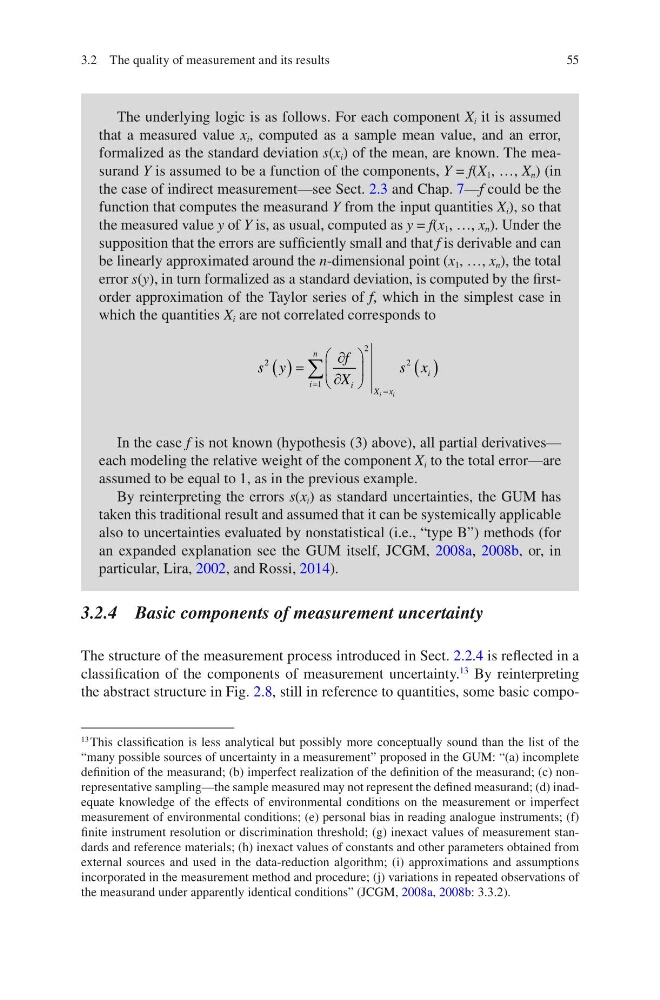
error s(y), in turn formalized as a standard deviation, is computed by the firstorder approximation of the Taylor series of f, which in the simplest case in
which the quantities X i are not correlated corresponds to
s y
f
X
s x
i
n
i
X x
i
i
i
2
1
2
2
w
w
§
©
¨
·
¹
¸
¦
In the case f is not known (hypothesis (3) above), all partial derivatives—
each modeling the relative weight of the component X i to the total error—are
assumed to be equal to 1, as in the previous example.
By reinterpreting the errors s(x i ) as standard uncertainties, the GUM has
taken this traditional result and assumed that it can be systemically applicable
also to uncertainties evaluated by nonstatistical (i.e., “type B”) methods (for
an expanded explanation see the GUM itself, JCGM, 2008a, 2008b, or, in
particular, Lira, 2002, and Rossi, 2014).
3.2 The quality of measurement and its results
3.2.4 Basic components of measurement uncertainty
The structure of the measurement process introduced in Sect. 2.2.4 is reflected in a
classification of the components of measurement uncertainty.
13
By reinterpreting
the abstract structure in Fig. 2.8, still in reference to quantities, some basic compo13 This classification is less analytical but possibly more conceptually sound than the list of the
“many possible sources of uncertainty in a measurement” proposed in the GUM: “(a) incomplete
definition of the measurand; (b) imperfect realization of the definition of the measurand; (c) nonrepresentative sampling—the sample measured may not represent the defined measurand; (d) inadequate knowledge of the effects of environmental conditions on the measurement or imperfect
measurement of environmental conditions; (e) personal bias in reading analogue instruments; (f)
finite instrument resolution or discrimination threshold; (g) inexact values of measurement standards and reference materials; (h) inexact values of constants and other parameters obtained from
external sources and used in the data-reduction algorithm; (i) approximations and assumptions
incorporated in the measurement method and procedure; (j) variations in repeated observations of
the measurand under apparently identical conditions” (JCGM, 2008a, 2008b: 3.3.2).
The underlying logic is as follows. For each component X i it is assumed
that a measured value x i , computed as a sample mean value, and an error,
formalized as the standard deviation s(x i ) of the mean, are known. The measurand Y is assumed to be a function of the components, Y = f(X 1 , …, X n ) (in
the case of indirect measurement—see Sect. 2.3 and Chap. 7—f could be the
function that computes the measurand Y from the input quantities X i ), so that
the measured value y of Y is, as usual, computed as y = f(x 1 , …, x n ). Under the
supposition that the errors are sufficiently small and that f is derivable and can
be linearly approximated around the n-dimensional point (x 1 , …, x n ), the total
error s(y), in turn formalized as a standard deviation, is computed by the firstorder approximation of the Taylor series of f, which in the simplest case in
which the quantities X i are not correlated corresponds to
s y
f
X
s x
i
n
i
X x
i
i
i
2
1
2
2
w
w
§
©
¨
·
¹
¸
¦
In the case f is not known (hypothesis (3) above), all partial derivatives—
each modeling the relative weight of the component X i to the total error—are
assumed to be equal to 1, as in the previous example.
By reinterpreting the errors s(x i ) as standard uncertainties, the GUM has
taken this traditional result and assumed that it can be systemically applicable
also to uncertainties evaluated by nonstatistical (i.e., “type B”) methods (for
an expanded explanation see the GUM itself, JCGM, 2008a, 2008b, or, in
particular, Lira, 2002, and Rossi, 2014).
3.2 The quality of measurement and its results