

48
stab instrument t x z
t f x z t
t f x z t
, , ,
,,
,,
'
'
'
ª ¬
º ¼
/
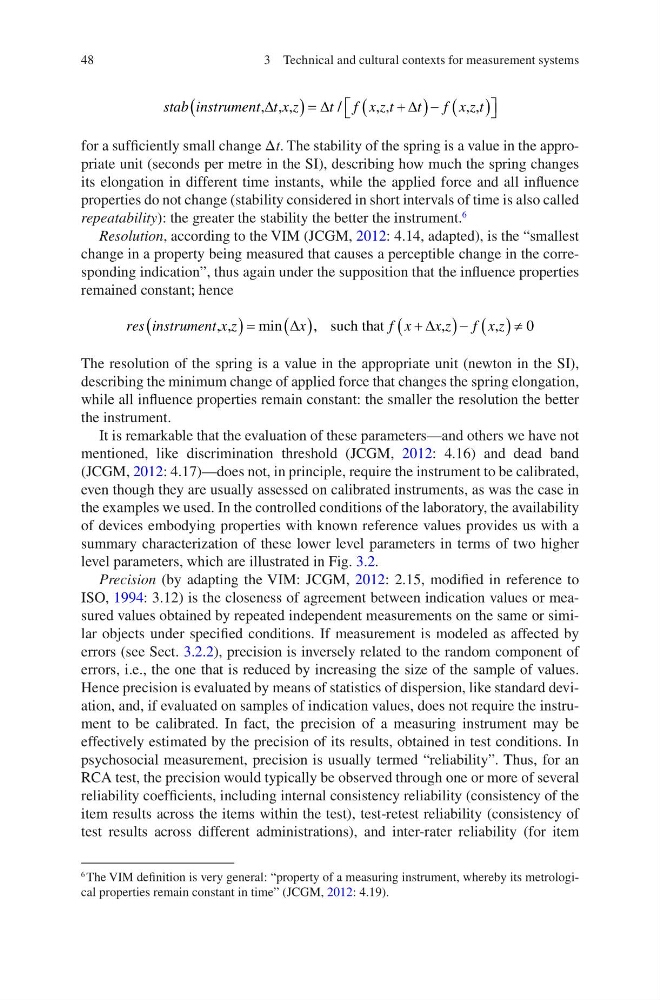
for a sufficiently small change Δt. The stability of the spring is a value in the appropriate unit (seconds per metre in the SI), describing how much the spring changes
its elongation in different time instants, while the applied force and all influence
properties do not change (stability considered in short intervals of time is also called
repeatability): the greater the stability the better the instrument.
6
Resolution, according to the VIM (JCGM, 2012: 4.14, adapted), is the “smallest
change in a property being measured that causes a perceptible change in the corresponding indication”, thus again under the supposition that the influence properties
remained constant; hence
res instrument x z
x
f x
x z f x z
, ,
such that
,
,
z
min
,
'
'
0
The resolution of the spring is a value in the appropriate unit (newton in the SI),
describing the minimum change of applied force that changes the spring elongation,
while all influence properties remain constant: the smaller the resolution the better
the instrument.
It is remarkable that the evaluation of these parameters—and others we have not
mentioned, like discrimination threshold (JCGM, 2012: 4.16) and dead band
(JCGM, 2012: 4.17)—does not, in principle, require the instrument to be calibrated,
even though they are usually assessed on calibrated instruments, as was the case in
the examples we used. In the controlled conditions of the laboratory, the availability
of devices embodying properties with known reference values provides us with a
summary characterization of these lower level parameters in terms of two higher
level parameters, which are illustrated in Fig. 3.2.
Precision (by adapting the VIM: JCGM, 2012: 2.15, modified in reference to
ISO, 1994: 3.12) is the closeness of agreement between indication values or measured values obtained by repeated independent measurements on the same or similar objects under specified conditions. If measurement is modeled as affected by
errors (see Sect. 3.2.2), precision is inversely related to the random component of
errors, i.e., the one that is reduced by increasing the size of the sample of values.
Hence precision is evaluated by means of statistics of dispersion, like standard deviation, and, if evaluated on samples of indication values, does not require the instrument to be calibrated. In fact, the precision of a measuring instrument may be
effectively estimated by the precision of its results, obtained in test conditions. In
psychosocial measurement, precision is usually termed “reliability”. Thus, for an
RCA test, the precision would typically be observed through one or more of several
reliability coefficients, including internal consistency reliability (consistency of the
item results across the items within the test), test-retest reliability (consistency of
test results across different administrations), and inter-rater reliability (for item
6 The VIM definition is very general: “property of a measuring instrument, whereby its metrological properties remain constant in time” (JCGM, 2012: 4.19).
3 Technical and cultural contexts for measurement systems
stab instrument t x z
t f x z t
t f x z t
, , ,
,,
,,
'
'
'
ª ¬
º ¼
/
for a sufficiently small change Δt. The stability of the spring is a value in the appropriate unit (seconds per metre in the SI), describing how much the spring changes
its elongation in different time instants, while the applied force and all influence
properties do not change (stability considered in short intervals of time is also called
repeatability): the greater the stability the better the instrument.
6
Resolution, according to the VIM (JCGM, 2012: 4.14, adapted), is the “smallest
change in a property being measured that causes a perceptible change in the corresponding indication”, thus again under the supposition that the influence properties
remained constant; hence
res instrument x z
x
f x
x z f x z
, ,
such that
,
,
z
min
,
'
'
0
The resolution of the spring is a value in the appropriate unit (newton in the SI),
describing the minimum change of applied force that changes the spring elongation,
while all influence properties remain constant: the smaller the resolution the better
the instrument.
It is remarkable that the evaluation of these parameters—and others we have not
mentioned, like discrimination threshold (JCGM, 2012: 4.16) and dead band
(JCGM, 2012: 4.17)—does not, in principle, require the instrument to be calibrated,
even though they are usually assessed on calibrated instruments, as was the case in
the examples we used. In the controlled conditions of the laboratory, the availability
of devices embodying properties with known reference values provides us with a
summary characterization of these lower level parameters in terms of two higher
level parameters, which are illustrated in Fig. 3.2.
Precision (by adapting the VIM: JCGM, 2012: 2.15, modified in reference to
ISO, 1994: 3.12) is the closeness of agreement between indication values or measured values obtained by repeated independent measurements on the same or similar objects under specified conditions. If measurement is modeled as affected by
errors (see Sect. 3.2.2), precision is inversely related to the random component of
errors, i.e., the one that is reduced by increasing the size of the sample of values.
Hence precision is evaluated by means of statistics of dispersion, like standard deviation, and, if evaluated on samples of indication values, does not require the instrument to be calibrated. In fact, the precision of a measuring instrument may be
effectively estimated by the precision of its results, obtained in test conditions. In
psychosocial measurement, precision is usually termed “reliability”. Thus, for an
RCA test, the precision would typically be observed through one or more of several
reliability coefficients, including internal consistency reliability (consistency of the
item results across the items within the test), test-retest reliability (consistency of
test results across different administrations), and inter-rater reliability (for item
6 The VIM definition is very general: “property of a measuring instrument, whereby its metrological properties remain constant in time” (JCGM, 2012: 4.19).
3 Technical and cultural contexts for measurement systems