

221
suppose a reader a has a RCA Θ[a], which a team of researchers is interested in
measuring.
7.3.5.1 Transduction
A RCA test is built for the purpose of experimentally obtaining and formally reporting information on the RCA of individuals. It typically consists of one or more
reading passages, with a corresponding set of items designed to prompt the reader’s
comprehension about the contents of those reading passages. The test may be then
interpreted as a measuring instrument in the form of a transducer, which, when put
in interaction with an individual, takes his or her reading comprehension and produces a response accordingly. Suppose, for simplicity’s sake, that the test m is composed of a single item, specifically a statement about the content of a passage, which
the reader must judge as either true or false. The result of a reader a responding to
the item is a response X m , which is the transduced property corresponding to Θ[a]
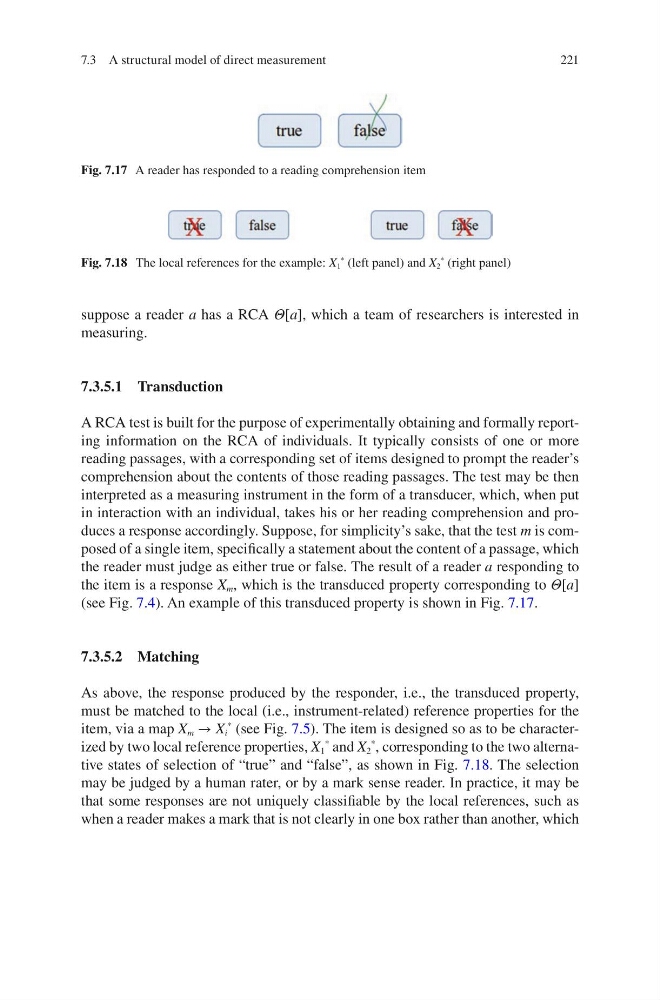
(see Fig. 7.4). An example of this transduced property is shown in Fig. 7.17.
7.3.5.2 Matching
As above, the response produced by the responder, i.e., the transduced property,
must be matched to the local (i.e., instrument-related) reference properties for the
item, via a map X m → X i
*
(see Fig. 7.5). The item is designed so as to be characterized by two local reference properties, X 1
*
and X 2
*
, corresponding to the two alternative states of selection of “true” and “false”, as shown in Fig. 7.18. The selection
may be judged by a human rater, or by a mark sense reader. In practice, it may be
that some responses are not uniquely classifiable by the local references, such as
when a reader makes a mark that is not clearly in one box rather than another, which
Fig. 7.17 A reader has responded to a reading comprehension item
Fig. 7.18 The local references for the example: X 1
* (left panel) and X 2
* (right panel)
7.3 A structural model of direct measurement
suppose a reader a has a RCA Θ[a], which a team of researchers is interested in
measuring.
7.3.5.1 Transduction
A RCA test is built for the purpose of experimentally obtaining and formally reporting information on the RCA of individuals. It typically consists of one or more
reading passages, with a corresponding set of items designed to prompt the reader’s
comprehension about the contents of those reading passages. The test may be then
interpreted as a measuring instrument in the form of a transducer, which, when put
in interaction with an individual, takes his or her reading comprehension and produces a response accordingly. Suppose, for simplicity’s sake, that the test m is composed of a single item, specifically a statement about the content of a passage, which
the reader must judge as either true or false. The result of a reader a responding to
the item is a response X m , which is the transduced property corresponding to Θ[a]
(see Fig. 7.4). An example of this transduced property is shown in Fig. 7.17.
7.3.5.2 Matching
As above, the response produced by the responder, i.e., the transduced property,
must be matched to the local (i.e., instrument-related) reference properties for the
item, via a map X m → X i
*
(see Fig. 7.5). The item is designed so as to be characterized by two local reference properties, X 1
*
and X 2
*
, corresponding to the two alternative states of selection of “true” and “false”, as shown in Fig. 7.18. The selection
may be judged by a human rater, or by a mark sense reader. In practice, it may be
that some responses are not uniquely classifiable by the local references, such as
when a reader makes a mark that is not clearly in one box rather than another, which
Fig. 7.17 A reader has responded to a reading comprehension item
Fig. 7.18 The local references for the example: X 1
* (left panel) and X 2
* (right panel)
7.3 A structural model of direct measurement